Do Not Speak, Memory

Masha Gessen - Never Remember: Searching for Stalin's Gulags in Putin's Russia

The Wall Street Journal, March 16, 2018

Vagankovskoye Cemetery, Moscow, Russia,  March 1993 © Andrew Stuttaford

Vagankovskoye Cemetery, Moscow, Russia, March 1993 © Andrew Stuttaford

Imagine a Germany where the Third Reich’s monuments abound but memorials to the Holocaust are scarce. Hitler is venerated by millions and his dictatorship given a positive spin by an authoritarian state that never definitively broke with the Nazi past. Replace Germany with Russia, Hitler with Stalin, and the Third Reich with the Soviet Union and that is pretty much the situation that prevails in Russia today.

The unbroken connection to the Soviet era is key to understanding “Never Remember,” a short, haunting and beautifully written book by Masha Gessen, the Russian-American journalist who is one of Vladimir Putin’s most trenchant critics. About halfway through, Ms. Gessen tells how Irina Flige, an activist who spent decades trying to restore to public view memories of what occurred under communism, has concluded it is wrong to see the problem as forgetfulness because, as Ms. Gessen summarizes it, “forgetting presupposes remembering—and remembering had not happened . . .” In Ms. Flige’s words, “historical memory can exist only when there is a clear line separating the present from the past. . . . But we don’t have that break—there is no past, only a continuous present.” In contrast to Germany, there was no reckoning. There was no Soviet Nuremberg.

Ms. Gessen offers up various explanations for this, including the long duration of Communist rule and the ways in which the categories of victim and perpetrator overlapped. The trauma was something that Russians inflicted on one another. In a sense they still do. Ms. Gessen is evidently saddened and frustrated by the spectacle of a people—her people—wandering through a manufactured reality unbothered by, or oblivious to, the obscenities or incongruities that surround them. Some of the old regime’s statues were, in the false democratic dawn of the 1990s, defaced and toppled or—in the case of one statue of Stalin—dug up and exiled to a sculpture park of shame in central Moscow. Now, however, the statues stand in the same place proudly, cleaned up but unexplained, sharing space with a rare commemoration of the Soviet regime’s victims as well as statues of poets, writers, and—why not?—Adam and Eve.

The melancholy that saturates Ms. Gessen’s prose is reinforced by pages filled with Misha Friedman’s bleakly evocative photographs, images that convey unease, absence and loss. The huts and barracks of the Gulag, ramshackle to start with, and often designed to be temporary, have often just rotted away—“only the barbed wire remained,” Ms. Gessen writes. Other, sturdier structures survive, either ignored—one of Mr. Friedman’s photographs is of a ruined prison on the edge of a housing complex—or inaccessible, swallowed up in the vastness of Siberia. One camp—just one—not far from the Urals has been restored, a project begun, tellingly, on the private initiative of two local historians but now taken over by the state. While, as Ms. Gessen notes, it has not been turned into some defense of the Gulag, its message has been muffled, shrouded in a deceptive neutrality. Ms. Gessen herself is no neutral (she describes the “distinguishing characteristic of the Putin-era historiography of Soviet terror as . . . [saying] in effect, that it just happened, whatever”).

This is an angry book. Ms. Gessen makes her case with a series of vignettes ranging from the discovery of a mass grave in northwestern Russia to a trip to the region of Kolyma in the country’s far east. (“If the Gulag was anywhere, it was in Kolyma.”) The years of glasnost and Boris Yeltsin finally provided pitifully small scraps of comfort to the descendants of the disappeared—a photograph, a death certificate, something—yet the Gulag’s poison continues to seep through the generations. When Ms. Gessen visits Kolyma’s “capital” in 2017, all the people with whom she has contact are later visited by the FSB, the successor to the KGB.

Among the ufologists

The New Criterion, March 1, 2018

International UFO Museum and Research Center, Roswell, NM, July 1, 2017 © Andrew Stuttaford

International UFO Museum and Research Center, Roswell, NM, July 1, 2017 © Andrew Stuttaford

After losing my way last summer in a tiny town best known as the deathplace of Billy the Kid, I eventually located the right desert highway. Outperforming the alleged aliens who, seventy years before, had allegedly crashed their alleged spacecraft nearby, I swept past a welcome sign decorated with—in honor of a cow town’s real and imagined pasts—cattle and a flying saucer, and reached Roswell, New Mexico, in one piece:

The City of Roswell invites UFO enthusiasts and skeptics alike to join in the celebration of one of the most debated incidents in history.

History is not what it was.

Baymont Hotel, Roswell, NM, June 30, 2017 © Andrew Stuttaford

Baymont Hotel, Roswell, NM, June 30, 2017 © Andrew Stuttaford

Alien kitsch at my hotel’s front desk, an alien face on the elevator floor and each elevator button too.

Baymont Hotel, Roswell, NM, June 30, 2017 © Andrew Stuttaford

Baymont Hotel, Roswell, NM, June 30, 2017 © Andrew Stuttaford

Applebee’s held itself aloof, but Arby’s was ready to “welcome” unsuspecting aliens. A little green matador graced the walls of a Mexican restaurant, and the striking architecture of one local McDonald’s paid tribute to a saucer that never was. Downtown, an immense metallic construction with a pointed rocket nose turned out to be an old grain silo, a disappointment dispelled by a $2 “black light spacewalk” in a nearby souvenir store, the not-exactly-NASA  Roswell Space Center.

Roswell, NM, July 1, 2017 © Andrew Stuttaford

Roswell, NM, July 1, 2017 © Andrew Stuttaford

The Roswell story—or, appropriately, its fragments—can be found scattered across American culture. It starts in mid-June 1947 when ranch hand William “Mac” Brazel, a link to a legend of the Old West (his uncle may have killed Billy the Kid’s killer), stumbled upon the debris that propelled him into a legend of a space age that had yet to arrive.

Brazel wasn’t impressed by the “bright wreckage made up of rubber strips, tinfoil, a rather tough paper, and sticks” strewn out there in the desert, but a week or so later he heard that a sighting in Washington State had triggered America’s first proper UFO “flap” and, critically, a $3,000 reward for physical evidence of one of these contraptions. Even then it was a few days before Brazel (who had no phone) “whispered kinda confidential” to the sheriff during a routine visit to Roswell, some seventy-five miles away. The sheriff contacted the authorities at the Roswell airfield, home, perhaps fittingly, to the only unit on the planet then equipped to drop an atomic bomb: there are those who speculate that it was New Mexico’s role—from Los Alamos to White Sands—in so much of the development of America’s nascent nuclear arsenal that (supposedly) drew extraterrestrial observers to the Southwest. It was two humans, however, the intelligence officer Jesse Marcel and a colleague, who retrieved the wreckage from Brazel. On July 8, the base’s commander ordered his public information officer to put out a press release, and that’s what Lieutenant Walter Haut did:

The many rumors regarding the flying disc became a reality yesterday when the intelligence office of the 509th Bomb Group . . . was fortunate enough to gain possession of a disc.

The wreckage had become a disc, the disc became a headline: “RAAF [Roswell Army Air Field] Captures Flying Saucer on Ranch in Roswell Region,” was the Roswell Daily Record’s headline on a front page, still available for sale across town in formats ranging from T-shirt to magnet.

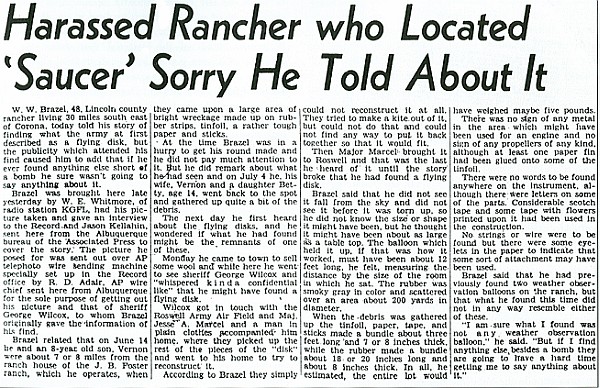
In the release, Haut also explained that the disc had been inspected, “then loaned by Major Marcel to higher headquarters.” It was there that Brigadier General Roger Ramey let the air out of the balloon by telling the press that the wreckage was a balloon, or, more precisely, what was left of a weather balloon and the radar reflectors it had been transporting. The Roswell Daily Record ’sheadline was bleak: “General Ramey Empties Roswell Saucer.” A “harassed” Mac Brazel, it related, was sorry he had “told” but added that “he had previously found two weather observation balloons on the ranch, but . . . what he found this time did not in any way resemble either of these”—intriguing, but not intriguing enough to be talked about for the next three decades.

Roswell, NM, June 30, 2017 © Andrew Stuttaford

Roswell, NM, June 30, 2017 © Andrew Stuttaford

But people continued to watch the skies. The suspicion that there might be something up there bubbled away, ginned up by an eager press and spinners—mad, Munchausen, mercenary, or misguided—of tall tales that won a huge following. An obsession fed by an entertainment industry that in turn echoed and amplified the stories that its own creations provoked among the credulous, flying saucers were made all the more believable by Sputnik, Vostok, and Gemini. If we could do it, why couldn’t they? Even Uncle Sam was curious and, with unknown Soviet weaponry also in mind, carried out studies—most famously Project Blue Book—into UFOs, only to conclude by the end of the 1960s that aliens were not involved. Many Americans (and not just Americans) disagreed, and it was revealed last December that between 2007 and 2012 the Pentagon ran a secret project (with an afterlife that apparently still continues) to take another look at what might be up there. Its investigations turned up some thought-provoking reports as well as startling video and audio recordings, but the fact that its funding has—so we’re told—been eliminated is pretty good evidence that there is no evidence that anybody green has come calling.

The postwar fascination with UFOs attracted the attention of Carl Jung, a man with a weakness for the strange. In a letter to the editor of the New Republic in 1957, Jung essentially conceded that—whatever UFOs were—they were real, but the title of his Flying Saucers: A Modern Myth of Things Seen in the Skies (1958) gives the game away, and its text is high Jung: Platonic months, “spring point enter[ing] Aquarius,” mandalas, manifestations of anxiety about atomic war. But the dodgy old sage was not wrong to spot traces of the spiritual in this phenomenon. The wave of interest in UFOs has occasionally curdled into flying-saucer cults, and some of their descendants, despite Heaven’s Gate’s opening to oblivion, still flourish today.

Roswell, NM, July 2, 2017 © Andrew Stuttaford

Roswell, NM, July 2, 2017 © Andrew Stuttaford

Both the Bible and concerns about the dangers of UFO cults helped inspire “Challenges to E.T.,” a conference held that seventieth- anniversary weekend in the Roswell Mall, a complex most notable for the crashed saucer lodged in the roof of its movie theater, and some way from the goings-on downtown. Perhaps that was just as well. Whatever the underlying reason for this gathering, its focus seemed to be on rejecting “the extraterrestrial hypothesis” in favor of just about anything else outré enough to draw a crowd, from human experimentation to, well, I’ll just quote from the best introductory slide I have ever seen: “Demons and the Pentagon: What the Hell?”

Roswell, NM, July 2, 2017 © Andrew Stuttaford

Roswell, NM, July 2, 2017 © Andrew Stuttaford

More benignly, belief in powerful, otherworldly aliens has a niche in the catch-all spirituality of our own time, a belief inspired by a notion, however weird, of technology, while satisfying an all-too-human craving for enchantment. The “God gene” is not easy to escape: those who would not normally consider themselves religious appear to be more likely to believe in ufos than their churchgoing contemporaries. Then again, why choose? In one store downtown, aliens shared shelf space with Jesus, Mary, and, if I’m not mistaken, a Hindu deity.

Roswell, NM, July 1, 2017 © Andrew Stuttaford

Roswell, NM, July 1, 2017 © Andrew Stuttaford

A British speaker at “Challenges to E.T.” did more than most to decode the enduring interest in the Roswell Incident, comparing it with his country’s long-standing fixation with Jack the Ripper: people like a puzzle. I watched the audience at a session elsewhere in town, gripped by a grainy computerized reconstruction of otherwise illegible wording on the piece of paper—the “Ramey Memo”— photographed in the general’s hand as he studied what was either the wreckage from Roswell or, some maintain, a tawdry substitution for the real thing: “Now we come to a really intriguing group of words, which are clearly visible as on the ‘disk’ with discernible quotation marks around ‘disk’ . . . ”

Roswell, NM, July 1, 2017 © Andrew Stuttaford

Roswell, NM, July 1, 2017 © Andrew Stuttaford

But Roswell’s puzzle was meant to have been solved by Ramey. For decades it seemed that it had, remaining largely forgotten until the late 1970s. As recounted in the invaluable UFO Crash at Roswell: The Genesis of a Modern Myth (1997), a work in part anthropological study and in part persuasive forensic debunking, one of the preconditions for its resurrection was a growth in distrust of the U.S. Government (who else would have concealed the wreckage?), a precondition that the U.S. Government did its best to foster. It’s telling that a leading “ufologist,” Stanton Friedman, a retired nuclear physicist no less—has described Roswell as a “cosmic Watergate.”

Roswell, NM, July 1, 2017 © Andrew Stuttaford

Roswell, NM, July 1, 2017 © Andrew Stuttaford

Suspicion of dark doings by the government is as American as dark doings by the government. The sight of conspiracy theorists being welcomed into a red, white, and blue town is not so very contradictory. Banks and fast food joints advertised their support for the police and the military while street lights were topped with alien head globes but wrapped in Old Glory (July 4th was approaching). And there is something splendidly American about the way that a remote city of fifty thousand not known for very much milks the cash cow that didn’t fall to earth.

Roswell, NM, June 30, 2017 © Andrew Stuttaford

Roswell, NM, June 30, 2017 © Andrew Stuttaford

A section of downtown had been blocked off. Businesses vied for the best alien (“or patriotic”) window display. Supplementing a distinctive collection of storesAlien InvasionAlien Headz, Alien Stop, Alien Zone—were booths offering alien this, alien that, and alien tat. Vendors sold snacks of any description and snacks beyond description. There were pony rides, a water slide (the temperature was in the nineties), an alien costume contest for pets, and an alien costume contest for humans. A man under a canopy invited passers-by to “receive prayer,” while a rival peddled an enlightenment all his own: “The hierarchy of the cosmos and the connection between God, aliens, and man.” Attractions in front of the fine early-twentieth-century courthouse included a welcome tent, the Ten Commandments carved in stone, and a signpost to the planets. Bands played soft rock and Tejano, a borderlands mingling.

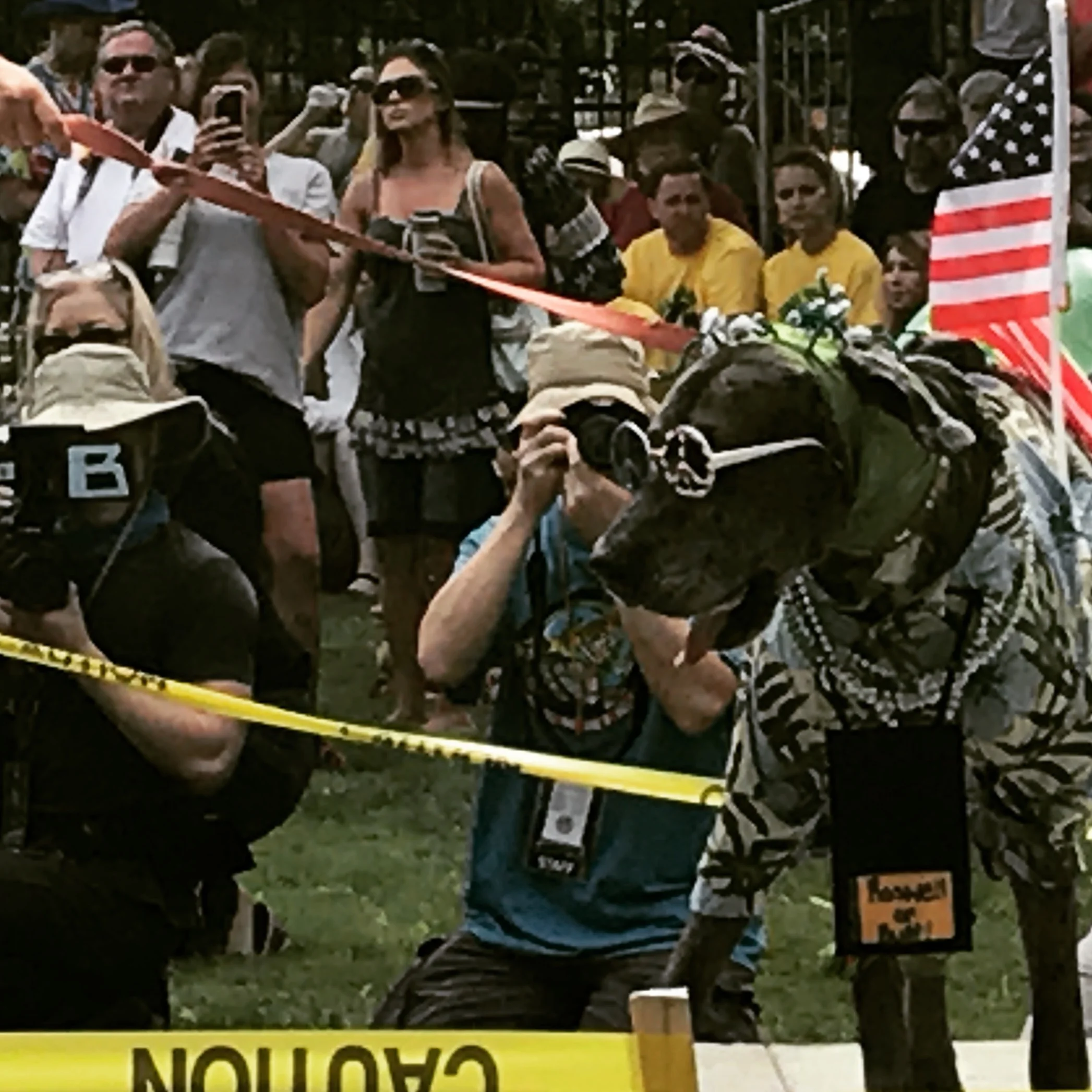
Alien Costume (pet) contest, Roswell, NM, July 1, 2017 © Andrew Stuttaford

Alien Costume (pet) contest, Roswell, NM, July 1, 2017 © Andrew Stuttaford

A block or two away, at the International UFO Museum and Research Center, much expanded since, oh yes, my last visit in 1995, there was work to be done. Travis Walton discussed his abduction by aliens in 1975, a distressing if dubious story subsequently turned into the unexpectedly entertaining Fire in the Sky, a movie released during the early ’90s abduction boom. Other stars in the Roswell Galaxy spoke on the government cover-up, physical evidence of the crash, and additional matters that, if proven, would change our understanding of everything. Yet a touch of carnival had crept in. A flier (“the alien bodies! wow!”) promoted a workshop hosted by the “alien hunter” Derrel Sims (admission $10).

Roswell, NM, June 30, 2017 © Andrew Stuttaford

Roswell, NM, June 30, 2017 © Andrew Stuttaford

More than a touch: to be sure, there was a well-stocked library crammed with ufological scholarship, but the gift shop struck a more frivolous note: alien T-shirts, alien sweatshirts, alien sippy cups, alien key-rings, alien pens, alien onesies, alien ashtrays, alien beanies, alien magnets, plush aliens, plastic aliens, blow-up aliens, everything alien except the real, elusive thing. Educational materials lined the walls of the main hall—those photographs that can’t always be so quickly explained away, pictures of “ancient astronauts,” the usual—but a replica of the robot from The Day the Earth Stood Still stood still nearby, not far from a recreation of that infamous alien autopsy and an engaging display in which a flying saucer whirled behind four forbidding animatronic aliens. The UFO  museum, “a 501(c)(3) non-profit educational organization,” may maintain a claim to represent the “serious side” of UFO research, but it subverts that seriousness with a wink and a nod.

International UFO Museum and Research Center, Roswell, NM, June 30, 2017 © Andrew Stuttaford

International UFO Museum and Research Center, Roswell, NM, June 30, 2017 © Andrew Stuttaford

Many of those thronging its premises understood that very well. Yes, true believers parted respectfully when Stanton Friedman made his way through his flock and gathered earnestly around Travis Walton. But others seemed less convinced, sci-fi curious perhaps, intrigued maybe, believers even, but without the conviction to take their belief very seriously. They were playing a game they half-hoped was real. Others were just there for the fun, their pilgrimage more Mardi Gras than the Camino de Santiago, four girls in shiny skirts and headphone hairstyles, three middle-aged ladies in “alien” eyeglasses vamping in front of those forbidding aliens as the dry ice billowed. Uncle Sam sauntered around the main exhibition hall on stilts, his presence a salute to the doomed spacecraft’s touchdown into American folklore.

International UFO Museum and Research Center, Roswell, NM, July 1, 2017 © Andrew Stuttaford

International UFO Museum and Research Center, Roswell, NM, July 1, 2017 © Andrew Stuttaford

The deliberations weren’t confined to the museum and the mall. The Roswell Daily Record hosted a series of lectures in a conference room behind K-Bob’s Steakhouse. At the city’s convention center, topics included abductees’ civil rights and, the horror, “the origins of the UFO ridicule factor.”

Roswell, NM, June 30, 2017 © Andrew Stuttaford

Roswell, NM, June 30, 2017 © Andrew Stuttaford

Bryce Zabel, one of the creators of Dark Skies, a UFO-conspiracy TVshow from the mid-nineties, once observed that “true or untrue . . . Roswell is seminal.” True or untrue.

It took more than Vietnam and Watergate to bring a long-lost moment in New Mexico’s history back to life. Possibly it was only a coincidence that, as is noted in UFO Crash at Roswell, tales of crashed saucers were beginning to come back into vogue in the late 1970s, but it was then that the not-always-reliable Jesse Marcel (by now, he said, a believer in UFOs, certain that the wreckage “was nothing that came from earth”) gave an interview to National Enquirer, a magazine known for publishing items that could be believed, half-believed, or believed not at all.

Other stories too were recalled: the same issue of the Roswell Daily Record that had featured Walter Haut’s press release had also contained a report of how the “hardware man” Dan Wilmot, “one of the most respected and reliable citizens in town,” and his wife had witnessed “a large glowing” object “zooming” over Roswell on July 2, 1947 (awkwardly a week or so after Brazel had discovered that mysterious wreckage, an inconvenient truth that failed to deter some of the faithful or the fraudulent from treating the two stories as one).

The Wilmots’ account was at least published contemporarily. Vern and Jean Maltais were not so timely. Two prominent members of the long cavalcade of hoaxers, grifters, pseudo-sleuths, opportunists, attention-seekers, and fantasists who have contributed to the ever-shifting Roswell narrative, they emerged in 1978 to claim that they had been told by a friend that he (and, naturally, given the rich cast of characters who wander in and out of this saga, some archeologists) had discovered alien wreckage (and small alien corpses) in the Plains of San Agustin, New Mexico, or maybe somewhere else. This was enough for Charles Berlitz, a linguist (one of those Berlitzes) and the author of books on Atlantis, the Bermuda Triangle, and other concocted mysteries, and the ufologist William Moore. With the help of research by Stanton Friedman, they published The Roswell Incidentin 1980, a farrago of speculation that arguably did more than anything else to turn a spurious crash into a genuine sensation. The most interesting thing about it was how well (very) it sold.

Roswell, NM, July 1, 2017 © Andrew Stuttaford

Roswell, NM, July 1, 2017 © Andrew Stuttaford

As the Roswell industry grew, clarity shrank, dates blurred, locations went walkabout, saucers changed shape, there was one crash, there were two, the aliens all died, one survived, a local undertaker was asked about the availability of undersized coffins, a “missing” nurse saw more than she should, the military (a mean-eyed, red-headed colonel or captain, a black sergeant) bullied witnesses into silence, evidence was stolen. Documents showing that Eisenhower was briefed were later shown to be forgeries and set off a schism, but were the forgeries created to discredit those who were coming too close to the truth?

Roswell, NM, June 30, 2017 © Andrew Stuttaford

Roswell, NM, June 30, 2017 © Andrew Stuttaford

As it happens, there probably was a cover-up, of sorts. The U.S.Air Force published two reports in the mid-1990s, just after TheX-Files, a television show that played off (and further popularized) the Roswell myth while weaving it into a dense conspiratorial mix that spread far beyond the small screen, had begun its long run. The first, the exhaustively researched and at times drily amusing The Roswell Report: Fact vs. Fiction, brings a touch of much-missed Mission Control rigor as it cuts through the miasma, both pre-modern and post-, which envelops so much of the Roswell debate. If you’ll forgive the spoiler, its writers found “no evidence of any extraterrestrial craft or alien flight crew.” What they did find “[was] . . . a shadowy, formerly Top Secret project, code-named mogul,” involving the launch of “balloon trains” some six-hundred feet long and laden with sensors designed to detect whether the Soviets had successfully tested a nuclear device (America’s nuclear weapons monopoly only ended in 1949). Given the secrecy that surrounded mogul, Ramey either didn’t recognize the Roswell wreckage or was unwilling to identify it: either way, he left enough of a gap for the conspiracy theories to seep through.

The Roswell Report: Case Closed was a sequel designed to address the question of alien corpses. Rather charitably, it suggests that recollections of these extraterrestrial unfortunates were the result of memories—muddled over the decades—of Air Force anthropomorphic test dummies parachuted from high altitudes over the desert and, separately, two accidents in which Air Force personnel were killed or injured in the late 1950s.

To some, these reports were merely a new twist on an old cover-up. Facts rarely get in the way of a good story or a satisfying cult. The Roswell show rolls on, sporadically spiced up by the rise and fall of ever-more-innovative embellishments and now graced by a hereditary nobility of sorts: at one meeting we were invited to applaud descendants of the principal witnesses, proud to carry a torch that sheds no light. No matter: according to a 2013 survey, roughly a fifth of Americans believe that a saucer crashed near Roswell and the government covered it up. The UFO museum received some two hundred thousand visitors in 2016 and fifteen thousand people reportedly showed up for the seventieth anniversary celebrations.

Roswell, NM, July 1, 2017 © Andrew Stuttaford

Roswell, NM, July 1, 2017 © Andrew Stuttaford

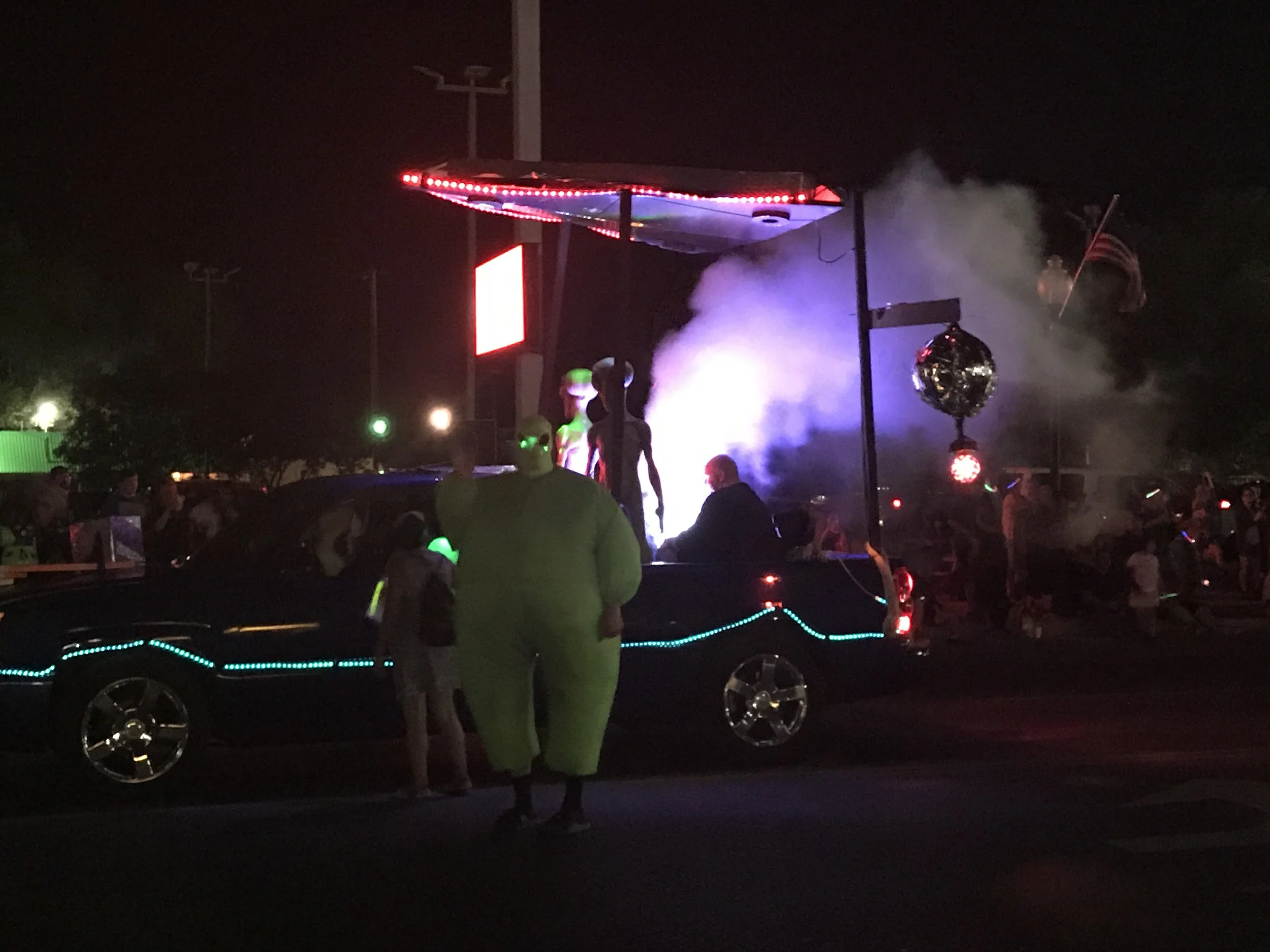
No pilgrimage is complete without a procession, no Mardi Gras without a parade. On the Saturday night of my visit, we lined Main Street as hot dusk cooled into warm darkness, some in costume, some prudently sporting tinfoil hats, one (your correspondent) clad in a white linen jacket that had already attracted some comments from more casually dressed attendees earlier in the day. At around 9 P.M., the Electric Light Parade began; illuminated floats and illuminated cars coasted by, escorted by a retinue of illuminated aliens and a zig-zagging skater encased in a glowing green saucer. The High Desert Pipes and Drums of Albuquerque brought up the rear, its marchers illuminated and kilted, drums beating and pipes skirling their way through—of course—Scotland the Brave into the New Mexico night.

Roswell, NM, July 1, 2017 © Andrew Stuttaford

Roswell, NM, July 1, 2017 © Andrew Stuttaford

Time has let Corbyn off the hook

Corbyn Adams.jpg

Talk of contacts with Czech Intelligence has generated some entertaining headlines but it hasn’t done Jeremy Corbyn much harm. According to a YouGov poll, only eight per cent of voters think less of him. Nearly two-thirds (some of whom, I suppose, may have already thought that he was a Commie spy) are apparently left unchanged in their opinion and six per cent seemed somewhat impressed. We shouldn’t be surprised. The unelectable, unthinkable Corbyn swept to the leadership of the Labour Party and then led his unelectable party to an almost unthinkable result in the general election. Nearly nine months later, this unelectable party is ahead at the polls: a lead that has grown since Jan Sarkocy started to reminisce.

We do not know what, if any, Cold War skeletons may yet emerge from Corbyn’s cupboard, though it should be stressed that there is, so far, no convincing evidence that he was recruited as an agent or did anything other than have meetings with a representative of a foreign government. But even if there were to be any revelations, it’s difficult to see what difference they would make. After all, there are horrors enough out there as it is: they range from Corbyn’s involvement with (let’s be polite) Irish republicanism to a politically and psychologically disturbing series of fanboy infatuations with thugs, goons and hard men overseas. That some of them are on the hard Left is unsurprising, given Corbyn’s always adventurous interpretation of “democratic” socialism, but it says something – and nothing good – that others appear to be united by little more than their distaste for the liberal West, a liberal West that includes the country that Corbyn would like to lead.

Corbyn, secular and socialist, has praised the revolution that led to Iran’s klepto-theocracy. He once called for “political compromise” with ISIS, and has marched rather too closely in step with a Kremlin that in reality, if not always in imagery, has long since left the red flag behind.

Large numbers of Labour voters are aware of at least some of this, and quite a few are aware too that there is plenty more – hatred of Nato, say, or a degree of sympathy for Serbia’s Slobodan Milosevic – bubbling in the sewer from which Corbyn’s enthusiasms emerge. Yet they still vote for him and his party. They would thus be unlikely to be too concerned by accusations of Cold War skullduggery from over 30 years ago, even, I suspect, if it turned out that “Agent Cob” had handed the Czechs some gossip he felt might speed up the march to Utopia.

Such insouciance is a worry, but not much of a mystery. To no small extent, Corbyn has been let off the hook by nothing more complicated than time. It’s been more than three decades since his alleged Czech encounter, and, for that matter, since he invited two convicted IRA terrorists to a meeting in parliament shortly after the Brighton bombing. The Troubles were ended by the Good Friday agreement and the Cold War by the collapse of the Soviet empire. Memories of both conflicts have faded and so have the passions they once aroused. Time can be too good, and too forgiving, a healer. It is also an accomplished gravedigger. Many of those able to understand the significance of Corbyn’s past behaviour are no longer around to explain.

Later generations have been taught a version of the past that has also been helpful to Corbyn. The Left won the history wars: Corbyn’s Irish entanglements are often excused, with more success than his contemporaries might have expected – or the IRA’s victims deserved – as freelance peacemaking. His embrace of socialism’s rougher variants and with it, a certain fondness for the other side of the Iron Curtain, is regarded as evidence of a heart in the right place. The Soviet experiment was built on a noble ideal, you see. Or so the lie goes.

The broader history of Britain’s 1970s and early-1980s has been rewritten in a way that emphasises the twilight of the pit village rather than the winter of discontent. The focus is on the harshness of Thatcher’s economic medicine, not the deadliness of the disease it was attempting to cure. The remarkable recovery that followed is reduced to a caricature – big hair, big phones, and sharp elbows.

Under the circumstances, Corbyn can be portrayed not as the revolutionary turned relic that he was, but as a former dissident, a prophet, a fighter for fairness, an eccentric, kindly, truth-teller, an image that owes a great deal to his grizzled grandad appearance and almost nothing to the truth.

There are those who are excited by dark tales from Corbyn’s time in the wilderness, seeing it as a promise of what the future might bring. They are not wrong. But those who tell themselves that the old boy has mellowed are fooling themselves. And those who tell themselves that what Corbyn might have muttered to a man from Czechoslovakia (the original “faraway country” filled with people of whom the British were said to “know nothing”) is an irrelevance, of no more importance today than some of the other unsavoury company he has more provably kept in the past, reveal only what they don’t know or, maybe, don’t care to know. They are either ignorant of, or have decided to ignore, Corbyn’s extensive track record of support for causes and regimes hard to reconcile with parliamentary democracy, a record that – as demonstrated by his cynically delicate waltz around the anti-Semitism running through a segment of the Labour party, or his threats against the press after the Czech story broke – is by no means played out.

Perhaps this blindness, willing or otherwise, is just the complacency of those who live in a country where, whatever they may claim to the contrary, most believe that things cannot go that wrong – “Venezuela, here? Impossible”. Comforted by that illusion, an illusion made credible by not having no clear memory of the 1970s, many on the centre-Left, and even the centre, will be prepared to take a risk on a Corbyn-led Labour.

Buying a place to live is beyond the reach of many of the young, wages have stagnated, and the government is busy blundering its way to a Brexit which will be loathed by far more than the 48 per cent. What’s to lose? Quite a bit, as it happens, as Britain may one day discover.

An International Man of Mystery

National Review Online, February 17, 2018

Peter Wyngarde.jpg

Afew weeks ago, a British actor died at the grand old age of 90 (probably). Peter Wyngarde’s death was accompanied by wryly affectionate obituaries and, among Brits of a certain age, a certain sadness: For a brief iridescent moment, one of the zanier icons of their youth had shone. Now he was gone.

According to an early-1970s survey, 40,000 Australian women chose Wyngarde as the man to whom they would have liked to lose their virginity. He was voted Britain’s best-dressed male personality, admittedly no great feat, in 1970 and then again in 1971. Mobbed by tens of thousands of women — how many virgins is unknown — on his arrival in Sydney, he took three days in hospital to recover.

Despite an “amorous” crowd, held back by 50 policemen, there was a gentler conclusion to Wyngarde’s opening of a menswear store in Plymouth, a city in the more sedate southwest of England. A writer for the website Hellfire Hall, “part of the official Peter Wyngarde Appreciation Society,” recalled that Wyngarde, “wearing a grey speckled suit with a mauve shirt and matching tie, tried on several garments…before settling for a black leather jacket and an aubergine-colored suit.” (Aubergine is British English for eggplant.)

This might be the moment to mention that Wyngarde, or rather Jason King, the character and self-caricature (“a romantic extension,” he explained) he played on television as the Sixties seeped into the Seventies, was the inspiration for Austin Powers. An old episode, or even a still, is all it takes to understand why.

Wyngarde reached this peak after appearances on the stage, in a film or two, and, increasingly, in television drama. The Sixties being the Sixties, he gravitated towards roles in telly-time treats designed for a Britain beguiled by James Bond. He showed up in The PrisonerThe Saint, and (most notably as the Hellfire Club’s John Cleverly CartneyThe Avengers. The latter two were part of a stable of not-always-so-serious action and adventure shows produced by ITC, a company run by a wily British TV mogul with an eye on the American market.

ITC enlisted Wyngarde (he signed his contract on a napkin over a meal) in Department S, a new series about three agents working for a crack Interpol unit. There was a former G-man and a female computer expert, and then there was King, best-selling crime writer, ladies’ man, charismatic, eccentric, flamboyant, witty, ingenious. His moustache was dramatic. His tailoring was epic. His fights didn’t always work out too well, but his shrewd, knowing performance stole the show, and in Jason King he was given his own.

King’s big-knotted wide ties were often — just as on that day in Plymouth — the same color as his shirts, another trademark. His boots were snakeskin, his dressing gowns silk, his foulards silk, his cravats silk, his voice silk. His coats were sweeping, his caftans evoked decadence in Tangier rather than a grubby pilgrimage along the hippie trail, and his tight leather outfit was worn with obvious and unashamed delight.

Wyngarde fell short of the matinee-idol standard (ITC’s boss grumbled about his failure to look like The Saint’s Roger Moore), but women, sometimes in hot pants, sometimes in less, sometimes in more, didn’t seem to mind as they succumbed, not always one by one, to King’s louche charms. A medallion swung and so did King, a Lothario, but despite the occasional appalling comment (a habit he shared, like so many others, with Wyngarde), no Weinstein.

Nearly a decade after Jason King had ended its run, readers of the X-Men comic books discovered that the original name of the villainous mutant Mastermind, a member of another Hellfire Club who looked — how can I put it — somewhat familiar, was Jason Wyngarde, evidence — as if any were needed — of how tricky it was to work out where Wyngarde ended and King began. To judge by some unflattering comments from one or two of his colleagues, Wyngarde may have not found it too easy to do so himself. He even “lent” King his clothes, and with them, much of his style: “I was inclined to be a bit of a dandy, I used to go to the tailor with my designs,” he confessed later, surprising nobody.

On the show itself, King’s adventures were interwoven with those of Mark Caine, his fictional creation and alter ego: In its first episode, King, the author, pitches a Mark Caine adventure to an American TV producer. The fictional Caine is played by the fictional King and the fictional King by the real — that adjective will have to do for now — Wyngarde playing Wyngarde as Wyngardewanted Peter Wyngarde to be seen by his fans.

The X-Men’s Mastermind had the ability to project illusions, to make people see what he wanted them to see.

In 1970, capitalizing on the success of Department S, Wyngarde released an LP, modestly called Peter Wyngarde. RCA had told him he could do what he liked. Fools! What the record company got was what Wyngarde’s obituarist in the London Times describes as a “revoltingly seedy album,” a bizarre and pretentious collection of songs, more spoken than sung, and, in its saner moments, designed (we must hope) as a not entirely serious showpiece of what a Jason King (who gets a shout-out at its nadir) might relax to or seduce to:

Do go in
No, the lights haven’t fused – it’s candlelight.
Now what would you like to drink — I’ve started on Champagne.
That is a beautiful dress! Do sit down
No, not over there – it’s too far away.
Come over here, it’s closer to everything.

Other tracks veered onto far more dangerous ground, most notoriously the supposedly jokey, undeniably very creepy “Rape,” about which the less said the better. RCA pulled the album after its first pressing. Decades later it was reissued by an independent label under the title “When Sex Leers Its Inquisitive Head.”

By then, sex had done rather more than that: In 1975, Wyngarde was found guilty of committing an act of “gross indecency” with a truck driver in a provincial British bus station. This followed an official warning for something similar the previous year. Wyngarde blamed a “mental aberration” (the first incident had been a “misunderstanding”). He received a token fine, but the spell was broken. His career never recovered. Prejudice played its part, but the scandal had shattered an image inextricably connected to that of King’s globe-trotting Casanova. Making matters worse, within a year or so, the bleakness of late-1970s Britain, and the fashions that came with it, had reduced King to an embarrassing memory too recent for nostalgia to rescue. Wyngarde’s mannered style of acting only reinforced the impression that time had passed him by. A battle with alcohol and a reputation for being “difficult” won’t have helped either. His best-known role after his fall was in Flash Gordon, where he played the sinister General Klytus, face hidden behind a golden mask.

But Wyngarde’s mask was subtler, a flickering, layered creation. Sometimes it wasn’t even there at all. If he hid, this King’s Road magnifico, known (some say; along with so much else in Wyngarde’s biography, there is a debate about this) in some showbiz circles as “Petunia Winegum,” hid in a way still possible before the Internet’s panopticon gaze, not quite in plain sight, but not far from it either. There are hints in Department S and Jason King that all was not as it seemed (and even more so in that infamous LP), although the reality may have been less clear-cut than newspaper headlines and men’s-room walls after Wyngarde’s conviction liked to suggest. We will never know for sure: Thus there was a marriage in the 1950s, and something seems to have happened with Vivien Leigh, Scarlett O’Hara no less. Years later, when there was no longer any need to pretend, there was still a touch of King in the way Wyngarde described past encounters with the opposite sex, perhaps even with an approximation of accuracy. Who’s to say? The mask was allowed to slip only so far. It had, after all, been the work of a lifetime, a product of necessity, fantasy, and ambition.

The early sections of Wyngarde’s Wikipedia entry (at least as I write) are evidence of a wild reimagination at work: “Peter Wyngarde’s date and place of birth, his birth name, and his parents’ nationalities and occupations are all disputed.” Well, yes. He was born between 1924 and 1933 in either Marseilles or Singapore (probably in Singapore in 1927, although Wyngarde preferred to cite Marseilles in 1933). His father was not a diplomat named Wyngarde, but Henry Goldbert, a naturalized Brit from Ukraine, who seems to have been a merchant seaman, at least for a while. His mother was either a French or a Swiss national and may have been Eurasian. Wyngarde said she looked like Claudette Colbert and was a racing driver. Then again, Wyngarde also claimed that he was a nephew of the French actor Louis Jouvet (he wasn’t), that he’d studied for a few months at Oxford (he hadn’t), and that Peter Wyngarde was the name he was born with (Cyril Goldbert just wouldn’t do).

It is true that he was interned by the Japanese during the later stages of the Second World War in a camp near Shanghai. The British writer J. G. Ballard, a rather more highly regarded teller of tales, was also there (an experience that inspired his Empire of the Sun) and remembered him (as Goldbert) from those years. For his part, Wyngarde said that he had no memory of Ballard. Maybe it was too awkward to admit to the connection: Ballard had known him while the mask was first being assembled. Goldbert, unlike Ballard (who was interned with his parents), was alone. It was there that he turned to acting and not, I suspect, only in the camp’s makeshift theater. His performances included a version of Dr. Jekyll and Mr. Hyde in which he played every part.

A Tragedy of Errors

The Weekly Standard, January 26, 2018

WSMay.jpg

In July 2016, Theresa May won the Tory party leadership contest, and thus became the U.K.’s prime minister, for one simple reason. There was no one else. It was less than a month after the Brexit referendum had upended Britain’s political order. The only thing her predecessor, David Cameron, was running for was the exit. Her sole credible rival, Boris Johnson, long the party’s darling and the most prominent Conservative to campaign to leave the E.U.—May had been a tactically tepid “Remainer”—was the favorite for the job. But he was felled in a botched coup by his most important ally, Michael Gove, a Leaver with laughable dreams of 10 Downing Street himself.

And the lack of a credible alternative is why May is still at her post. In April 2017, she called a snap election intended to strengthen her hand in advance of Brexit negotiations that instead cost her the modest majority she had inherited from Cameron. The Conservatives can now govern only thanks to the support of Northern Ireland’s Democratic Unionists. But Johnson remains tainted by the referendum’s rancid aftermath and has not shone in his role as foreign minister. No other electorally plausible challenger has emerged.

“She’s just not up to it,” one former Tory M.P. told me over Christmas—and he is far from alone in that thinking. To be burdened both by a second-rate leader and the complications of minority government would be hard going for the Conservatives at the best of times. These are anything but. Brexit is an immense economic, legal, and diplomatic task made infinitely more difficult by a political environment for which May must take the lion’s share of the blame.

By squandering the Tories’ majority in an ill-planned and tin-eared election campaign, May not only turned the parliamentary arithmetic against her but also trashed the aura of authority that had come with her leadership victory just the year before. A lame duck who is allowed to limp on remains a lame duck. Most ominously of all, the Tories’ poor performance made a mockery of the assumption that a Labour party led by the far-left Jeremy Corbyn was unelectable and has only accelerated his takeover of Britain’s main opposition party. In Britain, the opposition is rarely more than a recession or a fiasco away from government. With a bungled Brexit offering the prospect of both, betting against a Corbyn premiership would be unwise.

Brexit, the reversal of over 40 years of ever-deeper integration with the E.U., will be easy enough to bungle. Those four decades cannot be wished away. The Gordian solution, simply quitting the E.U. and trading with the bloc under the rules set by the World Trade Organization, is not as straightforward as the hardest Brexiteers are wont to claim. Such an arrangement would not, said the director general of the WTO in November, be “the end of the world,” and he should know. Nevertheless, its impact on the country’s intricate connections with the global economy would come with consequences that no one should wish to see.

Besides, it’s unlikely that such a stark break is what the majority of those who voted for Brexit wanted. The question posed by the referendum was deceptively simple: “Should the United Kingdom remain a member of the European Union or leave the European Union?” A vote to leave was a vote to leave, just that: It said nothing about the relationship that the country should maintain with Brussels after Brexit. The polling on this topic is muddled, and plenty of politicians have their own self-serving interpretations of what the voters “really meant,” but in the end it has been left to May’s government to resolve what Britain should aim for.

A starting point might have been recognition of the extraordinary rancor that the referendum has left in its wake. The vote was close: 52 to 48. Many Remainers— the more upscale voting bloc, with a higher percentage of those Britons used to getting their way—believe that they were robbed. A referendum, they argue, was not the way to decide such a complex matter, and the case for Brexit was dishonestly made. A smarter government would have acknowledged the strength and persistence of Remainer sentiment as it decided its next move.

That’s not what May did. To the extent that the Tories’ post-referendum strategy consisted of anything more than bickering amongst themselves (they are divided over the nature of the deal that should be cut with the E.U.), soundbites (“Brexit means Brexit”), and wishful thinking (claiming that countries were “queueing up” to do trade deals with Britain), they behaved as if 52 percent was a much larger slice of the pie than conventional arithmetic would suggest.

The most obvious solution was the “Norway option,” a shift to the status enjoyed by Norway, Iceland, and Liechtenstein, who are outside the E.U. but inside the “Single Market.” This is the plan that might have eased the anger of many Remainers. But May ruled it out, fearing trouble from her party’s hard Brexiteers and, perhaps even more, that accepting “Norwegian” immigration rules risked alienating blue-collar voters—especially those she hoped would follow up on their support for Brexit by switching more permanently from Labour to the Tories.

Despite encouraging noises from Brussels, there were some decent arguments against pinning too much hope on the Norway option. Perhaps the most important stems from the conflict between the E.U.’s insistence on the free movement of workers and British unease over immigration. Theoretically, the Norway option offers a significant exception (essentially an “emergency brake”) to the right of residents to move between Single Market states, which is not available to E.U. members. A British announcement that it was prepared to take full advantage of that exception might have sold the Norway option back home—though equally might have sunk it in Brussels. May’s speedy rejection of the Norway option means that we will never know. As so often during Britain’s long European entanglement, it was hard to avoid the suspicion that its government did not know what it was doing.

May’s failure to reach out to at least some of the 48 percent cost her party dearly in last year’s election. The Conservatives were hit hard by the defections of aggrieved Remainers in the affluent south, defections that lost them more seats than the number they gained due to increased support from Leave voters elsewhere. There’s been no recent British election more necessary not to get wrong. Instead, the Conservatives have set the stage for a drama in which their weak parliamentary position could easily combine with a bad Brexit deal and the growing strength of the hard-left Labour opposition to create a historic catastrophe.

There are many paths to disaster, but the central concern must revolve around the lack of a Conservative majority. May can insist on little in London and less in Brussels. And time is not on her side. When she filed notice under Article 50 of the Treaty of Lisbon on March 29 last year, formally beginning the U.K.’s exit from the E.U., she did so without any clear notion of the type of Brexit she either wanted or could realistically expect to negotiate. Nonetheless, she started the clock running. She should have waited until she was ready: If the U.K. has not finalized the terms of its divorce from Brussels and (not the same thing) agreed on the basis of at least an interim relationship with its ex by March 29, 2019, it will crash chaotically out of the E.U. The economic and political damage would take years to clean up.

That said, in December, Brussels and London agreed that they had made “sufficient progress” on a divorce settlement to turn the discussion to their relationship after Brexit. They reached this milestone by coming to agreement on the rights of E.U. citizens in the U.K. (and, up to a point, vice versa) as well as a basis for calculating how much the U.K. must pay (probably around $55 billion) to satisfy its existing obligations to the E.U. They have also found sufficiently vague and sufficiently optimistic wording to keep alive the fantasy (made more fanciful still by the rejection of the Norway option) that the whole of the U.K. can quit both the Single Market and the E.U.’s customs union without the necessity of reintroducing a hard border between Northern Ireland (part of the U.K.) and the Irish Republic (an E.U. member). Such a border would not only be economically disruptive in its own right but also cut through the blurring of divisions on the Emerald Isle that British and Irish membership in the E.U. had made possible and, as such, could represent a threat to the hard-won peace enjoyed since the 1998 Good Friday Agreement. More prosaically, it could trigger an Irish veto of a deal on the U.K.’s future relationship with the E.U., which will have to be approved by all the member countries.

Yet this is to assume there will be something to veto: But there is no chance of the U.K.’s both agreeing on and implementing its post-Brexit relationship with the E.U. by the 2019 deadline. At this point even the simpler Norway option couldn’t be adopted in time. As a result, the E.U. and U.K. are discussing a “transition period” during which Britain will be a de facto member of the E.U. without having any say in how it is run. It will be a rule-taker, not a rule-maker, which will infuriate harder-line Brexiteers, and not only them. May will have to watch her M.P.s carefully.

Quite when the basis of this transition agreement will be settled is unclear (the U.K. is hoping by the end of March)—as is what is required before it can enter into legal force. What does seem to be agreed is that it will last about two years. To think this will be time enough—trade deals are complex beasts, and this one has to be agreed on by 28 countries—is optimistic. It is just as likely that all the transition will achieve is to push the cliff’s edge two years into the future.

If Britain fails to close a mutually satisfactory deal by this new deadline, it’s uncertain whether it will be permitted to linger on in that humiliating transitional status while it renews its efforts to work something out. Britain’s increasingly uncomfortable position (and an approaching general election) might well mean that it is forced to accept the alternative identified by the E.U.’s chief negotiator last year, some variation of the bloc’s free-trade deal with Canada, the Comprehensive Economic and Trade Agreement (CETA)—a deal, incidentally, that took seven years to negotiate.

A “Canadian” solution would still have to be squared with the Irish border conundrum and would raise tricky legal and political issues arising out of the “most favored nation” status that various countries, including Canada, enjoy as a result of their E.U. trade deals if the U.K. tries for a sweetened deal. And it will: CETA’s benefits include eliminating some 98 percent of tariffs, knocking down barriers on bidding for public contracts, and easing rules on temporary transfers of workers, but it doesn’t have much impact on non-tariff barriers to traded goods, nor will it liberalize the trade in services, two areas of particular British concern.

The precise form an improvement might take remains elusive. More than 18 months after the referendum Britons know what May doesn’t want (Norway or Canada) but are left to guess at the nature of the “bespoke and comprehensive” deal she is looking to wrest from Brussels. Nervous about divisions within her party and unwilling to explain to the British public how hard a hard Brexit could be, May has been long on platitudes (a “deep and special relationship,” our “strongest friend and partner”) and short on precision.

Within her cabinet, the key division is between those, such as finance minister Philip Hammond, who want a deal effectively based on maintaining close regulatory alignment with the E.U. and those, such as Johnson, looking for a broad agreement that nevertheless gives the U.K. freedom to diverge from the E.U.’s regulatory structure. David Davis, the underwhelming “Brexit minister,” has recently edged closer to the Hammond camp. He has previously called for “Canada plus plus plus,” and an “overarching” deal. If that remains his goal, fairly close regulatory alignment will be part of it.

Where all these approaches overlap is in the desire to include services in any deal and to make trade with the E.U. as “frictionless” as possible. The latter ambition recognizes that potential barriers to trade can extend far beyond tariffs. They can, for example, include regulatory roadblocks and literal ones too: That long line at customs can wreak havoc.

As for the former, it’s not hard to understand: Services account for some 80 percent of Britain’s GDP and made up 38 percent of its exports to the E.U in 2016. The U.K. reported a $19 billion trade surplus in services with the E.U. the same year. It’s worth noting, because they will be a major presence on any British wish list presented to Brussels, that financial services, even narrowly defined, make up roughly 8 percent of the country’s economy, and that’s before the boost they give to other businesses, such as law, accounting, real estate, and, naturally, restaurants. Meas-ured by the trade surplus it generates, finance is the U.K.’s most successful services export.

London clearly accepts that any agreement will involve trade-offs (less alignment means less access and so on). That’s realistic enough, but the British government’s insistence that a favorable special deal is within the U.K.’s reach is not.

The E.U. sells many more goods to Britain than it imports: a surplus of $133 billion in 2016. This ought to offer an incentive to strike a more attractive deal with the U.K. (the sixth-largest economy in the world, after all) than Brussels is suggesting, including sufficiently generous provision for services. But to many members of the E.U., Britain’s negotiating stance looks like an attempt to have its cake and to eat it. Seen through continental eyes, infamously perfidious Albion is trying to grab privileged access to the Single Market without meeting the obligations that go with it, including, of course, the rules governing who can settle on the skeptic isle.

For the E.U. to accept such a regime would be regarded as a wasted commercial opportunity (especially the chance to take business from the much envied, much resented City of London). But the political hit would be worse, and in the trudge to “ever-closer union,” politics trumps economics. The notion that “the four freedoms”—the free movement of goods, capital, services, and labor—underpinning the Single Market are indivisible is, to Brussels, an essential element in the building of a united Europe. Its leadership won’t want to set a precedent by handing the Brits a deal that might encourage other malcontents to head for the exit ramp.

Those who ask why this should count for so much to Britain—many countries trade quite happily with the E.U. without being part of the Single Market—need to remember that the E.U. is the U.K.’s closest neighbor and largest customer (in 2016 it accounted for 43 percent of U.K. exports). If Britain leaves the Single Market, its access to it will, by definition, deteriorate. That’s a very different trading challenge from the one faced by a country like, say, the United States, which has long since learned to make do with an imperfect trading relationship with the E.U. The suspension in 2017 of negotiations on a possible U.S.-E.U. free-trade deal, the Transatlantic Trade and Investment Partnership, may have been a setback for free trade, but it didn’t make life any more difficult for American companies.

By contrast, Brexit will change Britain’s economic relationship with the E.U. for the worse (and this, whatever hard Brexiteers might believe, will not be compensated for by expanded trade elsewhere any time soon). This is not just a matter of British companies risking a decline in their business in Europe. Over the decades, the U.K. has successfully exploited its comparatively deregulated economy to be a useful conduit for international companies wanting frictionless—that word again—expansion into the E.U. and a valued host to a valuable part of increasingly integrated European supply chains. Much of this business is well enough established to survive even a somewhat unsatisfactory Brexit deal, but it will struggle to grow.

All of this is good news for Labour. The weaker the economy, the greater the chance that Jeremy Corbyn can win a general election—the next is set for 2022, if the Tories can hang on that long. And the greater the chance that Corbyn will win, the less confident business will become, weakening the economy still further in a vicious circle that, with every turn, brings an extremist closer to 10 Downing Street. Labour is already polling slightly ahead of the Conservatives. The economy is slowing (GDP growth is forecast to decline to 1.4 percent in 2018, after approximately 1.6 percent last year), in part, I suspect, due to worries over Brexit, worries that the current confusion is doing nothing to alleviate. The Tories’ approach to Brexit is giving the entirely accurate impression of a party that is both divided and incompetent. Meanwhile, Remainers remain enraged, and the closer the end of the transition period comes to 2022, the fresher that rage will be. The hard left is licking its chops.

If Labour does prevail, there will be little that is moderate about the way it governs. Scarcely two years since Corbyn unexpectedly became its leader, the party has been transformed. An eccentric fanatic, he may not be the brightest, but he and his coterie have shown a sharp grasp of how to make the most of the opportunity he was so carelessly given. What mattered, they realized, was to take control of the Labour party, long the principal alternative to the Conservatives, and wait for the election victory that will come its way when voters want the Tories out—as one day they are bound to. Much of the party’s organization, including its commanding heights, has been taken over by the hard left. There has not so much been a long march through the institution as a blitzkrieg. The large number of new members who joined the party either to vote for Corbyn or to rally behind him have stood by their man, and Labour moderates in Parliament (still quite a large group) have largely been reduced to unhappy acquiescence.

Whatever he said in 2016, Corbyn, the leader of a party that supported Remain, has always favored withdrawal from the E.U. His halfheartedness during the referendum campaign, in one of the many ironies of that vote, almost certainly put Leave over the top. To Corbyn, the E.U. is an obstacle to socialism, and these days he is barely bothering to conceal what he really thinks (unlike an overwhelming majority of Labour party members, he opposes remaining in the Single Market). Despite his party’s commitment to “respecting” the referendum result, Labour has—through mood music, creative ambiguity, and the occasional tantalizing hint—managed to retain much of its appeal to Remainers. It is the Tories who are tarred with Brexit.

Many Conservatives who defected last year to punish their party for Brexit may be worried enough about the possibility of a Corbyn victory to come home the next time round, but that’s unlikely to be enough to save the day. In particular, under-45s have turned on a Tory party they see as old-fashioned (to many of them Brexit is an exercise in ill-judged, and probably racist, nostalgia), out-of-touch, and uncaring. Throw in wage stagnation, a housing market that makes it prohibitively expensive to buy, and an absence of historical memory of where the hard left, including Jeremy Corbyn, were trying to take Britain in the late 1970s, and it’s hard to see them changing their minds by 2022. That’s something of which business is also well aware, with the result that the vicious circle will make yet another turn.

Under the circumstances, if the Tories continue to handle Brexit in the way they are now doing, Britain will be Corbyn’s for the taking. Whether he would give it back is an interesting question.

The Red Broom

Anne Applebaum - Red Famine: Stalin’s War on Ukraine

National Review, November 27, 2017

GolodomorKharkiv.jpg

Nearly 40 years ago, I met the parents of a graduate-school friend. They were exiles, Ukrainians, a people said not to exist, not really. Their son had told them that I took an unfriendly interest in Soviet history, and that I knew a little about their lost homeland.

The father asked if I’d heard about a famine there in the early 1930s. I had: something to do with collectivization.

“There was more to it than that.”

In Red Famine, Anne Applebaum, a prominent journalist and the author of fine histories of the Gulag and the Soviet subjugation of Eastern Europe, recounts just how much more there was. Red Famine is powerfully written, extensively researched, and, frequently, painful reading. It tells of a meticulous annihilation that tore a nation away from its traditions, its language, its morality, its past, its future, its everything: “A woman whose six children died over three days in May 1933 lost her mind, stopped wearing clothes, unbraided her hair, and told everyone that the ‘red broom’ had taken her family away.”

Her life had unraveled, her culture had unraveled — there’s accidental symbolism in that unbraiding — and she unraveled. The land around her unraveled too: once a breadbasket, now a wasteland, a domain of the dead and those waiting to die, Muselmänner, as they were known in Auschwitz.

Neighbor was set against neighbor, cannibalism was far from rare (yes, you read that right).

By the time — it took less than a year — the red broom had completed its 1932–33 sweep (there were smaller sweeps before and after), roughly 3.9 million Ukrainians were dead: a decimation, and more. Countless others were deported, many to a Gulag that had plenty of demand for slave labor. Large numbers never returned.

Some of this came with collectivization, Stalin’s decision to impose larger collective or state-owned farming across the USSR. Even Walter Duranty, the New York Times’ Moscow correspondent and a reliable shill for the Soviet dictator, admitted that collectivization had been a “mess”; still, he said, while there had been casualties, “you can’t make an omelet without breaking eggs.” And quite often those casualties were not unwelcome to the regime. Communism, like the millenarian movements it succeeded, rested on the notion of a great sorting between sinners and saved. Collectivization could be used to weed out enterprising, more successful private farmers, the relentlessly demonized “kulaks” (a category regularly expanded to include peasants who owned, say, a cow or a pig more than their fellow villagers), who were too smart to be won over by deceptive promises of the bounty that Communism would bring to agriculture: They were another of the Soviet Union’s disposable classes, “former people” in the sinister and, all too often, prophetic terminology of that era.

In Ukraine, the noose was drawn far tighter than anywhere else — a fact still denied by today’s Kremlin and its apologists. The millions who starved to death there, like those who died in famines elsewhere in the USSR at that time, were, it is maintained, the victims of a reckless agricultural experiment, nothing more. Applebaum agrees that the “chaos of collectivization helped create the conditions that led to famine,” but rightly goes on to argue that neither chaos, nor the weather, nor crop failure can account for the death toll in Ukraine, and especially that terrible spike in the spring of 1933. For that, the better explanation is a series of measures enacted by the regime that can only have been intended to kill. There’s a reason this famine is known to Ukrainians as the “Holodomor,” a term, Applebaum explains, derived from the Ukrainian words for hunger and extermination.

Stalin, writes Applebaum, “launched a famine within the famine, . . . specifically targeted at Ukraine and Ukrainians.” It was not enough to hit the region’s faltering farms with grain-production targets they had no chance of meeting and then to requisition what they had managed to grow. Seed corn was often seized too, as were livestock, potatoes, and, eventually, just about anything else that someone might have hoped to eat. Houses were repeatedly ransacked in hunts for any hidden scraps. Cooking utensils (and other goods) might well be taken, too. Tight controls were imposed to restrict movement out of the countryside into hungry cities (which were often unable or unwilling to help in any case), let alone out of Ukraine. Exports of grain, however, continued. Millions in hard currency were worth more than millions of lives.

Traveling to find work elsewhere was out of the question. Farms and villages judged to have fallen particularly short of production quotas — no small number — were “blacklisted”: burdened with yet more restrictions, confiscations, and prohibitions, and denied credit, essential services, and the right to barter or trade. The peasants were trapped, cut off. Not to be starving was a sign of guilt, inviting another search.

Applebaum records how a Polish diplomat crossing the border from rural Ukraine into an adjacent Russian province in May 1933 was left with the impression that he had crossed into “Western Europe,” so great was the contrast. Ukraine had, quite clearly, been singled out.

And the reason for that was Stalin’s recognition that Ukrainians’ belief that they were a people distinct from their Russian neighbors was authentic and thus potentially dangerous. The confused period that followed the Bolshevik Revolution had seen two attempts to establish a separate Ukrainian state as well as a massive peasant uprising that had evolved into a war of all against all — and a serious threat to the nascent Soviet regime. When the Bolsheviks finally secured their hold over the country, they first played, by their dismal standards, nice. Ukrainians were led to believe that their Soviet Republic would, in a real sense, be Ukrainian and, often, run by Ukrainians.

That was never likely to be a solution acceptable to Stalin, that paradoxical Georgian enforcer of Russian imperial control, a man who knew a thing or two about nations — and how to break them. When, in 1925, Stalin declared that “the peasant question is the basis, the quintessence, of the national question,” it was Ukraine that was on his mind. If Ukraine was to become “a true fortress of the USSR, a truly model republic,” which Stalin had said that he wanted, the uncomfortably large, uncomfortably independent peasantry, the repository of so much of Ukrainian tradition and, in some sense, Ukraine’s soul, would have to be ground down.

But Ukraine would have to be decapitated, too. Applebaum details the silencing and, often, destruction of much of Ukraine’s intelligentsia, and the purge of a Ukrainian Communist Party with a membership too prone, the Kremlin suspected, to go its own way.

The Holodomor is properly understood only when it is understood as part of a broader, deeper assault on the Ukrainian national idea. Applebaum records how, even as “the famine was raging, . . . Stalin’s de facto spokesman in Ukraine forced through a decree eliminating Ukrainian textbooks as well as school lessons tailored to Ukrainian children” — another warning that Moscow had not finished with Ukraine. Taken as a whole, Stalin’s multifaceted onslaught on Ukrainians as a peoplewould (as Applebaum points out) “certainly” pass the test established for genocide by Raphael Lemkin, the legal scholar who coined the term. Indeed, Lemkin acknowledged as much. Whether it would meet the narrower definition of genocide set out in the U.N. Convention on Genocide is, Applebaum contends (perhaps too cautiously), a different matter, but, as she notes, that convention was heavily influenced by a Soviet Union that had no interest in being asked to answer for its crimes.

The final stage of genocide or ethnic cleansing — call it what you will — is usually the replacement of the old population with a new one. Russian peasants started to move into the emptied villages, the beginning of what Applebaum describes as a “slow-motion movement of Russians into a depopulated Ukraine” that was to last for decades, further blurring the idea of a Ukrainian Ukraine in a way that helped the Soviets then, and helps Vladimir Putin now.

The Holodomor was unmentionable in the Soviet Union until just before the USSR’s collapse. And shamefully, indifference in the West played a part in greasing its transformation from a topic that was forbidden into one that came close to being forgotten. Applebaum rightly highlights the role played in the original Soviet cover-up by Times man Duranty, not least the way he so effectively smothered the reporting of Gareth Jones, a Welsh journalist who stepped off a train at a place he wasn’t meant to, walked for three days through the hell the Holodomor was creating, and told the world what he had seen.

Memory can sometimes outlast efforts to repress it. When, in the late 1980s, it finally became possible to talk about the Holodomor in the USSR, the long-buried memories of those years played their part in paving the way to Ukrainian independence in 1991. This was perversely acknowledged by the “Russian-backed separatists” who (Applebaum relates) destroyed a Holodomor memorial in the occupied eastern Ukrainian town of Snizhne in 2015. It was a desecration that also echoed the Kremlin’s attempts to escape the consequences of the past by evasion and denial, a would-be rewriting of history that makes this compelling book all the more timely — and all the more necessary.

Mueller’s revelations so far aren’t particularly damning—but the White House has been put on notice

Prospect, Oct 31, 2017

Mueller.jpg

The unsealing of a grand jury indictment of Paul Manafort, Donald Trump’s campaign manager in mid-2016, did not come as much of a shock. Long-standing suspicions about Manafort’s dealings with Ukraine and what the Washington Post has delicately referred to as his “complicated financial past” were bad enough, but when the FBI descended on his house in a pre-dawn raid in August, well…

Special Counsel Robert Mueller was appointed to look into possible links between the Trump campaign and the Kremlin, but he can nose around much more widely than that job description might suggest—and then follow up on whatever it is he thinks that he has found.

What Mueller thinks he has found arises out of Manafort’s career as a political consultant and lobbyist, and specifically the work he carried out for Ukraine’s ‘Party of Regions’, the party of the now-deposed president, Victor Yanukovych, and the party that succeeded it after Yanukovych fled to Russia. Along with his business associate and fellow Trump campaign worker Rick Gates, who has also been indicted, it is alleged that Manafort laundered millions of dollars, failed to declare his full income to the taxman, failed to register as a ‘foreign agent’ and failed to furnish the information that that status would have required. When questioned about this, Manafort allegedly lied to the Feds—something that is also illegal.

The indictment has its theatrical moments, including talk of “conspiracy against the United States”—a phrase that means rather less than non-lawyers might think. As is usual when American prosecutors want defendants to crumble, squeal or both, every imaginable charge—bank fraud, failures to disclose foreign bank accounts, you name it—is thrown into the mix, pushing the potential prison sentence out into some dismayingly distant date (Manafort is 68). The indictment also includes notice that prosecutors will seek forfeiture of any assets traceable back to the alleged money laundering, something that will add to the pressure on the defendants and will not, I suspect, have gone unnoticed by their lawyers.

Bad as this all is, these indictments may have been greeted with a degree of relief in the White House. Donald Trump was quick to—surprise—tweet that “this [was] years ago, before Paul Manafort was part of the Trump campaign. But why aren’t Crooked Hillary & the Dems the focus?????”

While this isn’t wholly accurate—the allegations cover the period between “at least 2006 and 2015”—the president had a point. The conduct complained about does not—in any direct way—relate to the Trump campaign. It also seems that at least one prominent Democrat, the older brother of Hillary Clinton’s campaign chairman, has been caught up in the indictment’s backwash: Tony Podesta has announced that he is leaving the lobbying firm he founded amid speculation that it is one of the unnamed firms that came under investigation by Mueller for its work with Manafort.

However, any celebrations in the Oval Office will have been muted by the knowledge that Mueller now has Manafort where he wants him. If Manafort has anything to confess about campaign shenanigans—and, to be fair, we don’t know that he has—he now can be under no illusion about how much he has to lose by not doing so. It is also unlikely to have escaped Trump’s notice that the fact that this indictment has nothing (directly) to do with the election campaign cuts both ways. It is also an unsettling reminder of how far Mueller can cast his net.

Then there’s George Papadopoulos. Before Monday, he was relatively little-known, a low-level foreign policy adviser to the Trump campaign. Now we learn that he had plead guilty to lying to the FBI about his relationship with the Russians as part of a plea bargainCourt papers were released disclosing that he “met with the [U.S.] Government on numerous occasions to provide information and answer questions”—in exchange, obviously, for leniency.

Previously Papadopoulos had said that he met his Russian contacts—“the overseas professor” and “a certain female Russian national”—before he had joined the Trump campaign. But not only were they far better connected than Papadopoulos had originally let on (he had told the FBI that the professor was a “nothing”), in reality they only took an interest in him after he had boarded the Trump train. It was only then that the professor told him that Moscow had “dirt” on Hillary Clinton: it had “thousands of emails”. With the help of other Russian officials, all three tried to set up a meeting between the campaign and the Russian government. Papadopoulos was also invited to Russia with “another foreign policy advisor,” although he never went.

It is not a particularly pretty picture, but it is neither damning nor complete. We do not know yet who else on the Trump campaign knew what Papadopoulos was up to. We do not know yet what else Papadopoulos knows about contacts between the campaign and the Kremlin. And we do not know yet, to pass on one intriguing theory, whether he’s been wearing a wire.

The president, however, wants you to know now that “there [was] NO COLLUSION!”

Even if there was, it is worth noting that while ‘collusion’ with Russia might be embarrassing, it is not necessarily illegal. So far, there is no proof that the Trump campaign’s dealings with the Russians crossed that somewhat blurry line into criminality.

So, what now? Politically, Trump is in no position to fire Mueller, but legally Mueller is still very far from being in a position to trigger Trump’s departure. The Trump presidency has had a bad day, but it has had many bad days—so many that the indictment of one of his former campaign managers, which would be a monumental drama had it happened under any president, just seems like another pratfall. The legal investigation will grind on, armed with all the formidable weapons that a skilled prosecutor such as Mueller knows how to wield, weapons now reinforced by two indictments and one guilty plea. Trump will have to live with that.

Gods and Monsters

Erich Kurlander: A Supernatural History of the Third Reich

National Review, October 2, 2017

Nazioccult.jpg

Adolf Hitler once argued that National Socialism represented “a cool and highly reasoned approach to reality based on the greatest of scientific knowledge and its spiritual expression.” If there are any people foolish enough still to fall for that, they will not enjoy this book. While the enthusiasm of some Nazi leaders, most notoriously Himmler, for the occult has been a staple of pop culture and the more disreputable corners of historical “investigation” for years, this volume shows that many others felt much the same way.

Kurlander depicts a Third Reich in which, despite uneven and often ambiguous efforts to rein them in, seers, magicians, and psychics flourished. Buddha was drafted into the master race, parapsychology “so long as it comported with ‘Nordic-Germanic feeling’” was recognized as legitimate, and the grounds were laid for an “Ario-Germanic” national religion as a syncretic (it wouldn’t all be Wotan) “substitute for Christianity.” Meanwhile, charlatan-historians and charlatan-folklorists hunted for proof that large swathes of Europe were part of an ancestral German homeland, charlatan-archeologists searched for evidence of “the Nordic origins of Asian civilization,” charlatan-doctors worked on monstrous human experiments, and charlatan-scientists struggled to develop weapons designed to draw on mysterious untapped electromagnetic forces. This arsenal was intended to include death rays, sound weapons, and anti-gravity devices — an absurdity and a waste made all the more grotesque by the contrast with the remarkably sophisticated technology successfully deployed by Germany during the war.

If the magical weapons proved harmless, the same cannot be said of the mix of superstition and pseudoscience that ran through the Nazis’ thinking about race, a mix that goes some way to accounting for both the intensity of their anti-Semitism and the meticulousness of the slaughter that followed. “Traditional” anti-Semitism rested on a distrust of difference reinforced by religious and then economic resentment. It generated exclusion, violence, and, as time went by, increasingly elaborate conspiracy theories. But the notion of Jews as perpetual enemies of an advanced “Aryan” race was a fairly new confection, dating back only to the mid 19th century.

Kurlander is an excellent guide to the complex and often conflicting “histories” of the Aryans’ origins, versions of which featured sex with angels, God-men from Tibet, a descent from heaven, moons made of ice crashing into the earth (the weirdly popular “World Ice Theory,” in which Hitler was one of numerous believers), and much more besides. These narratives also incorporated tales of a fall: The original Aryans had been scattered. Their racial integrity had been diluted by intermingling with “lesser breeds.” They had been preyed upon by — whom else? — the Jews, routinely smeared as parasitic and as a disease but also in terms that sometimes appeared to be more than metaphor: Hitler dubbed Jews the children of the devil and believed that forestalling the “Jewish apocalypse was our duty, our God-given mission.”

Kurlander contends that this supernatural dread was genuinely felt by “the Third Reich’s brain trust,” a claim that should be treated with some caution. When it comes to the supernatural, what people believe and what they say they believe are frequently very different — more so, indeed, than they might themselves understand.

When studying the translation of concepts of such malevolence into the deeds that became the Holocaust, it is easy to make the all too common mistake of treating the Nazis as a case apart, as an unparalleled eruption of evil. And, yes, there were aspects of the Third Reich — from the particular horrors it devised to an ideology that was as bizarre as it was sinister — that distinguished it from the other mass-murdering regimes of the last century. But take a step back and the similarities between National Socialism and its totalitarian counterparts on the left quickly become visible.

This is true of their shared “supernatural” dimension. All were essentially millenarian. Communist revolutionaries (nominally philosophical materialists despite a fundamentally mystical view of historical forces) would not have appreciated the connection, but it was there all right — the religious impulse is hard to discard — complete with the promise of a merciless sorting, after which the saved would march to a better world. Untethered to atheism, the Nazis could be more explicitly millenarian, referring to a “thousand-year” Reich. This number has, notes Kurlander (citing another author), “deep biblical overtones,” overtones to which he pays too little attention — a curious misstep in a history of this type, as is his relatively cursory handling of the Nazis’ knotty relationship with Christianity.

As Kurlander makes clear, the Nazis’ racial and occult obsessions did not come out of nowhere. The party that evolved into the National Socialists had roots in the Thule Society, a group formed in early 1918, focused on the occult, anti-Semitism, and, as Germany descended into defeat, politics. Its members sported a swastika in homage to the Aryans’ supposed Indo-European heritage — an important, if counterintuitive, theme that ran through much of esoteric German racism and was associated with the admiration for “Eastern” spirituality of the sort later felt by quite a few leading Nazis. The Thule Society (the name is a reference to a “Nordic” interpretation of the Atlantis myth) had in turn emerged out of a broader Germanic intellectual community that had wallowed in a swamp of Grenzwissenschaft (or “border science,” to give this nonsense — astrology, anthroposophy, “natural” medicine, parapsychology, radiesthesia, theosophy, and all the rest — a kinder name than it deserves), Aryan fantasy, and racial hysteria for decades.

There is no “right” side of history, no law that makes what we call progress inevitable. Other parts of Europe were also doing their bit to let the Enlightenment down. As Kurlander points out, it was a Frenchman, Arthur de Gobineau, who, writing some 40 years before the beginning of the Dreyfus Affair, did much to popularize the idea of a superior Aryan race. Anti-Semitism was far from being solely a Teutonic vice. Kurlander accepts that border science had scant respect for borders but maintains (without satisfactorily explaining why) that Germans were more despairing of the growing ascendancy of scientific materialism than most Europeans, and therefore more prone to succumb to the “re-enchantment” offered by border science. If that was true before 1914, it was even more so after a war that shattered any illusions about modernity — and a defeat that brought humiliation, chaos, and revolution in its wake. As Kurlander tells it, “hundreds of thousands of Germans and Austrians” bought “occult and New Age literature,” read “border scientific journals,” and participated in “astrological and theosophical societies, séances and spiritualist experiments.”

A key element in this collective derangement was the suspicion — still flourishing in the West today — that modern science had torn apart the harmony that had allegedly once existed between man, nature, and the divine, a breach that could be restored by a more spiritual, holistic approach. More often than not, the results — such as “biodynamic” agriculture (a more straightforwardly superstitious variant of organic farming) — were largely innocuous, but the fact that there was a biodynamic “plantation” on the grounds of Auschwitz is a reminder of where the retreat from reason can lead, a lesson that, judging by our own overly relaxed response to resurgent pseudoscience (the anti-vaxxers come to mind) or political attacks on the scientific method, has not been learned.

The dream of restoring a lost whole — even one that had never seen the light of day — was particularly toxic when applied to ethnicity. Imagining a heroic national past (even one with mythic or supernatural undertones) was not confined to Germans, nor was a sense of being a cut above other races, but in Germany, such prejudices were unusually intense. Kurlander never specifies quite why, but the comparatively late (1871) creation of a unified German state — a state then partly unraveled by the Treaty of Versailles — must have increased the pressure on Germans, including, in different ways, their kin in the multiethnic Austria-Hungary of Hitler’s youth or the truncated Austria that was left after World War I, to define who they were. Among the ways they responded was by emphasizing who was not German, most notably the Jews, reviled for the threat they were meant to represent to the unity of the Volk: They were an Other that could have no place in a nation that wished to survive as a nation.

Even if he might occasionally exaggerate the contribution of the specific outlandish beliefs he describes to the catastrophe that unfolded, Kurlander provides a careful, clear-headed, and exhaustive examination of a subject so lurid that it has probably scared away some of the serious research it merits. In remedying that, Kurlander offers a strikingly different and deeply disturbing perspective on the rise and subsequent trajectory of the Third Reich, and, most unsettling of all, on the numinous appeal of its Führer. Hitler both shared and channeled (some contemporaries referred to him as a medium) the discontents of a people so drastically detached from reality that they were seduced by a conjuring trick, albeit one in which the conjurer himself may well have believed. It was a dark magic so potent that it took an apocalypse to break the spell.


Proletarians, Painters and Propagandists

The Wall Street Journal, September 29, 2017

RedWedge.jpg

The poet Vladimir Kirillov vowed to ‘burn up Raphael for our Tomorrow’s sake’ but didn’t say what would come next. The Bolsheviks’ was a supremely didactic revolution, intended to produce a new kind of man. Artists were ready to help out. Even before the revolution, painters such as Kazimir Malevich had taken abstraction to new extremes, pursuing what he called the ‘zero of form’—a rejection of everything that had gone before and a timely anticipation, it might be thought, of the Bolshevik ‘year zero’ that lay just ahead.

‘Revolution: Russian Art 1917-1932’ (Royal Academy Publications, 320 pages, $65) is a beautifully illustrated account of art that followed upon, but was ultimately discarded by, the revolution. It closes with a 1932 exhibition commemorating the artists of the new order’s first 15 years, a swan song for an avant-garde rapidly being eclipsed by the inspiring banality of Socialist Realism.

While “Revolution” focuses on painting, the lavishly produced ‘Revoliutsiia! Demonstratsiia! Soviet Art Put to the Test’ (Art Institute of Chicago, 324 pages, $65)takes a broader approach with regard to types of artistic expression, documenting theater productions, posters, periodicals and other ephemera as well as painting, photography and design. The works are often of remarkable quality, raising uncomfortable questions about how we are to regard great art that was the accomplice of totalitarianism.

The earlier part of ‘Moscow Vanguard Art: 1922-1992’ (Yale, 278 pages, $55) highlights the debate between those who pushed art’s frontiers forward toward Utopia and those who believed that the masses needed something more easily understood. Stalin, no Utopian, took the latter side, to the delight of artists such as Evgeny Katsman: After a meeting in 1933 to discuss this controversy with the Soviet leader, Katsman rhapsodized in his diary over Stalin’s ‘sweet face’—a vision that only a Socialist Realist could see.

The Road to Red October

The Wall Street Journal, September 29, 2017

RussianRevolution.jpeg

‘Few apocalyptic millenarians live to see the promised apocalypse, let alone the millennium,” writes Yuri Slezkine in “The House of Government” (Princeton, 1,104 pages, $39.95), a brilliant retelling of, mainly, the first two decades of the Soviet era in a sprawling saga centered around a famous and infamous Moscow apartment building created for the new elite. The Bolsheviks were a millenarian sect if ever there was one, as Mr. Slezkine, a professor at the University of California, Berkeley, demonstrates. And, even if the millennium proved elusive, they were able to set off an apocalypse in Petrograd, then Russia’s capital, almost exactly a century ago.

That old-time millenarian ardor smolders away in “October” (Verso, 369 pages, $26.95), China Miéville’s history of what he calls the “ultimately inspiring” Russian Revolution: “This was Russia’s revolution,” he writes, “but it belonged and belongs to others, too. It could be ours. If its sentences are still unfinished, it is up to us to finish them.” It is? After the hecatombs created in communism’s name, such a call to arms is evidence of a faith untroubled when prophecy fails again and again.

Mr. Miéville is a respected Britain-based writer of science fiction but also a man of the far left, and “October” is deftly written but so skewed that the book risks tipping over into alternative history. “I am partisan,” writes Mr. Miéville, a confession that comes as no surprise; but “I have striven to be fair,” which does. Mr. Miéville’s narrative is at times—how to put this—selective. On occasion, he’s careless with facts, not least when it concerns the Bolsheviks’ January 1918 suppression of the Constituent Assembly (Russia’s last democratically elected “parliament” until the Yeltsin years): It is misleading to maintain that its membership was “chosen” before the Bolshevik coup.

That “October” is written from a sympathetic perspective is an unsettling reminder of the persistence of ideas—with roots long predating Marx—which can never safely be consigned (to appropriate Trotsky’s words) to the dustbin of history. Nevertheless this book is worth reading for its emphasis on the bitter debates within Russia’s revolutionary left over how to take advantage of the opportunity it had been given by the fall of the czar—and by the fragility of the regime that replaced him in early 1917.

When the year began, Nicholas II was clinging to his throne, Lenin was an exile in Zurich and the Bolsheviks were just one faction in a fissiparous revolutionary underground. Less than 12 months later, they were running the country—or enough of it to count. The czar was overthrown in a revolution in February (dates given are according to the Julian calendar then used in Russia). Food shortages, wider economic difficulties and general war weariness (World War I had entered its fourth year) had all reinforced the feeling shared by many Russians—even some among the ruling elite—that Romanov absolutism had had its day.

There was a wide agreement that the monarchy should go, but no consensus about what should come next. The new liberal “provisional government” had emerged out of a Duma committee during the crisis. Lacking much democratic legitimacy, it was well-intentioned, weak and well-named. A caretaker more naive than negligent, it threw open the door, but (to borrow a phrase from Engels), the hangman stood waiting outside. Dark forces poured through, including Lenin, who returned from Zurich in April, with assistance from Germany.

Russians, Lenin conceded, now enjoyed “a maximum of legally recognized rights,” but he claimed this was a capitalist con. Bolshevism was required, whether the masses realized it or not. That, eventually, was what the second, October, revolution gave them.

The excellent “Russia in Flames: War, Revolution, Civil War 1914- 1921” (Oxford, 823 pages, $39.95), by Yale’s Laura Engelstein, is a considerably more objective account than Mr. Miéville’s. It covers not just the two revolutions and their prelude, but also the civil war that ensued—a civil war that the Bolsheviks, Ms. Englestein argues, did what they could to foment. Lenin calculated that a great sorting, a “process of clarification,” as she terms it, would leave the Bolsheviks alone on top. The war turned out to be more terrible than even Lenin envisaged, but he was proved right in the end.

Lenin often was, but one interesting aspect of Ms. Engelstein’s discussion of 1917 itself is the degree to which she depicts the Bolsheviks as storm-chasers, struggling to keep pace with events they could not yet control. The successive iterations of the provisional government, the best known of which was led by the charismatic if not particularly effective Alexander Kerensky, were actually caught up in the storm.

They failed to feed the cities. They could not satisfy the demand by workers and peasants (and the soldiers recruited from those classes) for a system—collectivist and profoundly antihierarchical—very different from the liberal order they had in mind. They could—and should—have ended Russia’s unpopular, perilous participation in World War I, but didn’t. Meanwhile, democratic principles and a justified fear of both ends of the political spectrum kept Kerensky from gambling on a more authoritarian turn until it was too late.

It was a while before the Bolsheviks could take the helm. April, June and July all saw eruptions of popular discontent, which Ms. Engelstein maintains were beyond “the capacity of any political leadership to contain or direct.” The philosopher Fedor Stepun observed that Lenin’s post-exile speeches were merely “sails to catch the crazed winds of the revolution.” The Bolsheviks, writes Ms. Engelstein, were “on the margins of political life [but] . . . the margins were a good place to be.” Amid mounting disorder, “those at the center of authority, tenuous as it was, were in the process of exhausting their political credit.”

According to the Menshevik Nikolai Sukhanov (the somewhat more moderate Mensheviks and Lenin’s Bolsheviks had split in 1903), “Lenin’s group was not directly aiming at the seizure of power [in June 1917] but . . . was ready to seize it in favorable circumstances, which it was taking steps to create.” Ms. Engelstein explains how the Bolsheviks built their base, patiently gathering support among the military and in factories. They then mobilized this “relatively disciplined mass” in a manner designed to increase disorder and topple the flailing provisional government while acting as a “force for order” poised to step in when the moment came. In October, it did.

Contrary to those who assert that the workers and peasants lacked an agenda of their own, Ms. Engelstein believes they genuinely wanted social revolution—though not a Bolshevik dictatorship. But only the Bolsheviks were able “to create the architecture needed to run the successor to the autocratic state and transform the excitement of liberty into a new kind of discipline and power.” The result was totalitarian rule, in which the only “excitement” was the manipulated fervor of a cult on the march.

“Crime and Punishment in the Russian Revolution: Mob Justice and Police in Petrograd” (Harvard, 351 pages, $29.95) is an innovative study that’s about more than its title would suggest. Tsuyoshi Hasegawa, formerly a professor at the University of California, Santa Barbara, shows how the social breakdown that followed the February Revolution triggered a surge in crime that the provisional government could not reverse. It may be too much to argue, as Mr. Hasegawa does, that “the Bolsheviks rode a crime wave to power,” but the chaos did make it easier for them to exploit the growing vacuum in authority. The provisional government faded from shadow to ghost, essentially finished off in late October by the capture of a few buildings, a coup at first barely noticed by many in an exhausted Petrograd. Russia’s new Bolshevik rulers initially did not bother too much about crime, until devastating alcohol-fueled mayhem forced their hand, “inadvertently provoking,” claims Mr. Hasegawa, “the establishment of a new kind of police state”—one, I suspect, that was already on the way.

Helen Rappaport’s “Caught in the Revolution” (St. Martin’s, 430 pages, $27.99) is an account of 1917 as witnessed by Petrograd’s expatriate community, which was itself threatened by the lawlessness Mr. Hasegawa chronicles. A lively if sporadically florid book (“Petrograd was a brooding, beleaguered city that last desperate winter before the revolution broke”), Ms. Rappaport’s account works well as an introduction to a complicated year, but is most valuable for its record of the impressions of those who lived through it. Many of these were relatively privileged (“the servants are beginning to get stuck up with this new-born freedom”), but their observations (“I see Russia going to hell, as a country never went before”) have aged rather better than those of the enthusiasts who welcomed October’s false dawn. Rhapsodizing over workers rallying at the Bolshevik headquarters, American journalist and fellow traveler Albert Rhys Williams wrote that they were “dynamos of energy; sleepless, tireless, nerveless miracles of men.” Visiting the same place a few weeks later, a less easily impressed Frenchwoman saw “dead, doctrinaire eyes.”

Despite its title, the worthwhile “Revolution! Writings From Russia, 1917” (Pegasus, 364 pages, $27.95) features surprisingly little from the revolutionary year itself—editor Pete Ayrton includes nothing, say, from Nikolai Sukhanov or from the diaries of the novelist Ivan Bunin, a harsh critic of Bolshevism. This is only partly compensated for by Leon Trotsky’s vivid report of October 24, the “deciding night” of the Bolshevik coup—complete with the complaint, as revealing as it was dishonest, that “the Revolution is still too trusting, too generous, optimistic and light-hearted.” The next morning Lenin announced that the provisional government was no more.

The inevitable extract from John Reed’s “Ten Days That Shook the World” is a gung-ho depiction of the taking of the Winter Palace on the evening of the 25th. Somerset Maugham makes a rather less-expected appearance with a short story from “Ashenden,” a volume of tales based on his experiences as a British spy. It’s good enough, if not up to the standard set by three sentences from the book’s preface: “In 1917 I went to Russia. I was sent to prevent the Bolshevik Revolution and to keep Russia in the war. The reader will know that my efforts did not meet with success.”

Finally, “1917: Stories and Poems From the Russian Revolution” (Pushkin Press, 236 pages, $14.95) is an anthology of literary responses to Bunin’s “damn year.” Neatly chosen by Boris Dralyuk, with room for the familiar (such as Boris Pasternak) and those known less well (the sardonic Nadezhda Lokhvitskaya, who wrote as Teffi), the volume is reasonably well balanced between the October revolution’s supporters and those appalled by it. Vladimir Mayakovsky catches the millenarian mood (“We’ll cleanse all the cities . . . with a flood even greater than Noah’s”) while in “The Twelve” Alexander Blok opts for a warmer purge: “We’ll . . . set the world on fire . . . give us Your blessing, Lord!”

History made fools of the cheerleaders of revolution, but the words of those who opposed it still haunt. Anna Akhmatova resolves to stay with her “nation, suicidal” and does so, her great chronicling of Stalinist terror still to come. Marina Tsvetaeva writes of the wine flowing down “every gutter” and a “Tsar’s statue—razed, black night in its place.” Zinaida Gippius mourns the death of long longed-for liberty: “The Bride appeared. And then the soldiers / drove bayonets through both her eyes . . . The royal axe and noose were cleaner / than these apes’ bloodied hands . . . Can’t live like this! Can’t live like this!” Both Gippius and Tsvetaeva went into exile. Tsvetaeva later returned to her homeland. She hanged herself in 1941.