Such, Such Were the Joys

Britain’s “public,” which is to say private, schools have been around since at least the 14th century. The controversy over their place in the country’s life sometimes seems to have been raging for almost as long, although it really only took off a couple hundred years ago, the day before yesterday in a land of ancient grievances.

“Gilded Youth,” James Brooke-Smith ’s addition to the sizeable canon of unflattering accounts of these curious establishments, has plenty of room for familiar complaints: bullying, sadism, sexual abuse, emotional repression, entrenching “the privilege of the wealthy few,” and so on. But even those exhausted with this well-worn topic may be intrigued by Mr. Brooke-Smith’s examination of the surprisingly complex history of public school dissent—there were some inmates who struck back against what they saw as asylums.

Read More

Boris Johnson Is Being Prosecuted over a Campaign Slogan

Britain is a country where tweeting, preaching, or posting the wrong thing can get someone in trouble with the police. Under the circumstances, it shouldn’t be too much of a surprise that Boris Johnson, one of the most prominent of those who campaigned for the U.K. to leave the EU — and now a possible leader of the Conservative party — is facing prosecution for the official Leave campaign’s claim that the U.K. sent “the EU £350 million a week.” This was money, Vote Leave asserted, that could be used to help fund the perpetually needy National Health Service, a claim that was plastered along the side of its big red campaign bus.

Read More

Before There Was Thatcher

If you can remember the 1960s, many are said to have said, you weren’t really there. But if Britain fails to remember the 1970s, it may soon find itself in a place where it really should not want to be. Towards the end of the latter, infinitely less entertaining decade, a good number of those at the top of Jeremy Corbyn’s opposition Labour party made their political debut as members of a hard Left that was far less of a fringe than it deserved to be. They have come a long way since, but their thinking has not, and with the Conservatives being broken apart by a botched Brexit, Corbyn’s own ’70s show could be playing in Downing Street soon.

Read More

Myths, legends & monsters

There’s a passage in Cold Calls (2005), the final volume in Christopher Logue’s magnificent and, fittingly, never-completed “account” of the Iliad, in which the British poet describes Ajax and Nestor calling on Achilles:

They find him, with guitar,

Singing of Gilgamesh.

Read More

The Dementia Tax should have taught the Tories not to turn on their allies. But May’s government is at it again

One ‘dementia tax’ ought to have been enough. The Conservatives were right to identify the cost of social care as an increasingly serious problem. Using their 2017 election manifesto to suggest a solution that was both unjust and likely to hit some of their most loyal supporters (or their children) the hardest was not, however, the way to go. The Tories made many mistakes in the course of that wretched campaign, but if there was one that set them on the path to a vanished majority, the dementia tax was probably it.

Read More

How Brexit Descended into ‘Braos’

Loosening the ties that bound the U.K. into the EU was always going to be complicated. Dropping out of Brussels’ relentless trudge towards political integration is not in itself too great a challenge, but doing so in a way that minimizes the damage to Britain’s economic access to its European markets is an entirely different matter. To Brussels, economic and political integration are inextricably intertwined. Preserving as much of the benefit of the former while escaping the latter needs patience, diplomatic savvy, a realistic understanding of the EU’s workings, and the ability to weigh the strength (or otherwise) of the U.K.’s negotiating position. Since the Brexit vote on June 23, 2016, Britain’s Conservative government has displayed no sign of any of these qualities.

Read More

Bear with a sore head

Keir Giles: Moscow Rules - What Drives Russia to confront the west

Standpoint, March 28, 2019

Archangel, Russia, August 1996 © Andrew Stuttaford

Archangel, Russia, August 1996 © Andrew Stuttaford

The key message underlying Keir Giles’s trenchant, persuasive and alarming Moscow Rules is that the idea of Russia as a part of the European family is an illusion. In fewer than 200 pages he pulls that notion to pieces and then suggests what the West’s policy towards Moscow should look like if it is to be guided by reality rather than hopes or a pretty dream.

Giles, a senior consulting fellow at Chatham House, explains how Westerners are misled by geography (a portion of Russia is, after all, in Europe), language (Russians may use the same political terminology as their counterparts in the West, but they tend to mean very different things by it), and even appearance: “[T]he majority of [Russians] are outwardly indistinguishable from white members of the Euro-Atlantic community.” The misunderstanding may be deepened by, as Giles notes, the high visibility of a “Westernised” intelligentsia, whose views are not representative of the country as a whole. And there’s something else that I’d add to the pile of deceptive resemblances: The civilisations of both Russia and the West owe much to Christianity. Even the Soviet rejection of religion (based, in no small part, on the writings of a German, which is to say, a Western, philosopher) can be reread as another of the millenarian explosions that have long scarred European history. The distance between Anabaptist Münster and revolutionary Petrograd is not so very far.

The belief, against a great deal of evidence (a good selection of it neatly sketched out in this book), in the essential similarities between Russia and the West is helped, as Giles points out, from the way that “Western minds, especially liberal educated ones, rebel against national stereotypes. The taint of orientalism causes them to reject explanations for personal or national behaviours that are based on psychological constructs or worldviews that are specific to a given people or culture. The notion that a nation will behave in a given way because that is how it has always done is a hard sell in academic circles.”

But “the taint of orientalism” is not the only reason for Western reluctance to accept Russia for what it is. Elsewhere, Giles refers to the manner in which the West “and, in particular, Western Europe, [has] moved on to a postnationalist view of international relations”. That’s true enough, but the blandness of the wording (“moved on”) understates the extent to which this shift is based on a quasi-religious faith in “progress”, rather than any understanding of human nature or, beyond a cosy corner of Europe, how much of the world actually still works.

Russia’s perception of itself is, Giles maintains, “far from unique — plenty of nations have convinced themselves of their special destiny and birthright of leadership”. But, even if the West has now adopted a different interpretation of what that means, Russia has not (and, nor, I suspect, has, China, say, or India). Russia’s claim to great power status may be considerably less convincing than it was in Soviet or imperial times, but the West still needs to deal with its consequences, which can be summarised as a demand for “respect”. In this context that is a more loaded term, as Giles warns, than the English word implies. It conveys a sense that Russia should be feared too. Russia wants to be deferred to both globally (Barack Obama’s jibe that it was a “regional power” stung) and also with regard to its supposed right to control a sphere of influence in its neighbourhood.

And the way that Russia sees itself cannot, Giles argues, be wished away, or blamed on propaganda or, for that matter, on Vladimir Putin. Putin is “enacting, rather than inventing” long-term ambitions which resonate with “ordinary” Russians in a way that should not be underestimated (Giles is clearly not optimistic that Putin’s departure would mean a change for the better). “What has changed” and “dramatically” so is Russia’s “capability to achieve these ambitions”.

That’s not a comforting thought, given Russia’s resentment over the humiliations of the 1990s, its zero sum approach to international relations (something also well covered in this book), and, if necessary, its willingness to resort to violence. The best response, Giles asserts, is to accept that there are profound differences between Russia and the West that cannot be “reset” away, and then find a method to manage them. This will have to include defining “the boundaries of acceptable behaviour” and then policing them, a task that will require the West both to stick more closely together and to increase spending on the various varieties of hard power required to back up its stance.

With President Trump still prone to thinking aloud about Nato and too many European nations still unprepared to take their own defence seriously, that may be a tall order. Under the circumstances, sending a few copies of this book to Berlin and Washington DC would be a good plan.

The Euro-fundamentalist

National Review, February 21, 2019

Jean-Claude-Juncker-800x500.jpg

The caustic reaction of EU Commission president Jean-Claude Juncker to a series of Brexit votes in the British parliament provoked a tweet from one Conservative Brexiteer describing Juncker in anatomical language un­printable in this magazine and — oh dear — of continental origin. Her fury was proof of sorts that Juncker is in the right job.

Jean Monnet, the most important founding father of what evolved into the EU, believed that only a united Europe could assure the continent’s peace and prosperity. In the absence of popular enthusiasm for such a union, it would have to be built, Monnet once remarked, “by zig and by zag,” obliquely, quietly, and by misdirection. “Of course,” observed Juncker years later, “there will be transfers of sovereignty. But would I be intelligent to draw the attention of public opinion to this fact?”

Sovereignty cannot be transferred to an idea. Monnet’s genius lay in establishing the essence of a government — a civil service (the commission), a court, and the precursor of a parliament — long before there was any state for it to run. The commission’s objective was to use the powers it had been given and then accumulate more, often with the connivance of politicians mistily supportive of “Europe” but unaware of the deeper significance of what they were agreeing to. As Juncker explained in a 1999 interview: “We decide on something, leave it lying around, and wait and see what happens. If no one kicks up a fuss, because most people don’t understand what has been decided, we continue step by step until there is no turning back.”

The three words — “ever closer union” — included in the EU’s defining treaties meant what they said. There is no reverse gear.

Two genuinely great Commission presidents were Walter Hallstein (1958–67), who set Monnet’s machinery in motion, and Jacques Delors (1985–95). Under Delors, the pace of integration picked up noticeably, not least with the establishment of the “single market” and the creation of a clear path to a shared currency. Since then, the principal task of the EU Commission’s president has been to steer rather than set the course, with plenty of direction — when it came to larger initiatives — from national leaders. Thus the Lisbon Treaty, the notorious pact that bypassed voter rejection of a proposed EU constitution, owed more to Angela Merkel than to José Manuel Barroso, then the president, a pattern repeated when the euro-zone crisis erupted in 2010. Merkel counted in a way that Barroso did not.

Juncker, too, counted. At the time, he was not only Luxembourg’s prime minister, a position he had held since 1995, but also its treasury minister. It was in that second capacity that he chaired the Eurogroup, a forum for the euro zone’s finance ministers, until 2013. He thus had a key role in the successful defense of the currency union against the financial pressures that could have fractured or even shattered it, a defense that, in its early stages, included — as his French counterpart admitted — violating “all the rules”: “The Treaty of Lisbon was very straightforward. No bailout.” What mattered more was keeping the euro zone intact, an example of how, throughout his career, Juncker has combined a certain — uh — flexibility with an unyielding dedication to ever closer union.

To be sure, the latter has been good for his career. The EU has handed Juncker a playing field that is far bigger than his native Luxembourg (which has a population of around 600,000). But his country’s geography and history, and, to the extent that we know much about it, the famously secretive Juncker’s background, are all reasons to think that his Euro-fundamentalism is sincere.

Luxembourg has three official languages, French, German, and Luxem­bourgish (a primarily Germanic language). It is lodged between Belgium and, more uncomfortably, France and Germany, both of which have lodged in it in the past — Germany, most recently, in both world wars. Luxembourg was incorporated into the Reich in 1942. Under the circumstances, it is unsurprising that Luxembourg was a founding member of what became the EU. Adding a personal twist, Juncker’s father, no Nazi, was drafted into the Wehrmacht and later taken prisoner by the Soviets. His father-in-law, by contrast, collaborated actively with Luxembourg’s German occupiers. Juncker was born nine years after the war, but his conviction that a federal Europe is a bulwark against a return to the horrors of the past makes at least psychological sense.

Juncker’s appointment to the Commission’s presidency in 2014 was a reminder that, however much Barroso may have been reduced to a secondary role during the euro-zone crisis, integration ground on. Juncker’s predecessors were chosen by the leaders of the EU’s member states, but this procedure was revised by the Lisbon Treaty with the addition of a proviso that they should “take into account” the results of elections to the EU’s parliament. This reliably federalist body, representing a European “demos” that doesn’t exist, used those words to try to snatch control of the nomination from the member states, asserting that the new president should be picked by the party that could summon up the necessary backing in the European parliament. That put Juncker, the nominee of the European People’s party, the parliament’s center-right bloc, in the pole position. Hungary’s Viktor Orban and, fatefully, U.K. prime minister David Cameron (backed by some of the more excitable sections of the British press) came out against Juncker. References in the Sun to Juncker’s family links to the “Nazi regime” were unlikely to turn the Luxembourger into an Anglophile.

Cameron and Orban distrusted Juncker’s Euro-fundamentalism. There were other concerns, too, and they were shared beyond the Anglo-Hungarian awkward squad even if those who felt them were not prepared to step so far out of line as to vote against Juncker. He was tainted by the memory of Jacques Santer, the last Luxembourgish commission president (handy intermediaries between France and Germany, there have been three in all), whose term ended in ignominy when he and his entire commission resigned amid widespread criticism and credible accusations of corruption against one of his team.

Juncker had served in government under Santer and had succeeded him as prime minister: Was he cut from the same cloth? Other worries included Juncker’s involvement in a scandal over the activities of — don’t laugh — Luxembourg’s intelligence service, which eventually led to his resignation from the premiership. Then there was his reputed love of the bottle. Wading through the euro mess might have driven anyone to drink, but it was a destination where Juncker had long since arrived. Allegedly.

None of this can have bothered Angela Merkel overmuch. She threw her support be­hind Juncker, and that, as usual, was that. Juncker took office in November 2014.

In normal times he would have been a suitable enough choice, amenable to accommodating the EU’s dominant Franco-German axis but otherwise devoted to the discipline of “ever closer union,” if, sometimes, rather late in the day. Almost immediately after assuming the presidency, Juncker came under fire when leaked documents showed how Luxem­bourg’s enviably relaxed tax regime had become even more welcoming during his years in office. Evidently shocked, shocked, by what had been going on, Juncker accepted only “political” responsibility for these “problems,” which could, he argued, be eased by the imposition of a “common tax base” across the EU of a type, further leaks a few years later revealed, he had previously opposed. Juncker, a climate warrior with a fondness for private jets, contains multitudes.

But these have not been normal times. Merkel’s decision to fling open Ger­many’s doors in September 2015 (and her subsequent demand that some of the new arrivals be relocated elsewhere in the EU) gave an additional boost to a populist revolt that had already been gathering momentum mainly, but not exclusively, in some of the countries most brutally affected by the procrustean economics of monetary union. Making matters worse still, even if they (for the most part) affected the U.K. only indirectly, the twin currency and migration crises reinforced many Britons’ belief that the EU was not only poorly run but also a menace, toxic sentiments with a Brexit vote in the offing. Even so, had Brussels demonstrated a little more flexibility in its negotiations with David Cameron ahead of the referendum, the Leave campaign, which secured only a 52–48 majority, would have lost.

Not all the blame or credit — far from it, in fact — for the referendum result lies with Junker. Nevertheless, his unbending loyalty to both Angela Merkel and ever closer union played a part in helping the Brexiteers past the winning post. To a lesser degree, the similar approach he is taking to the terms of Britain’s withdrawal is contributing to what is likely to be a damaging relationship with the U.K. after the divorce. Away from Brexit, Juncker’s robotic insistence that the answer to the EU’s wider problems — from its troubled currency to migration — is “more Europe” is stoking populist anger across the bloc, with possibly interesting implications for the EU’s parliamentary elections in May.

Juncker came into office promising a “highly political” commission, but, although he can boast of some technocratic achievements — such as this year’s trade deal with Japan — his political record, scarred by that rising populist challenge and, above all, Brexit, contains little to brag about. Brexit will, of course, remove the British brake on ever closer union, but that silver lining will accrue to a future president. The cloud is all Juncker’s.

A tin ear (fêting Marx’s 200th birthday was not a way to win over restless Eastern Europeans) and embarrassing public displays (his sporadically strikingly un­steady gait has, however, been blamed by loyal officials on sciatica rather than alcohol) have all contributed to an impression of growing disengagement from a job Juncker recently described as “hell.” All this has made all the more credible allegations that he has fallen under the sway of a German puppet master, Martin “The Monster” Selmayr, the authoritarian Euro­fundamentalist who was until recently his chief of staff. These fears were exacerbated when, in a charade rushed through in a few minutes and relying on a legally questionable technicality, Selmayr was appointed the commission’s secretary general (its top bureaucrat) in February 2018. Any opposition at the top of the commission was — it is claimed — muffled by talk of increased retirement benefits. After looking into the matter, the EU’s ombudsman expressed serious reservations last year. These were confirmed in a final decision issued on February 11: “Mr Selmayr’s appointment did not follow EU law, in letter or spirit, and did not follow the Commission’s own rules.” Meanwhile, in December, a vast majority of the normally docile European parliament had passed a resolution calling for Selmayr’s resignation. None of this has made any difference. Juncker will step down when his term ends later this year, but the Monster will continue to preside from his new lair.

This shady, secretive, and successful maneuver, which the EU’s parliament described as “coup-like,” is yet more evidence that the EU is sliding ever further away from democratic control. Despite the current turbulence, it will probably continue to do so, and there will be no shortage of Junckers to help it on its way.

Optimists, not Madmen

Boris Groys - Russian Cosmism

The New Criterion, February 1, 2019

Monument to the Conquerors of Space, Moscow, March 1993 © Andrew Stuttaford

Monument to the Conquerors of Space, Moscow, March 1993 © Andrew Stuttaford

If nothing else, the Bolshevik Revolution was seen as an absolute break with the past. That is how it was planned, how it was hymned (“We’ll burn up Raphael for our Tomorrow’s sake,” wrote Vladimir Kirillov; he was shot twenty years later), and how many of its opponents understood it. With the exception of those realists who regarded it as a reversion to barbarism, Red October was perceived as something essentially modern, or, even, to some, as rather more than modern, a pathway, to borrow a pre-revolutionary phrase from Trotsky, towards a “radiant future.”

The imagining of that radiant future owed more to ancient fantasies than a Lenin or Trotsky would ever admit, even probably to themselves. But burrow through their verbiage, eliminate the preoccupations of time and place—czars and capital and imperialism— and it becomes obvious that the Bolsheviks, or at least their truest believers, were merely the latest generation of millennialist fanatics to bother our planet, even if they wanted to build rather more of Heaven here on earth (or “earths”—I’ll get to that) than their predecessors. “We are kindling a new eternity,” declaimed the poet Vladimir Mayakovsky shortly after the revolution—and a decade or so before his suicide.

Read the words that follow Trotsky’s reference to “a radiant future” and the breadth of his vision is impossible to miss: “Man, strong and beautiful, will become master of the drifting stream of his history and will direct it towards the boundless horizons of beauty, joy and happiness.” Trotsky returned to this mirage just over twenty years later in some passages in Literature and Revolution (1924). The communist Heaven on earth was to be Promethean, with man moving “rivers and mountains.” Man himself would be its greatest project. “The most complicated methods of artificial selection and psychophysical training” would be used to “create a higher social biologic type, or, if you please, a superman.”

Trotsky clearly anticipated that his superman would be able to live a (very) long time, but he doesn’t seem to have expected him to be immortal. Compared with what the Russian philosopher Nikolai Fedorov (1829–1903) had in mind, Trotsky’s was a narrow, crabbed, shirker’s Prometheanism. Fedorov dreamed bigger dreams. He insisted that humanity’s (compulsory) “common task” should be not the postponement of death but its defeat, a demanding enough objective even without Fedorov’s typically maximalist twist. Immortality was not enough. All the dead must also be brought back to life. In a rare nod to practicality, Fedorov admitted that completing the common task would take a very long while. In the meantime, however, it would provide mankind with a great unifying purpose (under the direction, conveniently, of a Russian autocrat). It would also push our species into space, as we searched for the particles necessary to restore long-perished ancestors, many of whom would have to be re-engineered (in ways infinitely more extensive than anything envisaged by Trotsky) so that they could survive on some distant planet: all those Lazaruses, you see, would be too numerous for earth (by this time transformed into a spaceship, “a great electric boat”) to host.

An eccentric’s eccentric (slept on a trunk, vegetarian, librarian, odd views about sex, mistaken for a beggar in the street, impressed Tolstoy), Fedorov wrote reams and attracted a few devotees but published very little during his lifetime. Nevertheless, he became known as the father of “cosmism,” an ill-defined mishmash of beliefs, convictions, and delusions, not all of which he would have shared. Cosmism, or ideas that could be squeezed into that obligingly elastic pigeonhole, drew growing attention before the revolution, and considerably more in the decade of utopian hysteria that followed it, including, in every probability, from Trotsky. In his introduction to Russian Cosmism, a collection of writings by some of the better-known (in Russia at least; over here, well . . . ) cosmists published last year, the New York University professor Boris Groys observes how many cosmists took Trotsky’s side during his duel with Stalin.

Stalin, who had his own more downbeat take on the future, did not approve of cosmism and would not have been convinced by post-revolutionary efforts to strip it of its mystical baggage. He thought even less of those who sympathized with Trotsky. Under the circumstances, it is unsurprising that a number of cosmists were forced into the queue for resurrection earlier than they might have hoped. Others served long terms in the Gulag. But some “scientific cosmists” (cosmism is a tree with many branches), valuable to the regime in other respects, were tolerated so long as they kept their esoteric philosophizing mainly to themselves. Konstantin Tsiolkovsky (1857–1935) may have been inspired by Fedorov’s visions of space travel, but he was also the father of Russian rocketry, and, despite official unease over some of his views, was supported by the Soviet state.

Other cosmists’ encounters with science were less successful. Alexander Bogdanov (1873–1928), an early associate of Lenin and a revolutionary, doctor, science-fiction writer, and much more besides, recommended blood transfusions from the young to the old as a way of reversing aging. As the appearance of a “blood boy” in an episode of the television show Silicon Valley suggests, this theory is going through a revival, but it killed Bogdanov. He died after an exchange of blood with a student who had been written off by her doctors owing to malaria and tuberculosis. She, amazingly, recovered.

Interest in cosmism within Russia began to pick up again in the waning days of the Soviet Union and has gathered speed since. Anton Vaino, Vladimir Putin’s chief of staff since 2016, no less, has claimed to be the co-inventor of a “Nooscope,” a device designed as a technocratic tool to study humanity’s collective consciousness. This is a questionable proposition at many levels, but it was undoubtedly inspired by the thinking of Vladimir Vernadsky (1863–1945), some sort of cosmist, but a good enough geologist to be awarded a Stalin Prize rather than a stint in the Gulag—or worse. Cosmism’s comeback in post-Soviet Russia is part of a much broader effort to reconnect with an intellectual heritage wrecked by the long communist ascendancy. It has also helped that Fedorov’s preference for autocracy and his belief in a uniquely Russian form of manifest destiny fits into attempts to cobble together an ideological structure for a Putin regime that no longer finds Western liberalism compatible with its ambitions.

Cosmism is a slippery, protean concept. Anyone hoping that Professor Groys’s book will offer anything approaching a precise definition of what cosmism was (and is) will inevitably be disappointed. To be sure, Groys’s introduction does include some useful clues, notably the contrast between the cosmists’ view that science could fulfill the millennialist hopes of the past and the Futurist conviction that the new technologies of the twentieth century represented a chance to start again from scratch. Groys also spells out how Fedorov’s ideas were (at least notionally) rooted in materialism: to Fedorov, the soul had no existence separate from the body, let alone any prospect of outlasting it. But because, as Groys summarizes it, everything was “material, physical, everything [was] technically manipulable,” a properly organized society—a requirement that aligned some initially unsympathetic cosmists with Soviet statism and, in some cases, totalitarianism—should, in the end, be able to bring back the dead. Indeed, it had a moral obligation to do so. Why should admission to Utopia be confined to the (currently) living?

Yes, this was nuts, but it was a nuttiness not so far removed from what some in the Bolshevik hierarchy were saying (Trotsky was not alone), and it was embraced with enthusiasm by zanier elements on the revolutionary fringe. The Biocosmists-Immortalists called for “immortality, resurrection, rejuvenation . . . and the freedom to move in cosmic space.” They were “daring,” one prominent Biocosmist conceded, but “optimists, not madmen.”

After his introduction, Groys throws the reader in at the deep end, leaving him to work his own way through a well-chosen selection of writings (many only recently republished in Russian, and never translated before into English) that are both of scholarly interest and an intriguing glimpse into a certain state of mind. They can be heavy going—“Here I present only sixteen theorems of life”—but are not without their highlights, among them weather control, intra-atomic energy, a worldwide labor army, homes in the ether, the colonization of space, a spot of eugenics, “happy atoms,” and a mad sci-fi story from Bogdanov: “Margarita Anche, a blossoming woman of seven hundred and fifty . . . ” But any newbies relying solely on Groys’s introduction for their understanding of cosmism will be left somewhat bewildered. This book is better read alongside works such as George M. Young’s The Russian Cosmists (2012) and The Occult in Russian and Soviet Culture (1997), edited by Fordham University’s Bernice Glatzer Rosenthal. The title of the latter is yet another much-needed reminder that Soviet history is not always what we have been led to believe.

The Red Ink of Red October

Hassan Malik  - Bankers and Bolsheviks: International Finance & The Russian Revolution

The Wall Street Journal,  January 22, 2019

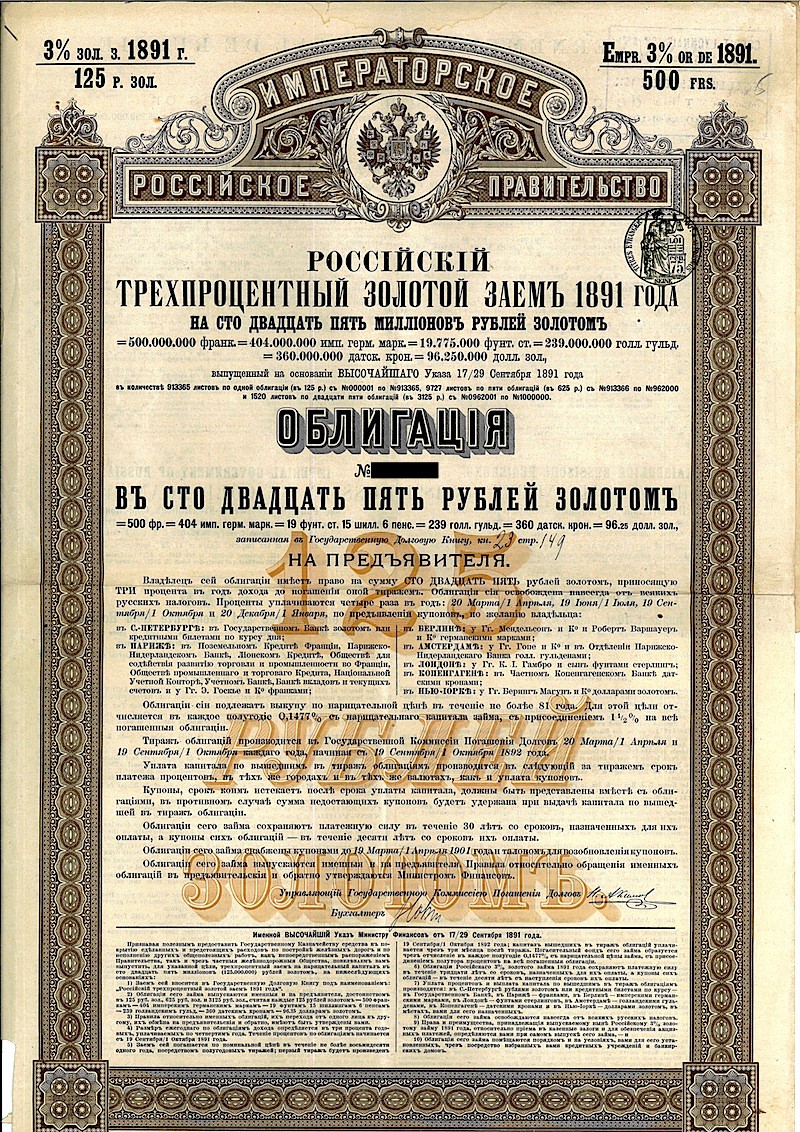
Russian bond.jpg

With “Bankers and Bolsheviks: International Finance and the Russian Revolution,” Hassan Malik has written a fascinating study of an overlooked topic—but not a book for emerging markets investors who like to sleep soundly at night. Mr. Malik chronicles the involvement of foreign capital in Russia before and up to the October Revolution. It ends expensively. Shortly after taking power in 1917, the Bolsheviks repudiated Russia’s debts. Adjusted for inflation, this remains the biggest sovereign default in history, made costlier by its completeness. No debts or obligations were “restructured”: With token exceptions, the money was gone for good.

Mr. Malik’s meticulous, forensic account reveals why late Romanov Russia—for a few years the world’s largest oil producer—had been so successful in attracting funding from abroad. Mr. Malik, an investment strategist and financial historian, is more skeptical than many about the contribution made by Sergei Witte, who was Russian finance minister between 1892 and 1903 (before rising higher still). But the surge in Russia’s economic development during those years is beyond dispute. Net national product grew at an estimated compound annual rate of nearly 5%, “very high” for the time, according to Mr. Malik. Other numbers tell a similar tale.

That Russia turned to foreign bond markets during a wave of financial globalization was not “particularly remarkable,” the author notes. That it would become “the largest net international borrower in the world” was, he believes, a different matter. Given the pace of Russian growth, however, and bankers’ perennially Pavlovian response to the whiff of profit, I am not so sure.

There was also the perception at the time that, for all its faults, Russia was “a responsible member of the European family of civilized nations.” As such, the czar’s government was rewarded with more trust than it probably deserved. In 1906 Russia secured a massive loan despite troubling finances, an economic slowdown, a shaky currency, recent military defeat by the Japanese, and something close to outright revolution. More foreign money followed, drawn in by a return to growth. Nevertheless, Mr. Malik argues that late imperial Russia was more fragile than understood then (and now). Debt was piling up and the political system was unstable. It took a huge build-up in defense spending—the silver lining of a cloud about to burst—to revive an economy that was again faltering.

If the attitude of foreign financiers toward Russia up to 1914 can be defended, their behavior afterward is rather harder to explain. By early 1917 Russia was losing World War I, its finances were crumbling, the economy was buckling and the political climate was deteriorating. Despite this, Mr. Malik notes, “the risk premiums on Russian debt relative to Western benchmarks approached multiyear lows.” Wartime politics played their part, and so did moral hazard, thanks to Russian government guarantees (and vague support from its allies). The liberal revolution that overthrew the czar in early 1917 was broadly welcomed as another step in a transformation in which, as Mr. Malik observes, international financiers considered they had long been participating. Maintaining or increasing their presence in a newly liberal Russia would be a “logical continuation” of that role, so that’s what they did.

What ensued, unfortunately, was not the next stage in a benign evolutionary process, but an abrupt break with the past. Foreign investors anticipated radical change, maintains Mr. Malik, but not the direction it took. This was a mistake more forgivable than he implies: There was nothing inevitable about the Bolshevik triumph that fall. The author is right to highlight the probability that, even if the liberals had held on to power, “a fairly significant default” was on the cards. But a default by a liberal regime would have borne no comparison to the Bolshevik default.

Even had the Bolsheviks been able to honor the debt, they would not have done so. This was a matter of principle (why, asked Lenin, repay lenders who financed “the Cossack whip and sword”?) as well as strategy. Debt repudiation was a weapon in the class war, intended to dismantle the economic strength of the bourgeoisie at home and to foment trouble abroad—specifically in France, where investment in Russian securities had spread a long way down the social scale.

Mr. Malik records the insouciance or even optimism of foreign financiers in the face of late 1917’s political turmoil. This may have peaked with “in hindsight . . . one of the most bizarre business decisions in American banking history”—no mean feat: The forerunner of Citibank opened its Moscow branch “nearly three weeks after the Bolshevik takeover.” This was an extreme example of the consequences of some financiers’ misreading of Lenin’s new order, a phenomenon Mr. Malik handles well. Precedent (Russia had never defaulted) suggested the new regime would see reason, as did a conventional understanding of morality and self-interest. Yet bankers and Bolsheviks defined reason, morality and self-interest in very different ways. Lenin’s oddball sect wanted to remake Russia (and the world). If that meant cutting itself off from international capital, too bad.

Mr. Malik criticizes foreign investors for not grasping “the political dimension” of financial support for the czar’s sometimes savagely repressive rule. But their unpopularity with the opposition was somewhat ironic: It overlooked the way in which “apolitical” foreign financing contributed to a modernization that, however unintentionally, subverted the ancien régime. And investors may have paid too much attention to politics later on. One element in the seemingly complacent reaction of international financiers to the February Revolution was a desire to help the liberal reformers. This may have been too much of a gamble but, given what was to come, it was worth taking. Russia’s tragedy was not that it ran out of money, but that it ran out of time.