AI & Job Losses: Straws in the Wind
National Review Online, June 4 2025
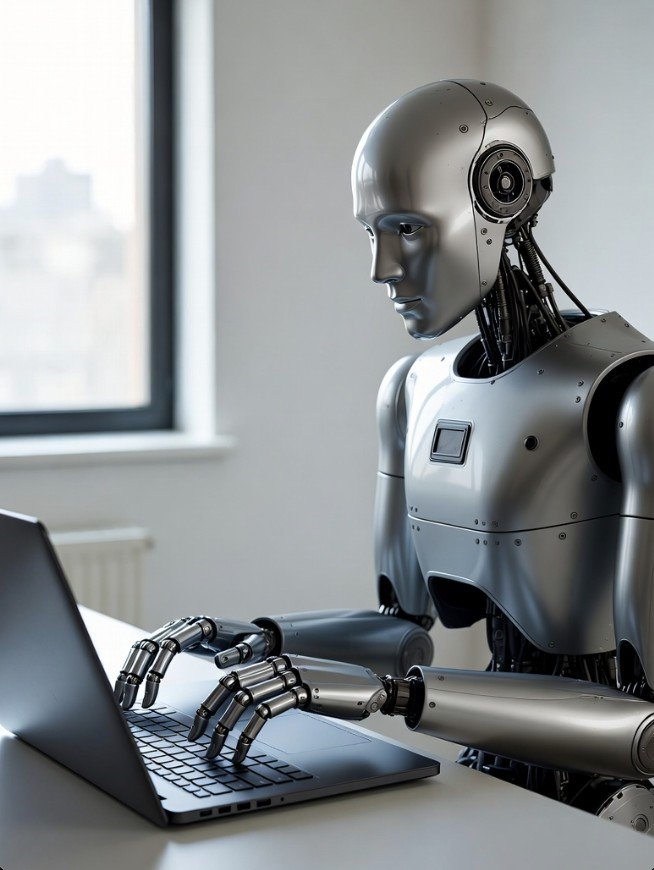
Beneath the surface, there have been a few signs and plenty of anecdata that artificial intelligence (AI) may be hitting the jobs market for a while. But harder numbers may now be emerging. Maybe.
Kevin Roose, writing in the New York Times (May 30):
This month, millions of young people will graduate from college and look for work in industries that have little use for their skills, view them as expensive and expendable, and are rapidly phasing out their jobs in favor of artificial intelligence.
That is the troubling conclusion of my conversations over the past several months with economists, corporate executives and young job-seekers, many of whom pointed to an emerging crisis for entry-level workers that appears to be fueled, at least in part, by rapid advances in A.I. capabilities.
You can see hints of this in the economic data. Unemployment for recent college graduates has jumped to an unusually high 5.8 percent in recent months, and the Federal Reserve Bank of New York recently warned that the employment situation for these workers had “deteriorated noticeably.”
Keep an eye too on graduate underemployment, which the New York Fed estimated had grown to 41.2 percent in March 2025 among recent graduates, up from 39.4 percent in January, an alarming-sounding development, but not particularly exceptional. Looking back to 1990 (the earliest date provided by the NY Fed), the number has been higher. It was standing in the high 40s in the early 1990s, before falling to a little over 36 percent as the dotcom boom ended.
Graduate underemployment (which the NY Fed defines as meaning “graduates working in jobs that typically do not require a college degree”) has been steady at around one-third, a surprisingly high number which probably arises out of the spread of university education. A degree has, for many employers, become the equivalent of graduating high school half a century or so ago. The lower rate of underemployment among older graduates is because, as they get a bit older, they have worked themselves through the labor market into the “right” level, a pathway that will narrow if entry-level graduate jobs are eaten up by AI.
And so far as that is concerned, recent talk has been worrying.
Roose:
Oxford Economics, a research firm that studies labor markets, found that unemployment for recent graduates was heavily concentrated in technical fields like finance and computer science, where A.I. has made faster gains.
“There are signs that entry-level positions are being displaced by artificial intelligence at higher rates,” the firm wrote in a recent report.
In “interview after interview,” Roose hears:
[T]hat firms are making rapid progress toward automating entry-level work, and that A.I. companies are racing to build “virtual workers” that can replace junior employees at a fraction of the cost. Corporate attitudes toward automation are changing, too — some firms have encouraged managers to become “A.I.-first,” testing whether a given task can be done by A.I. before hiring a human to do it.
And the individual stories Roose relates are, to say the least, striking. There’s the tech engineer who tells him that at his companies, they are not hiring programmers below a grade that typically requires 3-7 years’ experience. Anything below that level can be handled by AI coding tools.
Writing for Axios last month, Jim VandeHei and Mike Allen quote Mark Zuckerberg from January:
“Probably in 2025, we at Meta, as well as the other companies that are basically working on this, are going to have an AI that can effectively be a sort of mid-level engineer that you have at your company that can write code.”
Zuckerberg said this will eventually reduce the need for humans to do this work. Shortly afterward, explain Vanderhei and Allen, Meta announced plans to shrink its workforce by 5 percent. They also refer to lay-offs (at Walmart and Microsoft) that sound as if they could be linked to AI/automation. CrowdStrike, a Texas-based cybersecurity company, has slashed 500 jobs or 5 percent of its workforce, citing “a market and technology inflection point, with AI reshaping every industry.”
And so the clouds form. The Times’s Roose refers to a Brookings Institution fellow who quotes employers as saying that AI allows them to dispense “with marketing analysts, finance analysts and research assistants.” That sounds a bit like the excited talk of executives who have been handed a new toy to play with, but even if it is premature now, how long will that be the case? And if the potential of AI is what some of those promoting it claim, its scythe will not confine itself for long to easy to automate routine tasks or to a firm’s lower ranks for long.
Roose notes that AI is already being used for more sophisticated and complex tasks “in fields, such as software engineering, where there are clear markers of success and failure. (Such as: Does the code work or not?).”
He continues:
In these fields, A.I. systems can be trained using a trial-and-error process known as reinforcement learning to perform complex sequences of actions on their own. Eventually, they can become competent at carrying out tasks that would take human workers hours or days to complete.
But Roose, surely correctly, does not think that this will stop with software engineering. He quotes the CEO of Anthropic, an AI firm that has developed the Claude family of large language models. In his view “A.I. could eliminate half of all entry-level white-collar jobs within five years.” Hype? A bit, probably, but if that CEO is only half right, and the timeline is ten years, not five, we will still not be ready for the likely consequences.
The number of software development jobs postings has plunged in the last two years. It grew rapidly after the pandemic passed, peaking at roughly twice its pre-Covid (February 2020) level, and now stands at around half that. In The Atlantic, Derek Thompson blames the fall on higher interest rates, at least in part, and there’s something to that. Maybe those responsible for all that hiring are pausing for breath after that surge. But then Thompson notes that the unemployment rate for recent graduates has risen above that for the economy as a whole for the first time (apart from a brief period during the pandemic) in four decades. Is AI (or the anticipation of AI) partly to blame? It could be, although this trend can be seen from late 2020 onwards.
Thompson believes that some skepticism is still called for:
For one thing, supercharged productivity growth, which an intelligence explosion would likely produce, is hard to find in the data.
Yes, but it might take time for that productivity growth to emerge. It’s still early days, and the improvements that AI will deliver to productivity will (assuming the bugs can be worked out, not the smallest of assumptions) only take place when people learn how to work with it. That will take time.
Thompson adds that:
[A] New York Fed survey of firms released last year found that AI was having a negligible effect on hiring. Karin Kimbrough, the chief economist at LinkedIn, told me she’s not seeing clear evidence of job displacement due to AI just yet. Instead, she said, today’s grads are entering an uncertain economy where some businesses are so focused on tomorrow’s profit margin that they’re less willing to hire large numbers of entry-level workers, who “often take time to learn on the job.”
Then again, white-collar automation is not confined to AI.
We have always been an inventive lot, we humans. We have never made that more evident than in the last couple of centuries, when the combination of technological innovation and capitalism put an end to millennia of sluggish growth and replaced it with breakneck development. Numbers from before the pre-industrial age are little more than informed guesses, but, according to some of those making those informed guesses, global GDP in the year 1000 AD was, at 2021 prices, $281 billion. Half a millennium later it had risen to $584 billion, not much progress over 500 years. By 1700, the total had reached $872 billion, but by 1820 ($1.63 trillion), industrial capitalism was beginning to deliver. In 1850, the total had reached $2.15 trillion.
Two years before, a Mr. Marx and a Mr. Engels, had unleashed their Communist Manifesto. Much of their analysis was nonsense (and their prescriptions were something rather more sinister), but despite their distaste for the nature of capitalism — and its shock troops, the “bourgeoisie” — they had to admire what it had achieved:
It has been the first to show what man’s activity can bring about. It has accomplished wonders far surpassing Egyptian pyramids, Roman aqueducts, and Gothic cathedrals; it has conducted expeditions that put in the shade all former Exoduses of nations and crusades.
Indeed it had. By 1920, global GDP had risen to $6.7 trillion. A century later, that number had risen to $146.6 trillion. As I noted last week, in 1834, the year when Thomas Malthus died, the world’s population stood at around one billion. Now it is eight billion, a number far exceeding anything that he would have believed possible, as would how well so much of that population lived.
But it would be wrong to deduce from that achievement that the great technological transformation that made this possible had been a painless shift. According to the happy legend, the jobs created directly or indirectly by new technologies quickly replaced those that had been rendered obsolete. In reality, the transformation was much rougher, especially in its earlier years, and especially for those at or near the bottom of the economic heap.
In England, the epicenter of the early industrial revolution, it appears (although it remains a topic of debate) that real wages were close to stagnant from about 1780-1820 despite the increase in GDP triggered by the application of new modes of production, a phenomenon that has been dubbed the Engels Pause. Some argue that this pause has been exaggerated, and also that its effects were exacerbated by the effects of tariffs (the “Corn Laws”) on food prices. There is something certainly to the latter. Nevertheless, its root cause is hard to deny. Manufacturers were able to draw upon surplus (rural) labor, a “reserve army of labor” in Marx’s phrase. The British population roughly doubled in the 1700s, with the curve steepening in the century’s latter half (Malthus’s fears did not come from nowhere).
That reserve army was boosted by the displacement caused by the new technologies of the industrial revolution. In his recent Capitalism and its Critics, John Cassidy recounts how the number of weavers in England fell from 240,000 to 60,000 between 1820 and 1840. By 1830, their wages were 80 percent lower than in 1800. The Luddites who smashed the new weaving machines in the 1810s were doing the right thing for themselves and perhaps for their children, but not for their grandchildren. Real wages began ticking up in the 1820-40s, but really started accelerating after 1850 as the benefits of industrialization spread, creating new opportunities and new jobs, including for highly skilled workers to operate increasingly sophisticated equipment.
Technological advances can also free up talent, giving people the chance to work more productively, either where they are or elsewhere. It can be used to complement human endeavor as well to replace it.
And mass migration from the United Kingdom (even after excluding Irish emigration) up until 1914 gives the lie to any kind of straightforwardly happy ending to the story of the effect of mechanization on the work force.
The process of adjusting to the industrial era was also accompanied by popular discontent, especially during the “pause,” although not only then. If AI does deliver on its promise, there could well be another “pause,” as we learn how to use it as a complement to human skills as well as just a replacement. In the interim many white-collar jobs will go the way of those once held by those doomed weavers. Indeed they may already have done so, even if not so quickly as I anticipated when writing an article on automation for National Review in 2016. The strong economy of the late teens may have bought some time. In looking at those years, the ranks of those in upper-tier jobs (or on the way to them) increased, but did they increase by less (and did the pay attached to them increase by less) than would otherwise have been the case?
The Atlantic’s Thompson:
College doesn’t confer the same labor advantages that it did 15 years ago. According to research by the San Francisco Federal Reserve, 2010 marked a turning point, when the lifetime-earnings gap between college grads and high-school graduates stopped widening. At the same time, the share of online job postings seeking workers with a college degree has declined.
To be clear: College still pays off, on average. The college wage premium was never going to rise forever, and the fact that non-college workers have done a little better since 2010 isn’t bad news; it’s actually great news for less educated workers. But the upshot is a labor market where the return on investment for college is more uncertain.
Again, that may reflect, in part, the fact that a degree is not what it was, but that won’t ease the disappointment felt by those holding those degrees. Anger is subjective, not objective. One explanation for recent episodes of discontent, from Occupy Wall Street to the rise of woke, among the young intelligentsia and lumpen intelligentsia, victims of what historian-sociologist Peter Turchinlabeled “elite overproduction,” is that they have not received what they perceive to be their due. And when that occurs, the risk of social convulsion rises.
As I wrote in 2016:
Oppressed masses generally stay oppressed. They may smolder, but it takes the bright to spark a revolution. And if the bright feel they are missing out, that’s what they will be tempted to do.
The Luddites did not have university degrees, but they were much more than an angry, numbskull mob. Many were intelligent, highly skilled artisans, smashing the machinery they saw as a threat to their livelihoods and their status.
We won’t know for a while how AI effects employment, but that waiting period may be shorter than we expect, and not only because of the pace at which AI is developing. The economy will matter too. Thompson draws attention to the possibility that businesses will be more likely to risk turning to AI in harder times:
Recessions can accelerate technological change, as firms use the downturn to cut less efficient workers and squeeze productivity from whatever technology is available.
The Engels Pause took place in a society that was more deferential than our own. Most of those hit were poorly placed to push back, but it was not only the Luddites who did. Now, we are confronted with a possibly massive change occurring over a short period, with those adversely affected being both candidate and current members of the elite. They will not go gentle into the night. If there is a new “pause,” it will be far more turbulent than its predecessor.
Steve Bannon is not someone known for understatement. Nevertheless, when, as Axios reports, he predicts that the toll on jobs taken by AI will be a major issue in the 2028 election, it’s worth paying attention.
And in the meantime, stop worrying about a labor “shortage” brought about by demographic change. To the extent there is one (not really), it won’t last for long.
Extract from the Capital Letter for the week of May 26, 2025