Quidditch, It’s Not

Suzanne Collins: The Hunger Games, Catching Fire, Mockingjay

National Review, July 12, 2012 (July 30, 2012 issue)

Dystopias — dark, funhouse mirrors of our fears — will always be with us. Nineteen Eighty-Four was the product of a time when Big Brother Stalin was on the march, and the Eloi and the Morlocks of The Time Machine reflected H. G. Wells’s anxiety about where the onrush of 19th-century capitalism could lead. So what to make of the success of a “young adult” trilogy set in a North America that has — here a shout-out to a fashionably green vision of global catastrophe — emerged after “the droughts, the storms, the fires, the encroaching seas that swallowed up so much,” including, it appears, all of the spirit of 1776? This land is now Panem, run by a despotism that proclaims and reinforces its control with the Hunger Games, a brilliantly, sadistically choreographed contest that is broadcast across the nation. This annual ritual turns slaughter into both spectacle and terrifying statement of who is in charge.

The Hunger Games, the first of the trilogy by Suzanne Collins, spent nearly two years on the New York Times bestseller list after its release in 2008. By May 2012, Scholastic reported that some 36 million copies of the three books were in print in the U.S. The movie version (not bad, incidentally) has been a smash, grossing over $150 million in its opening weekend alone.

Earlier this year Collins became the best-selling author in Kindle’s history. That’s quite something for a writer of works aimed at (to repeat that cloying phrase) young adults, even in the age of Harry Potter and Twilight. What she has produced is no great work of art (the trilogy’s numerous grown-up devotees need to move on to more challenging fare), but Collins fully deserves her legions of teenaged fans. Her characters can find themselves burdened with names that hint at vintage sci-fi or sepia bucolic idyll (Katniss, Peeta, Haymitch, Cartwright), but the writing is taut and spare. Chapters frequently finish with cliffhangers that beg for a turned page.

Collins’s heroine, 16-year-old Katniss Everdeen, is tough and ornery, an accomplished huntress and, when she has to be, a deft killer. If less glamorously so, she is a model of adolescent female empowerment in the venerable Buffy tradition, with her harsher traits both diluted and emphasized by nods to girliness that won’t have hurt Collins’s sales in Sweet Valley High: Despite the dangers that lie in the Hunger Games ahead, and despite herself, Katniss exults in the outfit created for her presentation to the crowds in Panem’s capital. Nor is this the trilogy’s only fashionista interlude: Throughout the books there are detailed descriptions of what is being worn by whom, and a “stylist” is one of the heroes.

There is also a love triangle that could have matched that between Twilight’s Edward, Bella, and Jacob in its angst, but, revealingly, does not. Perhaps Collins felt that male readers could take only so much. They, and other savages, are thrown plenty of bones, limbs, mutilations, sinister mutant creatures, and well-told grotesque, disgusting deaths.

The brutality is inclusive. Sympathetic characters don’t escape Collins’s chopping block. Then again, dystopias are not meant to be happy places. And Panem is not. It exists purely to serve the needs of a predatory capital — the Capitol — that feeds off twelve ruthlessly exploited districts. Its coal is mined in Katniss’s Appalachian home, the desperately hardscrabble District 12; its fish comes from District 4; and so on. The Capitol regime is a caricature of vicious imperial misrule, and the Hunger Games are the acme of a cruelty as depraved as it is carefully targeted, a reminder of the consequences of a failed revolt by the districts three-quarters of a century before. Each district has to furnish two “tributes,” a boy and a girl between the ages of twelve and 18, for a gladiatorial competition in which they and the other 22 will be consigned to an arena from which only one is allowed to emerge alive.

Unkind critics have commented on similarities between The Hunger Games and Battle Royale, a Japanese saga of high schoolers forced to fight to the death by a totalitarian state, a connection that Collins denies. She cites instead, as an influence, the legend of the, uh, young adults handed over to the Minotaur. Spartacus, she says, is another: “Katniss follows the same arc from slave to gladiator to rebel to face of a war.” Lest the classical analogies pass anyone by, there are other clues, from the occasional Latinate coinage (a slave with his or her tongue cut out is an Avox) to the fact that many of the Capitol’s inhabitants, not to speak of the city itself, are named with a distinctly Roman flourish: Coriolanus Snow, Seneca Crane, Caesar Flickerman — you get the point. Then there is this from a member of the Capitol’s elite who switches sides: “In the Capitol, all they’ve known is Panem et Circenses. . . . [It] translates into ‘Bread and Circuses.’ The [Roman] writer was saying that in return for full bellies and entertainment, his people had given up their political responsibilities and therefore their power.”

Ah, Panem.

Katniss connects the remaining dots. The districts are compelled to provide the Capitol’s frivolous and decadent citizenry with abundance and, through the tributes, the “ultimate” distraction of the Hunger Games. Duly sated, the frivolous and decadent citizenry then leaves the business of power to those who wield it. By now even the slowest of Collins’s readers may suspect whose reflection they have been glimpsing in this particular funhouse mirror.

That seems to have been her intent. She has said that the idea for The Hunger Games first struck her while channel-surfing between reality TV and coverage of the Iraq War, something that troubled her NPRish fastidiousness more than it should: It’s a long way from Survivor to Katniss. There are certainly viewers who have been desensitized by the tube’s manufactured conflicts, but only psychopaths or the extremely stupid could have confused the images from Iraq with entertainment, make-believe, or both.

Collins’s explanation that war is hell (a theme of her Underland Chronicles too) is unoriginal, but commendable enough, at least until the moment — sometime in the course of Mockingjay — when sermon overwhelms story. The tale of the Capitol’s fall offered an ideal opportunity for a deeper exploration of the principle of morally legitimate violence that, from Katniss’s arrival in the arena, forms one of a number of this trilogy’s more interesting subtexts. That opportunity is at first grasped but then thrown away in favor of a dull plague-on-both-your-houses world-weariness that is more evasion or tantrum than an attempt at an answer.

There are always true believers of one sort or another who see a popular phenomenon and claim it for their own. Some Christians have detected a Christian message in these books. Meanwhile, writing in The Atlantic, Nicole Allan saw Katniss as “the populist hero the Occupy movement wasn’t able to deliver.” To be fair, that’s a proposition more credible than the notion of one of Katniss’s two suitors (an admirable lad, but still) as a Christ figure. At a time when the left side of the elite is using inequality to bludgeon the right, it’s easy to see how this trilogy could be cast as a manifesto for the 99 percent. Maybe that has been some of its appeal. Perfectly, The Hunger Games came out as Lehman went down.

And there are historical resonances far closer to home than ancient Rome is. Collins has given Zola’s Germinal, no mash note to the 1 percent, as a reason for picking coal-mining as District 12’s industry, but that district’s pinched iconography also has more than a trace (underlined in the movie) of Depression-era photographer Dorothea Lange about it. District 11 suggests the Jim Crow South. There are class and, possibly, ethnic tensions within the districts — the closest that District 12 comes to a bourgeoisie is WASPy, light-haired, and blue-eyed; the miners are olive-skinned, black-haired, and gray-eyed — and also between them. Pampered District 2, the source of Panem’s thuggish Peacekeepers, is filled with Capitol loyalists, but its stoutly proletarian stonecutters swiftly rally to the revolution.

But before draping Collins in a flag of the deepest red, look more carefully. The revolution’s base — the never-vanquished District 13 — is a repressive, sternly egalitarian place somewhere between Sparta and Mao, and it’s not sympathetically portrayed. Libertarians may appreciate the Sic semper tyrannis twist towards the trilogy’s end, and tea-party types will note that the Capitol is overthrown by a union of 13 districts.

Rebels of both Left and Right will identify with the contrast between the homespun virtues that can be found in the “real” Panem and the excess, affectations, and vice of its capital. And so they should: This is a time-honored narrative, sometimes accurate, sometimes not, but, in its combination of resentment and self-congratulation, one of eternal appeal to those on the outside. You would have heard it in Imperial Russia, you would have heard it in Imperial Rome, and, if there’s any truth to an old, old story, you would have heard it in Sherwood Forest too. Katniss, of course, is deadly with a bow.

Darkness at dawn

Keith Lowe: Savage Continent - Europe in the Aftermath of World War Two

The New Criterion, May 1, 2012

The starving, shattered Europe that Hitler left behind is a topic so vast, so terrible and so chaotic that it is hard to see how it could be confined to a single volume. The British historian Keith Lowe has not attempted to do so. In Savage Continent he uses just some of the fragments of history to assemble a vivid, if occasionally unevenly written, portrait of a broken, vagrant place oscillating between ancient barbarism and a post-apocalyptic future. With the Marshall Plan as yet undreamed, and Marshal Stalin on the prowl, no safe haven lay in sight.

Such a vision goes too far. More of old Europe endured than this volume—and its title—let on, but to worry about that, or the fact that Lowe has little to say about economics, the arts, or the broader culture of the time is to miss the point of what he is trying to do. This is primarily a book about the horrors of the first years of a questionable peace. That’s a story that’s well worth telling, and in Lowe’s hands, well worth reading. That it challenges the reassuring narrative of the Good War is another reason that it deserves an audience in America. And not just for historical accuracy’s sake: Old ghosts are stirring in Europe. We would do well to grasp where they come from, and why.

There is little in this book about Britain. There is less than might be expected on that slice of the Reich that rapidly and hungrily became West Germany, and—chocolates and Trümmerfrauen and black market and GIs and war brides and all that—never slipped far from the Anglo-American gaze. Instead, Lowe’s focus rests mainly on those nations that had emerged from under German occupation, nations in which (in the West) memories of the immediate postwar had either been muddled by (as he shows) kindly legend and convenient amnesia or (in the East) were suppressed under totalitarian rule.

Mr. Lowe describes a fragile, combustible, and lawless European wasteland so physically and morally degraded that it takes on the quality of nightmare, or a canvas by Hieronymus Bosch. Where to begin? With the rape of millions by a brutalized and brutalizing Red Army in a frenzy so revolting that to read about it is to despair (again) of mankind? There are so many abominations to choose from. Quieter, lesser known atrocities shine a new light on the extent of the abyss. Take, say, the fate of the ten thousand or so children fathered by German soldiers in occupied Norway. After the liberation that was not for them, many were labeled retarded by the Norwegian authorities on, Lowe maintains, “no evidence whatsoever.” A number were permanently institutionalized, and “right up until the start of the 1960s” all “had to undergo the annual humiliation of applying to the local police . . . for permission to remain in the country” of their birth.

They were a constant and peculiarly emasculating reminder of the powerlessness of life under a tyranny imposed from the outside. And it was not just in Norway that such feelings darkened the new dawn. The disgusting—and clearly related—spectacle of women stripped and shorn for sleeping with the enemy was, throughout Western Europe, a frequent accompaniment to the giddy celebration of liberation, shame repaid with shaming, the old sexual order reasserted. It would have been of no consolation to the wretched victims that these violent, but by the grotesque standards of this period, “relatively safe” (to use Lowe’s words) acts of retribution may have brought some sort of closure to communities that might have otherwise wanted much, much more.

Vengeance dominates this book. It “permeated everything” writes Lowe. It was “a fundamental part of the bedrock upon which postwar Europe was rebuilt.” After six years of Nazi savagery, 1945 was a time for a settling of scores. The Red Army was not alone in its ferocity. Without ever drawing facile analogies between the deeds of Germans and their collaborators and what was now being done to them, Lowe tracks the grim trajectory of revenge back and forth across the continent from the early explosions of long repressed rage—the first shootings, lynchings, and beatings—to the more systematic cruelties that followed.

Lowe explains that mob law waned once incoming governments took strong enough action to persuade their citizens that the state would punish those that merited it. In the West, this did the trick more often than not, and more quickly than not. This was helped along by the presence of liberating armies infinitely more benign than the Soviets and by the fact that the fabric of civilization had survived far better there than in the East. There was also something else at play. The ambiguities of occupations much gentler in the West than in the lands of the Lebensraum, and which even had some appeal to certain strands of local opinion, were impossible to reconcile with the sagas of unified resistance that were to play so prominent a role in the task of national reconstruction. To pursue the guilty too aggressively would be to uncover truths too incendiary for these battered societies to take. After an initial, demonstrative wave of harsh sentences, there were many who were left untouched.

In Western Europe, wild justice persisted in those parts of France and Italy where it could be transformed into vicious “revolutions in miniature” by a hard left that was on the ascendant all throughout Europe, a phenomenon about which Lowe is oddly insouciant: “Communism in Western Europe was a hugely popular, and largely democratic movement.” Maybe: Had it prevailed, it would not have been either for long.

But it was in the East that vengeance was the bloodiest, the most prolonged, and the most politically useful. These were the territories where Nazi criminality had descended to its dreadful nadir. What it hadn’t destroyed, it had warped and polluted. As the Wehrmacht retreated, these portions of the Bloodlands (to borrow the title of Timothy Snyder’s indispensable book) became Hobbes’ kingdom, and Stalin’s opportunity. Already emptied of its slaughtered Jews, the venerable overlap of peoples that had once given this region much of its character was too complex, too awkward, and, after decades in which touchy ethnic sensitivities had been groomed by rising nationalist ideologies, too dangerous to survive—but all too easy to manipulate.

Communities that had flourished for centuries were smashed up. In the greatest purge of all, some twelve million Germans were expelled from a wide swath of Eastern Europe including territories that had, until 1945, formed part of the old Reich. Half a million or, quite possibly, many more, died, a toll that seems heavier than the “many, many thousands” mentioned by Lowe. Germany itself shrank as Stalin shifted his puppet Poland miles to the West, a move sweetened for Poles by the fact that this land was to be theirs alone. Jews who returned to what they had still thought was home risked a roughing-up and, sometimes, much worse. But this at least did not have the official sanction of the state. Ukrainians were not so fortunate. Another unhappy minority of the old Poland, they were either driven from, or made to assimilate into, the new. Meanwhile, a feral civil war between Poles and Ukrainians in Western Ukraine concluded with the resumption of Soviet control and the region’s depolonization. Ukrainian nationalist insurgents were next on Moscow’s list.

They held out into the following decade, as did their counterparts in the re-enslaved Baltic States, three countries for whom 1945 was just another in a series of very bad years. Lowe focuses rare, overdue, but perversely grudging attention on the heroic and hopeless battle by Baltic “forest brothers” against Soviet despotism. Barely known, even now, in the West, it was a struggle that did much to keep alive the ideas of nationhood that were to prove so powerful in the Gorbachev era. Those who fought did not die in vain.

Even for a book that makes no claim to be comprehensive, there are puzzling omissions, however. Lowe makes room for the Communist takeovers in Hungary and Romania, but includes little on the one in Poland. Stranger still, in a work so attuned to the twisted politics of this twisted time, there is nothing on the forcible repatriation by the Western allies (and certain neutrals too) of huge numbers of individuals to the USSR and, all too often, their doom. By contrast, too much effort is devoted to finding a degree of equivalence between the actions of the Soviets and of those doing their best to keep them out of the half of Europe they had not already devoured.

Savage Continent combines hand-wringing with Kumbaya in its conclusion. There is happy talk of reconciliation, but there is also some fretting that older and darker sentiments may still be around. That the latter are increasingly stoked by the stresses and strains induced by an EU that portrays itself as the guarantor of European peace is an irony apparently lost on Lowe. Then again, his book went to press before neo-Nazis rode the Eurozone crisis into the Greek parliament with 7 percent of the vote.

What Lies Beneath

Norman Davies: Vanished Kingdoms - The History of Half-Forgotten Europe

National Review, April 13, 2012 (April 30, 2012 issue) 

Trakai, Lithuania, March 1994 © Andrew Stuttaford

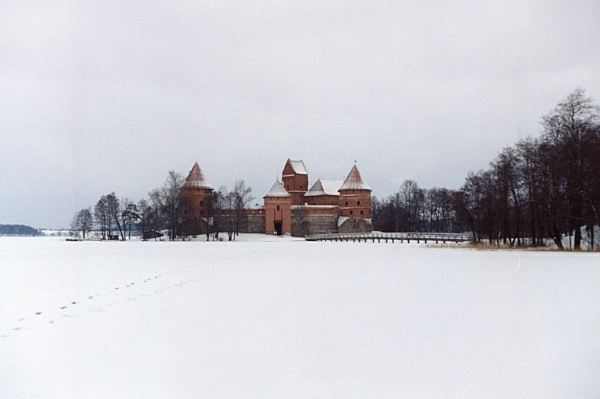
Trakai, Lithuania, March 1994 © Andrew Stuttaford

How to make a nation? In Vanished Kingdoms, his fascinating — and characteristically hefty — new book chronicling the rise and fall of 15 European states (from Visigoth Tolosa to the good-riddance empire of the Soviets), historian Norman Davies offers a number of suggestions. They include “good fortune, benevolent neighbors, and a sense of purpose.” There are nods to the power of a common language and a shared myth, and an implied recognition of the usefulness of conquest (where now are the Baltic people, the Prusai, whose land formed the core of ascendant Teutonic Prussia?), but little focus on the shared (if often exaggerated) sense of an ethnic bond that has held nations, and nations-in-waiting, together through the centuries. Perhaps the last was too obvious to need spelling out, or, in an era that sets such store in being over that sort of thing, just too embarrassing.

Making matters more complicated still is the way that history has left many Europeans with overlapping, and, not infrequently, conflicting identities: Sorb and/or German, Briton and/or Scot? But there can be few better guides to these muddled layers of nationality than Norman Davies, a combative, unusually original historian of Europe (Europe: A History) best known for his studies of Poland (God’s Playground, most famously), a nation blessed and burdened by shifts in borders and identity to an extent that stands out even in this most tangled of continents. That said, those expecting Vanished Kingdoms to be a comprehensive guide as to how, why, and when countries fail will, despite a postscript titled “How States Die,” be left a little disappointed. Suspects, usual or otherwise, are listed: invasion, of course; artificiality (Napoleonic Etruria); stillbirth (the day-long Republic of Carpatho-Ukraine); exhaustion; merger; de-merger; and the loosely defined “implosions” that put paid to the USSR and Austria-Hungary alike. But Davies has both a romantic streak and a sharp awareness of humanity’s susceptibility to hubris, and the explanation, I suspect, that really appeals to him is the inevitability of impermanence: Nothing endures forever, Ozymandias and all that.

For the most part, we are left to draw our own conclusions from the 15 national obituaries that form the backbone of this book. So densely packed that they can be difficult to digest (the five, six, or was it seven Kingdoms of Burgundy do rather blur), they reveal their author’s romanticism in a sometimes elegiac tone, crowned with moments of unexpected beauty. In his description of a piece of ancient Britain that endured in Scotland until the 12th century, Davies includes lines from a poem written in the days of its twilight of a loveliness so vivid that a scene from 800 years ago comes close enough — almost — to touch: “Gentle meadows and plump swine, gardens pleasant beyond belief, / Nuts on the bough of hazel, and longships sailing by.”

The forgotten and the neglected attract Davies, a passionate writer drawn to history’s underdogs (thanks to this book, I am now something of a Montenegrin nationalist): “Historians usually focus . . . on the past of countries that still exist. . . . They are seeking the roots of the present, thereby putting themselves in danger of reading history backwards. . . . In [the] jungle of information about the past, [today’s] big beasts invariably win out.” Attention is sucked away from smaller states, let alone those that no longer exist. We learn more about that of which we are already aware, and “the blank spaces in our minds are reinforced.”

References to “big beasts” hint at Europe’s history of, given human nature, all too imaginable violence, a blood-drenched danse macabre that reached a ghastly apogee in the wars, genocides, and ethnic cleansings of the mid–20th century. As so often is the case, these horrors are most powerfully conveyed in miniature. Thus we learn of Ustrzyki Dolne, a small, largely Jewish sub-Carpathian town that emerged from Austro-Hungarian Galicia into the interwar Polish republic. When, after Stalin’s pact with Hitler, the Soviets arrived, the local Germans were sent off into the temporary safety of the expanded Reich, and most of the town’s ethnic Polish inhabitants were deported to the east, and, in the majority of cases, their death. Two years later Hitler’s legions arrived. Ustrzyki’s Jews were exterminated.

That left the Lemkos, Ruthenians who had long farmed the surrounding countryside — and then they, too, were cleared out by the Communist authorities after the end of the war. Their replacements inherited a ghost town and ruined villages, “blank spaces” of the most literal type, and filled them with a Polishness that lacked any traces of that old awkward, butchered Galician ambiguity. Violence had done its bit for nation-building yet again, helped, as the years passed, by fading memory and the easing of inconvenient history into convenient oblivion. The annihilation of old Ustrzyki has little to tell us about Poland today: Lemkos, Germans, and Jews will never again come back to their land by the River San.

Under the circumstances, it’s unsurprising that the notes that conclude Vanished Kingdoms occasionally strike a wistful tone: “Since it cannot be fitted tidily into French, Swiss, or Italian history, Savoy is frequently overlooked. No standard survey has been published in English, either of the land of Savoy or of the House of Savoy.” Such are the “blank spaces” that Davies is looking to fill, beginning, as he has to, with “flotsam and jetsam.” He is a beachcomber-historian, delighted by a cabinet de curiosites in Krakow’s Czartoryski Museum bursting with celebrity treasures that include Rousseau’s briefcase, Voltaire’s quill, and Queen Barbara Radziwiłł’s knife and fork. Nearby is “a half-gnawed, rock-solid, bright green chunk of moldy bread . . . allegedly cast aside by . . . Napoleon.”

Allegedly: With a wink, Davies hints that, like some of the other wonders on display, Bonaparte’s bread may not be the real thing. But never mind: “Like all holy relics, genuine or fake, it has immense powers of imaginatory stimulation.” Above it hangs an inscription (“The Past in the Service of the Future”) that once crowned the entrance to a Temple of the Sibyl erected by Izabella Czartoryska (1746–1835), a Polish princess of the Enlightenment who was, splendidly, “as rich as she was patriotic as she was debauched.” But “whose past,” asks Davies, and “whose future”? The past, for Czartoryska, was the Polish-Lithuanian Commonwealth that had stretched from the Baltic to the Black Sea. The future of which she dreamed was the reversal of the partitions that had consigned that state to history, but if that past, and its relics and its memory, mean anything now, it is as symbol of a reinvented Poland — and a Polishness — very different from the sprawling multiethnic Rzeczpospolita for which the princess so yearned.

The persistence of some sort of Poland, however changed, brings up the question that lurks just below the surface of Vanished Kingdoms: What is it that defines a nation? And identifying that question helps us detect what Davies is really up to. A Briton of Welsh descent (aha!) who has predicted the disintegration of the U.K. with somewhat unseemly relish, he clearly doubts the authenticity, and thus the pretensions, of some of the nation-states that now dominate Europe, at the expense, in his view, of the essence of the peoples that live within their borders, and, indeed, beyond.

The time of the Prusai has irrevocably passed, but including a chapter in Vanished Kingdoms on the glories of Aragon makes the point that Spain’s restless Catalans may well be on to something, an approach Davies explored at even greater length in The Isles (1999), in which he argued that the United Kingdom was, is, and will be anything but united. The road to the future apparently ran through Brussels: The EU, wrote Davies, long an over-enthusiast for the gold stars on blue, “gives a place in the sun to Europe’s smaller and middle-sized nations,” a claim that looks absurd in the era of Merkozy and that was, even a decade or so ago, at best willfully naive. It is true that Scots and Fleming nationalists (and, doubtless, others too) maintain that the EU provides a framework within which they can “safely” claim their independence, but this independence would be one stripped of all meaning by a European project profoundly opposed to popular sovereignty and the assertion of national identity.

But as the bitter, distinctly un-communautaire feuding over the euro-zone crisis reminds us, notions of nationhood have a way of climbing out of the footnotes to which they have been banished. Rousseau warned the Poles of the doomed Rzeczpospolita that they were “likely to be swallowed whole” but must “ensure that [they were] not digested.” They did. The Baltic States were not fully “digested” by their Soviet occupiers either, but, as Davies (in a typically striking image) notes, “fifty years later, like the Biblical Jonah, they re-emerged from the belly of the whale, gasping, but intact.”

Should they so choose, the nations of the EU will now face a subtler challenge: how to escape from a trap they (or their politicians) set for themselves. Were they to succeed, and were Davies to write about it, the results would be well worth reading, but they would differ from Vanished Kingdoms in at least one crucial respect: Telling that story would not be a labor of love.

Downhill from Here

Marcus Scriven: Splendour & Squalor

The Weekly Standard, January 2, 2012

Henry Paget

Henry Paget

Anglophobes or egalitarians still looking for confirmation that the English aristocracy is no longer what it was may find Marcus Scriven’s Splendour & Squalor the most satisfying read since whatever it was that Sarah Ferguson last wrote.

These are well-told tales of well-born ruin to savor, complete with grubby interludes, penny ante crises, and tawdry finales that all combine to make a wider, and even more conclusive, point about the decline of the old social order: The aristocratic fiascos of the 20th century are those of a shrunken and shriveled caste. They simply cannot compete with the epic follies of Britain’s gloriously ignoble noble past, tantalizing flickers of which illuminate the introduction of Scriven’s marvelously off-kilter chronicle.

England’s older generation set the bar high, and would, in many ways, have been better suited to Scriven’s wry tastes than the later 20th-century dross to which he has dedicated his efforts. Scriven’s four aristocrats furnish him with squalor, certainly, but not so much in the way of splendor. For an example of the latter we have to turn to the past, making do with glimpses of exotics such as Henry Cyril Paget (1875-1905), the 5th Marquess of Anglesey, the “dancing Marquess” who scandalized an earlier era and brings his own peculiar glamour to Scriven’s introduction. His was a whirling, twirling saga of madness, camp, narcissism, waste, and style. The misfires of the more modern noblemen to whom Scriven’s book is devoted come across, by comparison, as distinctly damp squibs.

Anglesey devoted himself to his wardrobe, walking sticks, jewelry, yachts, cars, and, as his sobriquet would suggest, dancing. He converted the family chapel into a theater and “commissioned .  .  . a production of Aladdin, for which he pioneered ‘the Butterfly Dance,’ a solo which he alone performed,” both in the former chapel and then on tour. He died in Monte Carlo, after running up spectacular debts, a blow to a distinguished lineage made no easier to bear, as Scriven notes, by “doubts over his legitimacy,” a blurred hallmark he shared with Edward FitzGerald (1892-1976), the 7th Duke of Leinster, serial husband and serial bankrupt, who is first of the scapegraces to feature in the main section of Scriven’s roll of dishonor.

Disappointingly, perhaps, for some of his relatives, there were no such worries about the paternity of Angus Charles Drogo Montagu (1938-2002), the eventual 12th Duke of Manchester, and the least interesting of Scriven’s far from fantastic four. The dullard second son of one of the many branches of an ancient family, he had few skills, a demanding sense of entitlement, and a fondness, when he could get it, of the high life and repeat marriage (he managed four wives, equaling Leinster’s haul). This would have been tricky in more capable hands, but when combined with a love of alcohol, a yen for gambling, a nose for a bad deal, and resources that were generally as modest as his talents, the consequences tended to be messy, and included a spell in an American prison after one of his “bits of business” went wrong.

Scriven, a deft writer, makes what he can of Drogo’s dreary decline. No Icarus, Montagu aimed low, and landed lower, scrabbling for survival while failing to take advantage of the breaks that came his undeserving way. He was a man with little to commend him, and yet, such was the lingering appeal of a title, the mere fact of his persuaded a surprising number of people to throw some bones his way. He was recruited by fraudster and law firm alike to lend the sheen of his forebears to their business. The state chipped in, too. As the senior peer he eventually became, Montagu was entitled to play legislator (which was of no interest) in the House of Lords and to be paid whenever he turned up (which was), facts that may lead some readers to sympathize with Tony Blair’s purge of almost all the hereditary element from Britain’s upper house. That would be a mistake. Manned as of old, the House of Lords was too obviously and indefensibly archaic to be taken seriously. Dominated these days by cronies, stooges, bien-pensant worthies, and burnt-out grandees, it has become a more subtle, and thus more effective, insult to democracy.

But noble birth comes with an old, dangerous magic. Montagu used his to beguile, but was beguiled himself. It gave him both a sense of entitlement, and obligation, too. He could afford neither. No matter. Appearances mattered: “A duke must be seen to behave like a duke.” His tips were generous, his hospitality was lavish, and his pockets were emptied.

No British book on hereditary catastrophe would be complete without the Hervey family, long the poster boys for disorderly DNA, and Scriven gives starring roles to two of them, while scrupulously noting that if there was a “bad” gene, it was unusually recessive. The unorthodoxies of various 18th-century Herveys (including homosexuality, promiscuity, “exhibitionism of a specialist kind,” sadism, murder, and—impressive in a bishop—something close to atheism) were followed by a century in which they were, despite the “discordant” tendency of their Irish cousins to emigrate to Canada, “very nearly the embodiment of aristocratic virtue.”

The same could not be said of the dysfunctional duo at the heart of Scriven’s narrative, Victor Hervey (1915-1985), the 6th Marquess of Bristol, and his son John (1954-99), the 7th. The heir to a vast fortune, Victor went in for conventional aristocratic misbehavior—extravagance, brutal violence, reactionary politics, pathological snobbery, invented Ruritanian uniforms, absurd business ventures, immoderate matrimony, and immoderate drinking—with considerable enthusiasm. He then added flourishes that were all his own, including crooked Finnish arms deals, jewel theft, and episodes of fraud.

Of all the wreckage that Victor created, however, the most disastrous was his eldest son, John. Starved of paternal affection and kept away from his mother (Victor had moved on to another wife), this poor little rich boy’s upbringing was doubtless made more confusing by its toxic mixture of neglect, luxury, and frequent reminders of his elevated social status, a cocktail that cannot have left him well-equipped to deal with the temptations that the age of disco put in his way. The money was there, the drugs were there, and in the Dionysian interlude between the waning of traditional sexual morality and the waxing of AIDS (gene or no gene, John was one of the gay Herveys), playtime was what you could make of it.

But John’s was a compulsive hedonism, with not a lot of joy about it, marked by boorish displays of excess, sporadic stints in jail, and the humiliations of addiction. In the end, the money was exhausted, and so was his health. His life ended after only 44 years. It’s hard to believe that it was much fun while it lasted.

And was his aristocratic birth at least partly to blame? John could be a caricature of rampaging nobility—bullying, destructive, and arrogant—yet traces of noblesse oblige hint at a more rounded sense of self. He was kind to his household servants, a kindness that was repaid with devotion. They knew their place, and he knew his. That was in the script, too. He was, or would become, the marquess, and, like his father, he was not shy about proclaiming it with displays of don’t-you-know-who-I-am alien to the patrician restraint that has contributed so much to the survival of the English upper classes. There was a coronet on his bathrobe, his tie-pin,and on the top of his four-poster bed. There were heraldic crests on his slippers and coats of arms on his car.

Perhaps it’s kindest to see John’s doomed, wild ride as containing a strong element of performance. Was this not notably imaginative man, like the hopeless Manchester, merely trying to live up to what he imagined was expected of an aristocrat? Scriven is too disciplined a writer to indulge overmuch in long-distance psychiatry, and doesn’t say. This reticence is a pity: A touch more speculation from this shrewd, perceptive writer would have helped the story along.

In the end, John proved a dud even at debauchery, comfortably outclassed in that respect by the new rock ’n’ roll aristocracy with which he sometimes socialized and probably, at some level, tried to compete. They outdid him in vice, vigor, achievements, and, generally, lifespan. There’s probably some vaguely Darwinian lesson to be drawn from this, but if this book suffers from Scriven’s reluctance to act as a psychiatrist, it gains from his decision not to turn teacher, preacher, or leveler despite the obvious opportunities with which his material has presented him.

The social history that emerges is fascinating, but oblique, only there for those who wish to find it. There are no tiresome leftist tirades against the hereditary principle, no leaden sermons on the need for a sober life; merely dark, but all-too-human tales of privilege and disaster, drolly, drily, and not unsympathetically told, that together conjure up a spectacle as appallingly irresistible as the crash of an extremely expensive car.

Omega Men

It may be that, despite wars, revolutions, genocides, and jihad, there are still a few trusting souls who believe that modernity, technological progress, and reason move forward together in bright, benign convoy. If so, they cannot have read Heaven on Earth, an ideal tough love gift for any Candides of your acquaintance.

Read More

Stranger In a Strange Land

Alexander Theroux: Estonia - A Ramble Though The Periphery

The Wall Street Journal, December 15, 2011

Tallinn, Estonia, January 1995 © Andrew Stuttaford 

Tallinn, Estonia, January 1995 © Andrew Stuttaford 

Looking for someone to turn lemons into lemonade? In his own distinctive way, Alexander Theroux might be your man. In 2008, Mr. Theroux, an American author (among his works are "Laura Warholic," a novel, and "The Strange Case of Edward Gorey"), moved to Estonia, the northernmost Baltic state, to join his artist-wife, who was then in the former Soviet republic on a "dismally small" Fulbright grant.

It didn't work out. It was never going to. But it appears that Mr. Theroux did not so much succumb to despair as embrace it. In "Estonia: A Ramble Through the Periphery," he mines his disappointment and catalogs his discontents to impressively crotchety effect. He detested the "unforgiving darkness" of Estonia's long winter; and in a country where conversation can be more elusive, and the company cooler, than the wan November sun, he was infuriated by what he regarded as the locals' "pinched unforthcomingness" and "Völkisch suspicion." He was no more impressed by the natives' often "concave, vaguely worn-out appearance." He does admit to the extraordinary allure of Estonian women (a concession on a par with saying that the Grand Canyon is quite something) but then mars the moment by wondering why such "perfect beauty" should be found in such an unpromising place.

But the flak is not confined to Estonia. Other targets include Israel, Ayn Rand, America's treatment of the Arabs (positively Nazi-like, apparently) and the "dunce" George W. Bush, a "smirking, bowlegged . . . frat-boy" who reduces the usually inventive Mr. Theroux to cliché. Diluting this leftist blah are gibes hurled at secularism, Woody Allen, Oprah Winfrey and a number of the other Fulbright grant-winners (including a "pedantic sod" and "a textbook miser").

Narva, Estonia, February 1996 © Andrew Stuttaford

Narva, Estonia, February 1996 © Andrew Stuttaford

The book's subtitle promises a "ramble"—a gentle, bucolic word that gives no hint of the bedlam to come. Mr. Theroux does offer a lightning tour of Estonia's chaotic history and a discursive but weirdly gripping introduction to both the Estonian language and the country's "cuisine." (The scare quotes are Mr. Theroux's: In truth, Estonian food can have a certain Breughelian élan.) For the most part, however, readers are left to wend their way through an often beguiling maze of digression, reminiscence, yakety-yak erudition and occasional unreliability.

Tallinn, Estonia, January 1995 © Andrew Stuttaford

Tallinn, Estonia, January 1995 © Andrew Stuttaford

It doesn't matter too much that the "techno lezpop duo called t.A.T.u." was Russian, not Estonian, or that the tap water in Estonia is in fact fine, but Mr. Theroux's decision to play down the remarkable progress that this robustly laissez-faire nation has made since breaking from the Kremlin two decades ago is perverse, even if it fits in nicely with his depiction of the country as a Baltic Dogpatch. More strangely still, Mr. Theroux says little about the fraught relations between ethnic Estonians and the large Russian minority that Soviet rule left behind.

The gap left by those under-discussed Russians is filled by a large cast of characters united mainly by their lack of any obvious connection with Estonia and, frequently, distinctly faded fame. Thus, after noting the Estonian language's "primitive cast," Mr. Theroux turns his attention to Lord Monboddo, an 18th-century sage who believed that apes were essentially humans without the power of speech, enjoyably esoteric information that tells us little about Estonia but a lot about Mr. Theroux's magpie mind.

As Mr. Theroux eventually unnecessarily and endearingly explains, his book is as much about him as it is about Estonia. To be fair, amid all the grumbling he finds plenty to admire, not least the lovely medieval jumble of Old Town in Estonia's capital, Tallinn; the music of Arvo Pärt; the Grimm flair of Estonian names (Tarmo, Gerli, Epp); and, with characteristic contrariness, Vana Tallinn, a revolting liqueur of unidentifiable sickliness and bogus antiquity.

But like the country's many invaders—Russians and Germans, and, before them, Swedes and Danes—Mr. Theroux largely uses Estonia as a space for his own purposes, transforming this admirable country into a grotesque but clever caricature perfect for use as a foil. A rain-sodden backwater of "rough-hewn awfulness"—complete with "a queer language . . . rummy food [and] eccentric people"—becomes a stage for Mr. Theroux's verbal pyrotechnics and some fine jokes: "Regarding food, Estonians are accomplished generalists, like crows."

Tallinn-Narva Road, February, 1996 © Andrew Stuttaford

Tallinn-Narva Road, February, 1996 © Andrew Stuttaford

I laughed a lot, but guiltily. (I have been visiting Estonia for nearly two decades.) Then I re-read the book as the draft of a play about a grumpy, logorrheic stranger stranded in a strange, laconic land, an exercise that turned the joke back on Mr. Theroux. His frustration and mounting fury—by the end he even hated the cows—became the stuff of more respectably comedic delight.

But it is a comedy performed on a stage built on bones. Mr. Theroux is evidently appalled by the tyranny imposed on Estonia by Stalin in the wake of the 1940 annexation and, again, in nightmare reprise, upon its "liberation" from brutal Nazi occupation in 1944, even if he skimps on illustrations of the savagery involved. He understands how nearly 50 years of communist despotism still deform behavior in this "wounded country," in ways that cannot solely be put down to direct memory of atrocity. Some of the rudeness that Mr. Theroux encountered was simply the post-Soviet standard, seen from Vladivostok to Vilnius; and, as he grasps, some of the distance he felt in his interactions with Estonians was merely the product of the way that living under a dictatorship had curdled the reserve natural to the peoples of the eastern Baltic.

But his empathy only goes so far: Mr. Theroux wants the Estonians to overcome their "insistent and terrible past" by a collective act of "forgetting." A dubious suggestion made all the more so if it would mean bidding a final farewell to Estonia's prosperous interwar republic, the first period of self-government in seven centuries—the one time when Estonians were just themselves. The memory of that cruelly shattered idyll still haunts this indomitable people, but it inspires them too: Look at who we were. Look at what we did. Look at what we are doing again. Look at who we are. Mr. Theroux looked. But what he saw were extras in his own drama.

Eastern Reproaches

Max Egremont: Forgotten Land - Journey Among the Ghosts of East Prussia

The Wall Street Journal, November 11, 2011

In 1945, Stalin seized East Prussia, Germany's venerable redoubt on the Baltic Sea, as a spoil of war. A portion went to the "People's Republic" that the Soviets had just created in Poland. He kept the rest. The last surviving Germans were killed or deported. The cozy old Königsberg of the Teutonic Knights—the home, during the Enlightenment, of no less than Immanuel Kant—was transformed into Kaliningrad—a bleak Soviet place named after Mikhail Kalinin, the token peasant who was titular head of Stalin's USSR.

Nearly 70 years later, the countries behind these borders have changed, but the frontiers have not, and will not. The Polish part is finally and truly Polish; the sliver of East Prussia given to the Lithuanian Soviet Socialist Republic is now a part of independent Lithuania; the rest of the old Soviet slice is a seedy Russian exclave surrounded by the European Union. The only Germans there are tourists, in search of an elusive land that lingers on in family lore and in the dreams of the dispossessed for a vanished, fondly imagined, past.

Max Egremont's idiosyncratic, disjointed and beautifully written volume makes an ideal guide to this shifting, shadowy realm. In part a piecemeal history of the final half-century of German East Prussia, in part a travelogue through what was left behind, "Forgotten Land" is gently elegiac. Shifting constantly between present and a variety of pasts, it is as wistful as a flick-through of an old photo album, as melancholy as a rain-spattered northern autumn afternoon.

From East Prussia's tangled history Mr. Egremont extracts the one essential fact: To the Germans who lived there, this was the frontier, a vulnerable salient pierced deep into Slavic and Baltic realms. The Teutonic Knights of the Medieval Northern Crusades brought Christianity to the Eastern Baltic, and Germans into the region. Those who followed in their wake settled territories that became the Duchy of Prussia in the 16th century, then part of the larger Kingdom of Prussia in the 18th, before being absorbed into the German empire in the 19th. For all that, East Prussia was never quite able to shake off a vaguely colonial economy and a vaguely colonial unease, an unease exacerbated when the Treaty of Versailles left it separated from the Fatherland by a slice of newly reconstituted Poland.

The mansions of the Junkers that anchored this world—and this worldview—seemed frozen in a pre-industrial age, on occasion boasting moldering grandeur and aristocratic eccentricity on an English scale—Carol Lehndorff, owner between the wars of an ancestral pile that dominated Steinort (now Sztynort, Poland) rejoiced in alcohol, rejected vegetables and "when alone . . . lived in two rooms on the warm south side of the house, contemplating his collection of Prussian coins." Mr. Egremont grants us glimpses of an austerely gorgeous idyll, of untamed forests and wide Masurian lakes, of a "softly lit horizon . . . [and] the pale-blue East Prussian sky," of ice-sailing regattas and sleigh rides, of marzipan at Christmas.

The central tragedy of this book is the arrival of the Red Army in late 1944, raping, butchering and smashing its way through a civilization more than half a millennium old in a bloodbath that was both berserker vengeance and cold ethnic cleansing. But he does not let mourning for what was so cruelly lost obscure the edge to the old East Prussian idyll, the harshness that came from the hardscrabble rural life, an authoritarian culture and, always, the anxious politics of a borderland. Versailles turned this mix toxic; Hitler made it murderous.

And Mr. Egremont is unsparing in his account of the consequences. Thus he describes a massacre of Jews on the beach at Palmnicken (now Yantarny, Russia) just before the Soviets came, a killing field that, like so much in this area, came to be stripped of its story. When bodies were discovered in the 1960s, they were assumed to have been slaughtered Russian soldiers. A memorial went up. There was a wreath-laying each year and a parade. Decades later, a former Hitler Youth, returning to the scene of the crime, put the record straight.

Then there's the tale of Walter Frevert, senior forest master for Herman Goering at the kaiser's old hunting grounds at Rominten (now Krasnolesye, Russia). Asked to extend the estate into conquered Poland, Frevert complied, evicting inconvenient locals, a comparatively mild rehearsal for his subsequent transformation of another Polish forest, an exercise that involved the destruction of 35 villages and killing or deporting their inhabitants. After the war, Frevert published "Rominten" (1957), an evocative, if evasive, book about the "paradise" from which he—and Germany—had been expelled. It was a hit. And then the investigations began. The hunter shot himself. An accident, some said.

For others, confronting the past was easier. In early 1945, Marion Dönhoff, a countess long opposed to Hitler, jumped onto her horse and rode west, stopping off at the Bismarck estate at Varzin (now Warcino, Poland: Old Otto would not be pleased) to stay with the widow of the iron chancellor's youngest son. Dönhoff remained for two days listening to reminiscences of empire "as the refugees trailed by outside and an ancient butler served bottles of vintage wine." Then she rode on.

Dönhoff next saw her homeland 44 years later. In 1989, she gave Kaliningrad a statue of Kant, a symbol of reconciliation between old city and new. It was well-received. She was well-received. But the friendliness could not mask what everyone knew. East Prussia's mournful coda was coming to an end. The dwindling band of exiles grows smaller, and their sorrows, at last acknowledged, give off an ever fainter sound. Some buildings, some ruins and some tourists will soon be all that there is to show for the grand Teutonic centuries.

On visiting Kaliningrad in the 1960s, the poet Joseph Brodsky wrote that the trees "whisper in German." They don't any more. But Max Egremont heard their last words.

When the Silver Screen Went Red

Jason Zinoman : Shock Value

The Wall Street Journal, July 23, 2011

Like the ideal victim in the rougher sort of slasher flick, the Motion Picture Production Code was clean-cut, gradually gutted and took a while to die. But there's no need to mourn. Its slow passing (the code was finally scrapped in 1968) threw open a door through which tumbled the horror that turned the 1970s into a golden decade for the darkest of cinema. Born again in "Rosemary's Baby" (1968), the Devil became a superstar in "The Exorcist" (1972). Meanwhile, monsters terrified the multiplex in movies such as "Night of the Living Dead" (1968), "The Hills Have Eyes" (1977) and "Alien" (1979), and Michael Myers established himself as the first of a series of serial killers busily butchering their way to a franchise.

Jason Zinoman's "Shock Value" chronicles the rise of what is sometimes called "The New Horror," telling its story through the films of the group of directors at its center, including George Romero, John Carpenter, Wes Craven, Tobe Hooper, the often overlooked Dan O'Bannon and, slightly to one side, Brian De Palma.  The originality and intelligence of the best of these directors were remarkable. As Mr. Zinoman points out, they benefited from an interlude in which censorship was ending but the domination of special effects had yet to begin. They filled that gap with their imagination, creating spaces in which fear could grow and myths could thrive, most notably in Mr. Hooper's "The Texas Chain Saw Massacre" (1974), hallmark and herald of a new American gothic:

"The last look on [Sally's] face sums up the spirit of the New Horror: crying, exhausted and terrified, she stares at the monster from the back of a pickup truck. . . . Raising his buzzing chain saw to the sky, Leatherface, wearing a jacket and tie, spins around under the blazing sun, thrilling to the madness of the moment."

Didn't we all?

Even if Mr. Zinoman's gossipy and engaging book won't teach students of horror much that they don't already know, it will serve as a fine introduction to the revival of a genre whose popularity had plummeted from peaks once crowned by Castle Dracula and Frankenstein's Tower, if not quite so far as its author would like you to believe.

As Mr. Zinoman tells it, outside grubby grindhouse and the drive-in's exuberant wasteland, the cinema of terror found few takers in the America that Eisenhower left behind, but that's to exaggerate. The genre had no cachet, so the h-word was probably more rarely deployed than it should have been, but how else to describe movies such as 1962's "Whatever Happened to Baby Jane?" More horror was out there than Mr. Zinoman admits, but it hid in plain sight.

Indeed, if "Shock Value" has one key flaw, it is that its author sometimes forces the facts to fit his thesis—of horror's death and rebirth—rather than the other way around. Mr. Zinoman thus makes almost no reference to television, a medium with room for twilight zones amid the Cleavers and their Munster kin.

Equally, with some savage Italian exceptions (films by Mario Bava and Dario Argento), foreign influences on horror's revival are largely overlooked. Mr. Zinoman regards "Psycho" (1960), with its brutality, killer's-eye perspective and avoidance of the supernatural, as a precursor of what was to come. He has nothing to say, however, about Michael Powell's "Peeping Tom": a contemporaneous British film that covered similar  territory with greater sophistication.

Mr. Zinoman's thesis of a horror resurrection is greatly helped by the argument that what came back was not the same as what went before. "New Horror" is an elusive term, but the author does his best to distinguish it from both its predecessors and pure exploitation fare, not least by highlighting the way its directors liked to play with cinema and its lore. Cinematically literate movie-makers like Mr. Craven relished the self-congratulation implicit in making films that were often "about" film. The scenes in which the power-tool-assisted killer of "The Texas Chain Saw Massacre" is bullied by his family, for instance, are meant to evoke the pathos that enveloped Frankenstein's original monster. Similarly, themes of voyeurism run through Mr. De Palma's work, challenging movie audiences to ask what it was that they were really doing in those auditoriums.

Such arguments can only be pushed so far. Mr. Craven's 1972 "The Last House on the Left" may (loosely) be based on Ingmar Bergman's "The Virgin Spring," but the involvement of a chain saw reveals more the nature of this unlovely shocker than its vaguely Nordic antecedents. John Carpenter may have sprinkled "Halloween" with allusions to film history, but it was the panache, style and cleverness with which his tale of a lethal spree was directed (and, yes, that soundtrack) that made it a movie to take seriously. Above all, there was the nature of the killer, Michael Myers himself. He stood for nothing. He was nothing. He had no motive. He had no meaning. As Mr. Zinoman understands, it is this that makes him so terrifying. The audience is left in the dark. And that darkness is a frightening place.

But even this was anticipated, as Mr. Zinoman concedes, by the sniper in Peter Bogdanovich's "Targets" (1968), a strikingly smart film, co-starring Boris Karloff, that elegizes the passing of horror's old guard. As such, it signaled the arrival of the New Horror a little ahead of Mr. Zinoman's schedule, something that returns us to the question of what was so new. Mr. Zinoman never quite pins that down. Maybe that's just as well. To do so would be to create too narrow a framework for the sprawling survey of 1970s fright movies that this book really is.

And, unlike Mr. Zinoman, don't read too much into the success of these films. Humans have a taste for the grotesque and the gruesome. Our fairy stories, folk tales and literature are filled with ghouls, ghosts and slaughter most foul. The horror film has been around since the dawn of the movies. It should come as no surprise that the fortunes of the genre took a dramatic turn for the better by taking a blood-drenched turn to the worse.

Masters of the Dark Arts

Igor Golomstock: Totalitarian Art

The Wall Street Journal, June  25, 2011

Marszalkowska 1, Warsaw, September 1988  © Andrew Stuttaford

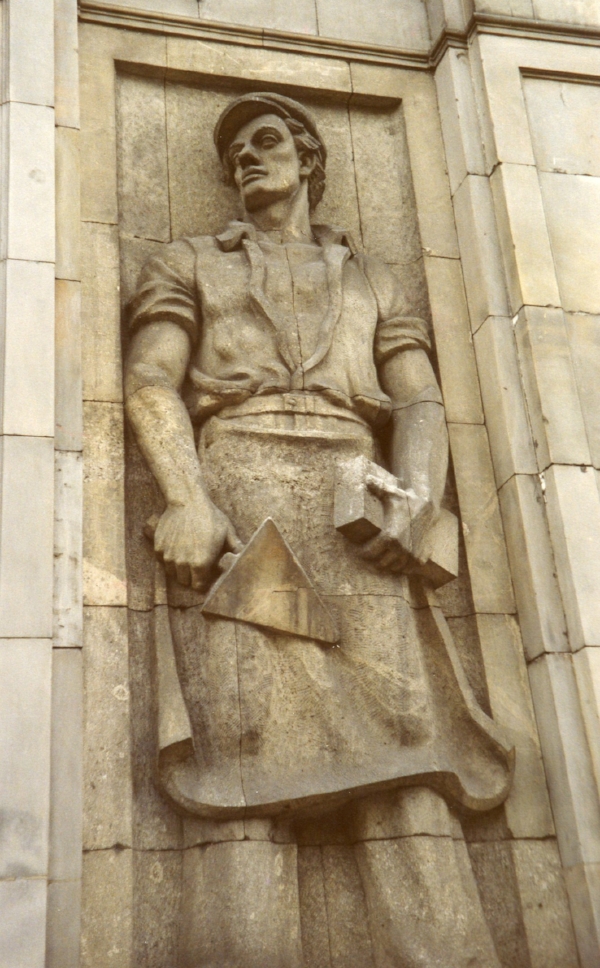
Marszalkowska 1, Warsaw, September 1988  © Andrew Stuttaford

Twentieth-century totalitarian art did not just gild the cage; it helped to build it. Paintings, movies, sculpture, architecture and festivals of choreographed joy were vital elements in the Nazi and Communist attempts to remake man. It is key to our understanding of the nightmare states that resulted, argues Igor Golomstock, and deserves to be classified as a distinctive artistic genre alongside Modernism, of which it was both byway and heir. Like Modernism, totalitarian art was intended to help sweep away what had gone before, but unlike Modernism it was prepared to steal from the past to do so. The style of the 19th-century "bourgeois" academy was thus conscripted into the service of Reich and eventually revolution, as hallmark, teacher and, to us, cliché.

In his newly updated (it was first published in 1990) "Totalitarian Art in the Soviet Union, the Third Reich, Fascist Italy and the People's Republic of China," Mr. Golomstock convincingly demonstrates how the overlapping aesthetic values of these superficially disparate regimes underlined how much they had in common. This was never clearer than at the Paris exhibition of 1937.  In an unsettling preview of the Molotov-Ribbentrop pact, the Eiffel Tower found itself squeezed between massive Nazi and Soviet pavilions. Conceived as fusions of sculpture and architecture, both were expressions of brute power that played Neanderthal tribute to ancient Rome and were guarded by giant images, of the master race on the one hand, the master class on the other.

The strongest sections of the book concern the Soviet Union, as one might expect from an author whose career included membership in the Union of Soviet Artists and direct encounters with Stalinist brutality. Mr. Golomstock's father was sent to the camps in 1934, and then, some years later, his mother, taking the young Igor with her, signed up to work as a doctor at Kolyma, one of the worst of the Gulag's outposts.

Mr. Golomstock tracks the way that the smash-it-all-up trial-and-error of late imperial Russia's avant-garde (experiments that were paralleled, revealingly enough, by Italy's proto-fascist Futurists) initially meshed with the ecstatic starting-from-scratch of the Bolshevik revolutionary intelligentsia.

The extraordinary artistic innovation of the early Soviet years was rapidly replaced, however, by the stodgy conservatism of high Stalinist culture. The revolutionary past was sanitized, then mythologized. The hardscrabble present was transformed into a time of abundance by what Mr. Golomstock marvelously calls the "magic mirror" of Socialist Realism. The didactic, neo-Victorian paintings, the monumental if clumsily neoclassical architecture and, after 1941, the numerous evocations of martial valor and national pride, were all manifestations of an ersatz traditionalism that resonated with a people exhausted by decades of upheaval and were, of course, perfectly suited to the maintenance of a tightly controlled, rigidly hierarchical new order.

That said, for all Mr. Golomstock's experience and erudition, he falls some way short of conveying the ambition, allure and, well, totality of totalitarianism's cultural projects. While his examination of Nazi art takes useful detours away from the time-worn trudge through lumpen Arcadias and leaden Valhallas to include discussion of the centralized (Soviet-style) control of artistic production, he devotes relatively little space to the party's sometimes brilliant manipulation of design, its use of spectacle—Albert Speer's cathedrals of light—or, even, the films of Leni Riefenstahl. The whole picture never quite comes into view, and it was the whole picture that was the point.

It is no less frustrating that Mr. Golomstock allocates such a small portion of his book to China, the third of the 20th century's great totalitarian empires—particularly as he does find room for an addendum on Saddam Hussein's Iraq, a revoltingly bloody but basically traditional despotism that left little behind it of artistic interest to anyone other than connoisseurs of peculiarly servile kitsch. By contrast, as Mao's Cultural Revolution gathered pace from 1966 on, the mounting political hysteria was reflected, channeled and amplified in and by the arts in ways still terrifying today.

There were the dazibao, the giant-lettered, largely hand-made "big character" wall posters that signaled its beginning. There was the hectoring banality of revolutionary opera. And there were the images—sometimes reproduced in their millions—that both drew upon Socialist Realism and transcended it, a process that culminated in the depiction of Mao as essentially divine. As a demonstration of the fundamentally religious nature of communism, the deification of the Great Helmsman is hard to beat, and it represents the logical conclusion of totalitarian art. Unfortunately, you won't find any direct reference to it in Mr. Golomstock's fascinating, painstaking but ultimately incomplete book.