Jokers You Can Sing Along With

Monty Python

The New York Sun, March 18, 2005

Monty Python.jpg

More than 30 years after its final, Cleese-less season limped to its cheerless end, the buzz surrounding "Spamalot" is yet another reminder that Monty Python is far from dead, deceased, shagged out, stunned, or even resting. For more than three decades, that dodgy old circus has flown on, soared even, through an astonishingly successful afterlife that has included movies, books, albums, documentaries, critical acclaim, condemnation by religious fundamentalists, spin-offs, the occasional reunion, a performance in the Hollywood Bowl, earnest academic analysis, a litigation victory over ABC, cult status on both sides of the Atlantic, and now a debut on Broadway. That's not bad for a show that premiered on the BBC at 10:55 p.m. on a Sunday night in 1969, immediately after a broadcast of theological commentary by Malcolm Muggeridge.

But this Monty Python, squire, this flying circus, what was, well, it like? Looking back now at some of the earliest episodes, it's striking to see how much Python was a creature of its time and of its place. It was often inspired, occasionally pedestrian, sometimes sublime, and all too frequently silly, very silly, but never quite so "completely different" as it so smugly liked to announce.

It was, really, a typically English show, filled with more bobbies, vicars, colonels, tweedy eccentrics and class consciousness than a Sunday night on PBS - Miss Marple with laughs, something that may help account for its remarkable success in America. Those bobbies, vicars, colonels, suburban accountants, and bowler-hatted stockbrokers who accompanied them were all archetypes of a gentle, genteel, fading country still caught in a way of life that had managed to survive the onslaught of the Third Reich and linger on into the 1960s, but would finally be buried by the unlikely combination of the Beatles, Mrs. Thatcher, and the Labour Party.

Even the contributions of Terry Gilliam, the Pythons' lone American - the weirdly gifted illustrator, cartoonist, and designer (I don't know the appropriate word to describe this polymath), who was later to make a career out of filming visually striking, but interminably dull, movies - were, like the artwork of "Sergeant Pepper's," the retro schmatta sold in Carnaby Street's Lord Kitchener's Valet and so much else of the pop culture of swinging London, steeped in nostalgia for the high summer of Britain's late Victorian and Edwardian heyday. This era was long remembered in England, fondly if not altogether accurately, as the last truly good time, a sun-speckled Arcadia lost to the dark horrors of the 20th century.

Likewise, the delirious, delightful sense of the absurd that permeated Python had deep roots in an English tradition of whimsy that stretches back to Lewis Carroll, Edward Lear, and beyond. Even the show's frequent descents into violence - those interludes of hacking, chopping, and blood so playfully mixed into the fun - will be nothing too new to anyone who remembers what young Alice witnessed in the course of her more disturbing adventures in Wonderland:

The players all played at once without waiting for turns, quarrelling all the while, and fighting for the hedgehogs; and in a very short time the Queen was in a furious passion, and went stamping about, and shouting "Off with his head!' or 'Off with her head!" about once in a minute. Alice began to feel very uneasy: to be sure, she had not as yet had any dispute with the Queen, but she knew that it might happen any minute, 'and then,' thought she, 'what would become of me? They're dreadfully fond of beheading people here; the great wonder is, that there's any one left alive!'

Closer to the Python era, the unsettled and unsettling nature of the postwar years meant that surreal, absurdist humor found a mass audience amongst Brits, most notably with the "Goon Show," an anarchic, and (to me) painfully unfunny, radio comedy that has the dubious distinction of being beloved by the (to everyone) painfully unfunny Prince Charles.

When former Goon Spike Milligan emerged long enough from manic depression to produce the oddball, chaotic, wildly entertaining, wildly hit-and miss "Q5" for television earlier in that annus mirabilis of 1969, the proto-Pythons were appalled. Milligan's madcap stream-of-consciousness comedy, sketches without structured beginning or formal conclusion was exactly what they had been planning to do. Milligan, it appeared, was Neil Armstrong and they were Buzz Who.

The Pythons' response was to use Terry Gilliam's animation as (to quote Eric Idle) "the link thing." It was a stroke of genius. Mr. Gilliam's artwork gave their new show a look that was distinctively its own, and, more importantly, gave it the illusion of structure. It made Monty Python accessible in a way that "Q5" never was.

We should not be surprised that the Gilliam gambit worked so well. The Pythons may have been intellectual (self-consciously so - who else would, or could, have included a nudge, nudge, aside about Charlotte Corday and Jean-Paul Marat in the middle of a television sketch?), innovative, and inspired. But they were also industry professionals, clever Oxford and Cambridge boys who had already used talent, connections, and very shrewd networking to build television careers that even before Monty Python were remarkable for their success and their precocity.

It was, perhaps, always inevitable that their television show would burn itself out so soon. For a brief, shining moment, six extraordinary, talented individuals took advantage of the extraordinary, experimental 1960s to give birth to a marvel. Then the moment passed. With the exception of the wise and wonderful "Life of Brian," a film even more relevant today, the Python movies never really recaptured the original magic. It was time to move on. Ever showbiz savvy, the Pythons finally did just that.

There have been other highlights - most notably John Cleese's terrific reworking of the sitcom (a genre the Pythons once looked down upon) in "Fawlty Towers" and Michael Palin's lovely, nostalgic return to that long Victorian summer in both "American Friends" and "The Missionary," but, for the most part, the Pythons' solo efforts have fallen far short of what the ensemble once achieved together, a fitting enough fate for a team once known as the Beatles of comedy.

But like the best of the Beatles, that old Flying Circus will continue to delight, even if it does not resonate now in quite the same way it once did. Devoted audiences will still cherish those sacred scripts, keep dead parrots alive, and gleefully sing along to songs of Spam, lumberjacks, and the bright side of life. Monty Python, meet Gilbert and Sullivan.

Global Warning

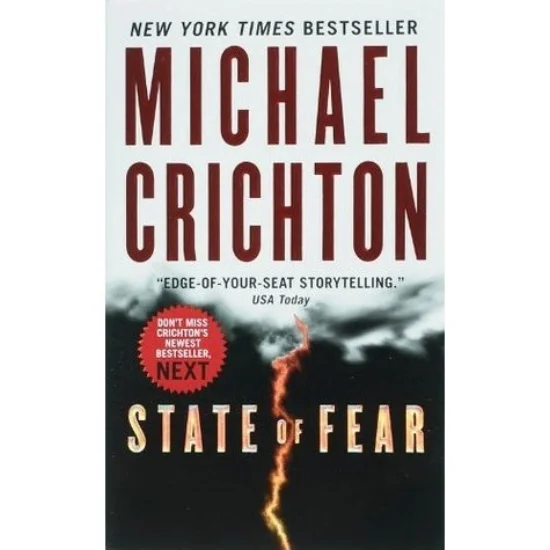
Michael Crichton: State of Fear

crichton.jpg

If you want to see what an apoplectic fit looks like in print, check out Michiko Kakutani’s review/denunciation in the New York Times of State of Fear, the latest book from Michael Crichton. Crichton is the author of Jurassic Park, Disclosure, The Andromeda Strain, and much more (or, in the case of Prey, less); in State of Fear he dares to challenge the numbskull pieties of “global warming” and that has made Michiko very mad indeed. State of Fear is, she writes, “shrill,” “preposterous,” and, horror of horrors, “right-wing.”

So many angry, foam-flecked adjectives jostle for attention in the text of Kakutani’s padded-cell philippic (I’d use the words “shrill” and “preposterous,” but she got there first) that the fastidious will want to mop the page for spittle before reading. Crichton’s book is, she sneers, “ham-handed”; the plot of this “sorry excuse for a thriller” is “ludicrous,” its disquisitions “talky,” its facts “cherry-picked,” its assertions “dogmatic,” and its efforts to make a case “lumbering.” Still, at least she spared Crichton contemporary culture’s most fashionable insult, that irrevocably staining mark of Cain, that deepest red of all scarlet letters, that other N-word. The Los Angeles Times does not; according to its reviewer, Crichton has written “the first neocon novel.” Ouch.

At this point, wiser, calmer readers will suspect that a book that attracts that sort of condemnation in the pages of the New York Times and the Los Angeles Times (reassuringly, The New Yorker didn’t like it either) must be really, really good. The wiser, calmer readers will be right. It is.

Crichton has, unsurprisingly, chosen to incorporate his message into the medium he knows best, the thriller, but what is surprising is that this latest effort is packed with graphs, scientific discussion, footnotes, a manifesto, and an extensive bibliography: not usually the stuff of popular fiction. And, remarkably, the whole package — all 600 pages of it — succeeds. State of Fear is a good, solid, exciting read, and if the writing is occasionally wooden, it is so in the finest, somewhat flat tradition of Ludlum, Turow, and the other bards of the airport bookstore.

State of Fear is a didactic work, but its author has not neglected the conventions of his genre: Men are men, women are hot (it’s the planet that’s not), and deaths are excruciating. Bullets fly, cars crash, poisonous octopi do their worst, hideous catastrophe looms, and, the last surviving fans of the late H. Rider Haggard will be delighted to know, cannibals make an appearance. Cannibals! And not effete Lecters either, but real honest-to-goodness, traditional missionary-in-the-pot anthropophagi, who know that fresh flesh needs neither sips of Chianti nor fava-bean frippery to make it something truly tasty.

But all those daunting graphs and lurking footnotes are a reminder that, populist format or not, Crichton is making a serious point about the dead and dangerous end that modern “environmentalism” has reached. In the hands of contemporary Greens, it no longer has much to do with brains, or, at least, reason. Protecting our planet has, he argues, degenerated into a religion — a matter of faith, not science.

The frenzied response to State of Fear proves his point. Crichton’s arguments have not been treated as a contribution to a legitimate debate, but as blasphemy. Yet if this is an urgent, insistent, sometimes overstated book, it’s because Crichton cares so much about the environment, not so little. Who with any brains does not?

Yes, Crichton raises the rhetorical stakes very high, but the real stakes are even higher. If the prescriptions of the Kyoto Treaty are followed, the cost could run into hundreds of billions of dollars a year, a cost that, if history is any indication, will be disproportionately borne by the world’s poor. Under the circumstances, the science that backs it had better be rock solid. Crichton argues that it is not.

To take just a sample of the intriguing data that turn up in this book, the melting of Antarctica is confined to just one relatively small peninsula. The continent as a whole is getting colder, its ice thicker. At the other end of the planet, Greenland too is chilling up, while here at home, the temperature in the United States is roughly where it was in the 1930s, there has been no increase in extreme weather, and changes in upper-atmospheric temperature have been far smaller than most global-warming models would suggest.

Those are some cherries, Ms. Kakutani.

In her disdain for inconvenient, ornery facts, however, Kakutani is sadly typical. While there are those in the Kyoto crowd who have genuine, and carefully thought-through, scientific concern about the fate of the Earth, the motivation of the many who shout so loudly and so dogmatically about the perils of global warming frequently owes less to logic than to neurosis, misplaced religious faith, and, often, the characteristic dishonesty of a Left looking for yet another stick with which to beat both Western civilization and those wicked, dirty capitalists.

And then there’s something else: greed. One of the more entertaining aspects of Crichton’s tale is that the clever, conniving, white-collar villains, regular thriller fare of course, are not the standard corporate swine. No, in this book they are environmentalists acting from exactly the sort of motives more usually attributed to the bad boys from the boardroom than to the saints from the NGOs. In State of Fear, the Gekkos are Green. They are caricatures, but Crichton is making a fair point: Big Environment is a big, big business, “a great fundraising and media machine — a multi-billion industry in its own right — with its own private agenda that’s not necessarily in the public interest,” and like any big business it comes complete with temptations, timeservers, fat paychecks, fatter payrolls, and a legion of lawyers trying to make a fast buck.

This combination of false gods and real mammon has replaced the hard science of global warming with scaremongering, publicity stunts (both have a key part to play in State of Fear), and relentless pressure, political and otherwise, to sign up for the new orthodoxy. The problem for its believers, however, is that it’s an orthodoxy that the facts do not support. In reality, the facts, such as they are, do not support any orthodoxy. There aren’t enough of them, and those that exist often appear to contradict one another. The hard science of global warming is, as Crichton explains, well, hard; the data are far from reliable, and there are so many variables that, even for today’s computers, the value of most climate-prediction models lies somewhere between a bookie’s tip and a crystal ball.

Crichton has his own theories as to what is going on (very roughly: mild warming, possibly purely natural, perhaps associated with the heat islands of urban development, or maybe both), but he is at pains to describe these as guesses, a humility that would be equally welcome among those who would base their highly interventionist environmental policy on little more than hysteria and a hunch — something, I suspect, that helps explain their reluctance to see their version of the truth subjected to serious intellectual criticism.

For matters to improve, Joe Friday science, freed from agendas, has to return to the center of the investigation of global warming. How mankind responds to those facts, once discovered, is a legitimate topic for political controversy and debate. Trying to establish what they are should not be. If Michael Crichton can push thinking even a little way in this direction, he will have written a very good book indeed.

Constitutionally Indisposed

National Review Online, February 22, 2005

Giscard.jpg

A little over two centuries ago, a small group of planters, landowners, merchants, and lawyers met in Philadelphia to decide how their new country was to be run. Within four months this remarkable collection of patriots, veterans, pragmatists, geniuses, oddballs and the inspired succeeded in agreeing the extraordinary, beautiful document that, even with its flaws, was to form the basis of the most successful nation in history.

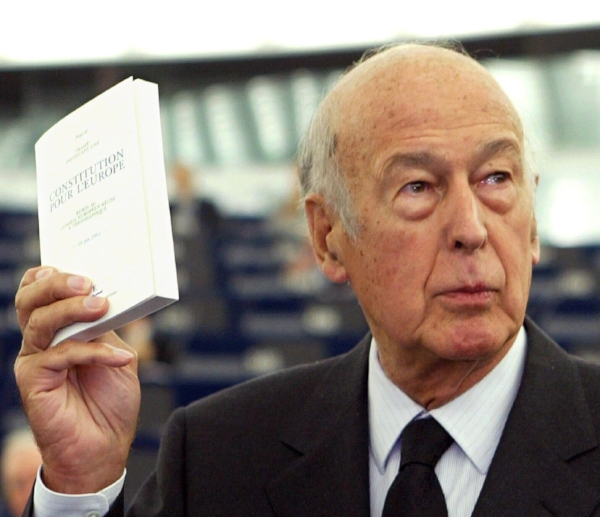
On February 28, 2002, another constitutional convention began its work, in Brussels this time, not Philadelphia. Its task was to draw up a constitution for the European Union. The gathering in Brussels was chaired by Giscard D'Estaing, no Hamilton or Madison, but a failed, one-term president of France best known for his unseemly involvement with Jean-Bedel Bokassa, the cannibal "emperor" of central Africa. Giscard's convention was packed with placemen, cronies, creeps, and has-beens to make up a body where to be called second rate would have been an act of grotesque flattery. Only a fool, a braggart, or a madman would have compared this rabble with the gathering in Philadelphia. Needless to say, Giscard managed to do just that. The rabble returned the compliment. At ceremonies held to celebrate the conclusion of the convention's work, one over-excited Austrian delegate compared Giscard to Socrates, a remark that would undoubtedly have reduced that ancient, and unfortunate, Greek to yet another swig of hemlock.

Once the convention had completed the draft constitution, there was further haggling over the text by the governments of the EU member states. A final version was agreed in June 2004, and what a sorry, shabby work it is, an unreadable mish-mash of political correctness, micromanagement, bureaucratic jargon, artful ambiguity, deliberate obscurity, and stunning banality that somehow limps its way through some 500 pages with highlights that include "guaranteeing" (Article II-74) a right to "vocational and continuing training," "respect" (Article II-85) for the "rights of the elderly... to participate in social and cultural life," and the information (Article III-121) that "animals are sentient beings." On the status of spiders, beetles, and lice there is, unusually, only silence.

All that now remains is for this tawdry ragbag to be ratified in each member state, a process that is already well underway. In some countries ratification will depend on a parliamentary vote, in others a referendum. The final outcome remains difficult to predict, and it is a measure of the current uncertainty over the constitution's ultimate fate that there is now open discussion of the idea that the document may be forced through even without ratification by one or two of the smaller countries. In an editorial over the weekend, the Financial Times, a generally reliable mouthpiece for the latest Brussels's orthodoxy explained, "in theory, one state's rejection is enough to kill [the constitution]. In practice, it will depend on the state." Within the EU, it seems, some nations are more equal than others. Rejection by one of the union's larger members, however, will be enough to throw the whole process into richly deserved chaos. We can only hope.

And it is at this point that, rather surprisingly, the Bush administration has come into the picture. Speaking a few days ago to the Financial Times, Condoleezza Rice appeared, weirdly, to give the constitution some form of endorsement: "As Europe unifies further and has a common foreign policy—I understand what is going to happen with the constitution and that there will be unification, in effect, under a foreign minister—I think that also will be a very good development. We have to keep reminding everybody that there is not any conflict between a European identity and a transatlantic identity..."

In a later interview with the Daily Telegraph, President Bush himself appeared to steer discussion away from the proposed constitution, but he did have this to say: "I have always been fascinated to see how the British culture and the French culture and the sovereignty of nations can be integrated into a larger whole in a modern era," he said. "And progress is being made and I am hopeful it works because one should not fear a strong partner."

How can I put this nicely? Well, there is no way to put it nicely. Even allowing for the necessity to come out with diplomatically ingratiating remarks ahead of a major presidential visit to the EU, the comments from Bush and Rice are either delightfully insincere or dismayingly naïve.

The project of a federal EU has long been driven, at least in part, by a profound, and remarkably virulent anti-Americanism, with deep roots in Vichy-era disdain for the sinister "Anglo-Saxons" and their supposedly greedy and degenerate culture. Throw in the poisonous legacy of soixante-huitard radicalism, then add Europe's traditional suspicion of the free market, and it's easy to see how relations between Brussels and Washington were always going to be troubled. What's more, the creation of a large and powerful fortress Europe offered its politicians something else, the chance to return to the fun and games of great power politics.

They have jumped at the opportunity. Speaking back in 2001, some time before 9/11 and the bitter dispute over Iraq, Swedish Prime Minister Göran Persson (who then also held the EU's rotating presidency) provided a perfect example of the paranoia and ambition that underpins this European dream. The EU was, he claimed "one of the few institutions we can develop as a balance to U.S. world domination."

Brandishing the American bogeyman was always inevitable. Condoleezza Rice may claim to have discovered a European "identity," but outside the palaces, parliaments, and plotting of the continent's politicians such an identity is a frail, feeble, synthetic thing. The preamble to the EU constitution refers to a Europe "reunited after bitter experiences," a phrase so bogus that it would embarrass Dan Brown. Unless I missed something in my history classes "Europe" has never been one whole. There is nothing to reunite. A Swede, even Göran Persson, is a Swede long before he is a "European." Naturally, the framers of the constitution have done their best to furnish a few gimcrack symbols of their new Europe (there's (Article I-8) a flag, a motto ("United in Diversity), an anthem, and, shrewdly in a continent that likes its vacations, a public holiday ("Europe Day") and perhaps in time these will come to mean something, but for now they are poor substitutes for that emotional, almost tribal, idea of belonging that is core to an authentic sense of national identity.

But if the EU has had only limited success in persuading its citizens what they are, it has done considerably better in convincing them as to what they are not: Americans. Writing in 2002 about the "first stirrings" of EU patriotism, EU Commissioner Chris Patten could only come up with two examples: "You can already feel [it], perhaps, in the shared indignation at US steel protection...You can feel it at the Ryder Cup, too." It's significant that when Patten gave examples of this supposed European spirit, he could only define it by what it was against (American tariffs and American golfers) rather than by what it was for. It is even more striking that in both cases the "enemy" comes from one place—the U.S. If Patten had been writing in 2005 he would, doubtless, have added opposition to the war in Iraq to his list—and he would have been right to do so.

This is psychologically astute: The creation of a common foe (imagined or real) is a good way to unify a nation, even, possibly, a bureaucratically constructed "nation" like the EU. Choosing the U.S. as the designated rival comes with two other advantages. It fits in nicely with the existing anti-American bias of much of the EU's ruling class and it will strike a chord with those many ordinary Europeans who are genuinely skeptical about America, its ambitions and, yes, what it stands for.

Insofar, therefore, as it represents another step forward in the deeper integration of the EU, the ratification of the constitution cannot possibly, whatever Secretary Rice might say, be good news for the U.S. How deep this integration will be remains a matter of dispute. In Euro-skeptic Britain, Tony Blair's government has denied that the document has much significance at all, but without much success. At the same time, claims that the ratification of the EU constitution will of itself represent the creation of a European superstate are overblown. It won't, but it will be another step in that direction, and, based on past precedent, we can be sure that the EU's fonctionnaires will use the vacuum created by all those helpful ambiguities in the constitution's text to push forward the federalizing project as fast and as far as possible.

It is, of course, up to Europeans to decide if this is what they want. Any attempt by the Bush White House to derail the ratification process would backfire, but that does not mean that the administration should be actively signaling its support for this dreadful and damaging document. Secretary Rice argues that the integration represented by the passing of the constitution would be a "good development." The opposite is true. If the EU (which has a collective agenda primarily set by France and Germany) does increasingly speak with one voice, Washington is unlikely to enjoy what it hears.

The constitution paves the way for the transfer of increasing amounts of defense and diplomatic activity from Europe's national capitals to Brussels. Article 1-16 commits all member states to a "common foreign and security policy." "Member states" are required to "actively and unreservedly support the Union's common foreign and security policy in a spirit of loyalty and mutual solidarity and shall comply with the Union's actions in this area. They shall refrain from action contrary to the Union's interests or likely to impair its effectiveness." In a recent radio interview, Spanish prime minister Jose Zapatero explained how this might work: "we will undoubtedly see European embassies in the world, not ones from each country, with European diplomats and a European foreign service...we will see Europe with a single voice in security matters. We will have a single European voice within NATO."

And the more that the EU speaks with that one voice, the less will be heard from those of its member states more inclined to be sympathetic to America. And as to what this would mean, well, French Green politician Noel Mamère put it best in the course of an interview last week: "The good thing about the European constitution is that with it the United Kingdom will not be able to support the United States in a future Iraq."

And would that, Secretary Rice, be a "good development"?

A Strangely Important Figure

Jeff Britting: Ayn Rand

The New York Sun, January 26, 2005

Ayn Rand.jpg

To call Ayn Rand, the high priestess of the human will, a mere force of nature would to her have been an insult as well as a cliche. But how else to describe this extraordinary, maddening, and indestructible individual? Born a century ago this year into the flourishing bourgeoisie of glittering, doomed St. Petersburg, Alisa Zinovyevna Rosenbaum was to triumph over revolution, civil war, Lenin's dictatorship, an impoverished immigrant existence, and bad reviews in the New York Times to become a strangely important figure in the history of American ideas. Even the smaller details of Rand's life come with the sort of epic implausibility found in - oh, an Ayn Rand novel. On her first day of looking for work in Hollywood, who gives her a lift in his car? Cecil B. DeMille. Of course he does. Frank Lloyd Wright designs a house for her. Years later, when she's famous, the sage of selfishness, ensconced in her Murray Hill eyrie, a young fellow by the name of Alan Greenspan becomes a member of the slightly creepy set that sits at the great woman's feet. Apparently he went on to achieve some prominence in later life.

To Rand, none of this would really have mattered (well, the fame was nice). To her, an intensely Russian intellectual despite everything, it was ideas that counted. They were everything. When, after nearly 50 years, her beloved long-lost youngest sister, Nora, made it over from the USSR, they promptly fell out - over politics, naturally. Poor Nora was on her way within six weeks, back to the doubtless more easygoing embrace of Leonid Brezhnev.

Scarred by her Soviet experiences, Rand was a woman on a mission. She couldn't stop: not for her sister, not for anyone. She had plenty to say, and she said it - again, and again, and again. She wrote, she lectured, she hectored, she harangued. Words flowed, how they flowed, too much sometimes, too insistent often, but infinitely preferable to the silence of the Soviet Union that she had left behind.

And somehow her work has endured in the country she made her own. Her creed of ego and laissez-faire, and the reception it won, was one of the more interesting - and encouraging - cultural phenomena of mid-20th-century America. It has persisted, lasting longer, even, than the vast, daunting paragraphs that mark her prose style. Just over a decade ago, "Atlas Shrugged" (1957) was voted Americans' most influential novel in a joint poll conducted by the Book-of-the-Month club and the Library of Congress.

Hers is a remarkable story, and I find it curious that one of the only publications being brought out to commemorate the 100th-birthday girl - besides new printings of the novels by Plume - is Jeff Britting's new, very very brief account (Overlook Duckworth, 144 pages, $19.95). The latest in the series of Overlook Illustrated Lives, it's too short to do Rand much justice; any reader already familiar with Rand's life won't learn much.

Biographies in this series are intended as overviews rather than something more comprehensive. The author is an archivist at the Ayn Rand institute, the associate producer of an Oscar-nominated documentary about Rand, and obviously a keeper of the flame. Thus Mr. Britting has little to say about the romantic entanglements, more Peyton Place than Galt's Gulch, that devastated Rand's circle in later years.

Most notably, Rand had an affair with her chosen intellectual heir, Nathaniel Brandon. While both Rand's husband and the wife of the intellectual heir agreed (sort of) to this arrangement, it added further emotional complications to what was, given Rand's prominence, a surprisingly hermetic, claustrophobic little world, one best described in "The Passion of Ayn Rand" (Bantam Dell) - the compelling, and sympathetic, biography of Rand written by, yes, the intellectual heir's ex-wife.

As I said, Peyton Place.

Closed, neurotic environments filled with true believers are the hallmark of a cult, and there's a good case to be made that that's exactly what Rand was running. Take a look at the way in which she treated her acolytes: angry excommunications, overbearing diktats, dramatic interventions, and, disappointing in one who preached self-determination, rather too much Führerprinzip.

The cult-or-not controversy goes unmentioned in Mr. Britting's book. What a reader will find, particularly in the excellent selection of illustrations, is a real sense of how Rand's life related to her novels. One glance at her Hollywood-handsome husband, and the rugged succession of steely supermen who dominate her fiction make more sense ("All my heroes will always be reflections of Frank").

Rand herself, alas, was no beauty; her glorious heroines, ridiculously gorgeous, impossibly named, remarkably lithe, are less the template for - as some allege - a sinister eugenic agenda than the stuff of Ayn's randy dreams garnished with a dollop of Art Deco kitsch. The first, extraordinarily violent, coupling in "The Fountainhead" of Howard Roark with Dominique Francon is not a general prescription for the relationship between the sexes but merely Rand's own erotic fantasy ("wishful thinking," she once announced, to the cheers of a delighted crowd).

Likewise, her sometimes overwrought style is no more than - well, judge this sentence from "Atlas Shrugged" for yourself: "She looked at the lone straight shaft of the Taggart Building rising in the distance - and then she thought she understood: these people hated Jim because they envied him." Call Dr. Freud.

If sex in Rand's fiction can be savage, so is argument. Her sagas deal in moral absolutes, her protagonists are the whitest of knights or the blackest of villains, caricatures of good or evil lacking the shadings of gray that make literature, and life, so interesting. Yet "Atlas Shrugged" and "The Fountainhead," at least, have a wild, lunatic verve that sweeps all before them. Like Busby Berkeley, the Chrysler Building, or a Caddy with fins, they are aesthetic disasters, very American aesthetic disasters, which somehow emerge as something rather grand.

There is plenty in Rand to make a modern reader queasy, though you would not know so from Mr. Britting's worshipful text. For example, there is something to the claim that like so many of the intellectuals, left or right, of her time she succumbed to the cruder forms of social Darwinism. For a woman who worshiped man, Rand did not always seem that fond of mankind.

But the accusation by Whittaker Chambers in National Review that there was a whiff of the gas chamber about her writings is wrong. Rand lived in an era of stark ideological choices; to argue in muted, reasonable tones was to lose the debate. As a graduate of Lenin's Russia, she knew that the stakes were high, and how effective good propaganda could be.

Rand's nonfiction may have a greater claim to intellectual respectability, but it was the lurid, occasionally harsh, simplicities of her novels that would deliver her message to the mass audience she believed was out there. She was right. Her key insight was to realize that there was an appetite among Americans for a moral case for capitalism. In a restless age that believed in the Big Answer, neither historical tradition nor utilitarian notions of efficiency would suffice. Ayn Rand gave Americans that case, perhaps not the best case, but a case, and she knew how to sell it.

The establishment always disapproved. Critics sneered. Academics jeered. The publishers Macmillan turned down "Anthem" (1938), saying that Rand, a refugee from the Soviet Union, "did not understand socialism." Oh, but she did, and so did those millions of Americans who bought her books, books that played their part in ensuring that the dull orthodoxies of collectivism never prevailed here.

The last image in Mr. Britting's biography is of an exultant Rand speaking at a conference in New Orleans in 1981, the final public appearance of this magnificent, brilliant oddball. Her hosts tried to lure her there with the promise of payment in gold coins and travel in a private rail car.

Needless to say, she accepted.

Waving The Bloody Shirt

National Review OnlineJanuary 18, 2005

Prince Harry.jpg

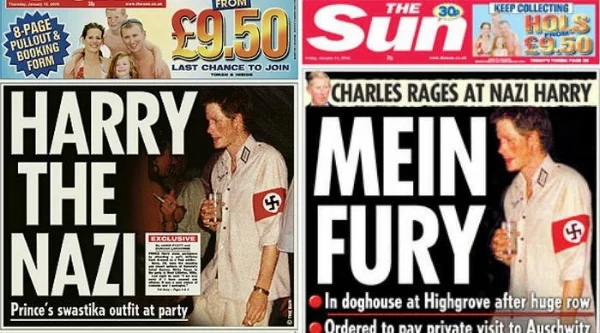
Gott im Himmel, what was Harry thinking? If you are a public figure, the great grandson of the last emperor of India no less, and you live in censorious—and camera-phone-saturated—times, attending a "Native and Colonial" party is almost certainly unwise. To do so in Nazi uniform is absolute madness. And after days of high drama, low farce, and massed denunciations, we all know the result. The "Clown Prince" and the Circus

To take just a brief selection of the criticism, Harry is now the "Hitler Youth" (the Sun, a newspaper that dilutes its moments of moral indignation with bouts of manic punning), "the most tasteless fool in the country" (London Times), and "an idiot" (Independent). Perhaps more worrying for the "clown prince" (Sun, again), the principal prominenti to rally to his support were David Irving (a historian often accused of Holocaust revisionism), a disgraced Tory MP, and Fergie.

It would have done nothing for the Night Porter, but Harry's has been the shirt seen 'round the world, the mother of all wardrobe malfunctions, a poor, sad scrap of bad taste, a feeble facsimile of an Afrika Korps tunic, garnished with a swastika armband, a touch that the late Field Marshal Erwin Rommel would, I suspect, have found somewhat vulgar.

And yes, it was a dumb, dumb thing to do. Stupid rather than malicious, but, particularly given Harry's status, it was clearly inappropriate—and genuinely offensive to many. Quite rightly, the prince was quick to issue an apology. That should have been an end to the matter. That it was not says plenty about modern Britain and contemporary Europe, little of it good.

To be sure, the British press was always going to keep the story alive for as long as it could. Royal scandals shift newspapers, and so do the Nazis. Combining the two was a circulation manager's dream. Even allowing for this, however, the torrent of humbug, hypocrisy, and hysteria that has engulfed the hapless Harry has been remarkable and, in some ways, rather more repellent than the wretched regalia that sparked the uproar in the first place. It also ignores the fact, critical to understanding this incident, that for many Brits, the Nazis have long been good for a laugh.

Now, Harry is not, by most accounts, much of an intellectual, so to claim that his brown-shirted burlesque was somehow a deliberate Producers-style satire is a stretch too far. At the same time, his dreadful choice of costume, however dimly, however unconsciously, reflected a national fondness for making a mockery of the pretensions of the Third Reich. On occasion this can be tasteless, but ridicule is not a bad way to strip the swastika of some of its malign power. The failure of neo-fascists ever to make much progress in the U.K. (unlike in some other European countries) can at least partly be put down to the fact that voters have been too busy laughing to take them very seriously.

Some press comment in Britain did allude to this tradition, but a good number of journalists took the chance to indulge in royal-bashing and class warfare. It was a wonderful opportunity to give the toffs a good kicking, while appearing to remain on the moral high ground. The Guardian is usually a good source for this sort of thing. It didn't disappoint. To take just a quick dip into the venom, we find John O'Farrell frantic and foaming over "pro-hunting upper-class twits," sly hints from Mark Lawson that the evil Tories are far more likely to dress up in Nazi uniform than their political opponents and a reminder from Duncan Campbell that Edward VIII had "admired what Hitler was doing in Germany."

In Germany itself, reactions were no less vitriolic, and, reflecting exasperation at the U.K.'s endless, and frequently crass, obsession with the Second World War, included some Brit-bashing for added flavor. The most weirdly entertaining response, however, came from a commentator in the mass-circulation Bild who scribbled this message to Harry. "You are...about as disgusting as a moldy piece of food. I vomit. It is high time that you were given serious medical treatment. You are a traumatized child."

Getting it exactly wrong, meanwhile, Der Spiegel described the uniform of the Afrika Korps as being "hated" in the U.K. because of British casualties in the desert war. In fact, the reverse is true. The soldiers of Rommel's army have traditionally been seen as the "good" Germans, worthy opponents beaten in a fair fight. If, as was apparently nearly the case, Harry had opted, God help us, for a SS uniform, the row would have been far, far worse.

Adding to the frenzy, and showing that, even now, after nearly six decades of democratic government, they do not fully understand the occasionally uncomfortable realities of free speech, some German politicians used Harry's gaffe to lobby for a Europe-wide ban on the display of Nazi symbols. Such a ban would be a mistake on a number of grounds, but it is interesting to see that there was no suggestion that it should also cover Communist insignia. Why not? Do the tens of millions who died under the hammer and sickle count for any less than those butchered by the Hitler regime? To look at this point another way, ask yourself if there would have been such uproar if Harry had come dressed as a Stalin-era commissar or clutching Mao's Little Red Book. You know the answer.

As if that level of hypocrisy was not enough, it seems that even some fascists, real ones, may be regarded as less of a scandal than the wayward Windsor. Le Monde has reportedly suggested that the furor over Harry may hit London's chances of winning the right to host the 2012 Olympics over rivals such as Paris, the capital of a country where some15 percent of voters regularly give their support to the National Front, a party headed by a man who has described the Holocaust as a "detail."

More ominously still, this wave of indignation over a spoiled and irrelevant young prince makes a revealing contrast with Europe's supine response to Islamic extremists, the brownshirts of our own era. But, perhaps we should not be surprised. How much simpler, and politically more convenient, to condemn one moronic 20-year-old, his unpopular social class, and (internationally) his countrymen, than to confront the real danger to freedom now developing among a section of the EU's Muslim minority. Facing this challenge will be a tricky task not easily reconciled with the multicultural pieties of Europe's ruling establishment, or, arguably, the pockets of anti-Semitism that may lurk within it. Symbolic solidarity with the vanished victims of the past is so, so much less demanding.

Ironically, however, these politics of the empty gesture reached their nadir with the suggestion by the Simon Wiesenthal Center (an organization which should know better) that Harry should be made to attend the commemoration at Auschwitz of the 60th anniversary of the camp's liberation. Such a grotesque stunt, both morbid and meaningless, would have been an insult to those murdered in that terrible place. Thankfully, the idea was rejected.

In this squalid and sorry saga, it was a rare moment of dignity.

The Trouble With Harry

G.P. Taylor: Shadowmancer; Wormwood

National Review, December 30, 2004

Shadowmancer.jpg

FOR those of us who like to believe, however tentatively, in human progress, the notion that there are 21st-century Americans who think that the brave, benign—and fictional—Harry Potter can be used as a recruitment officer for the occult is profoundly depressing. And yet there are surprisingly many who fear just that. For year after year now, different school districts across the country have faced complaints whenever the hero of Hogwarts rides his Nimbus 2000 broomstick onto the curriculum or into the library. But the Lord, or the market, works in mysterious ways and those so harried by the thought of Harry have recently found, well, a savior in the shape of a former policeman and roadie for the Sex Pistols, the Reverend G. P. Taylor, the vicar of Cloughton, a small town in the north of England. He’s the author of two bestselling children’s books (both, like Harry Potter, with a surprisingly strong crossover readership among adults), Shadowmancer and Wormwood, novels of deviltry, danger, and intrigue where the ultimate hero is neither wizard nor witch, but God.

Funnily enough, it was that disreputable Master Potter who prompted the parson to pick up his pen. As Taylor explained in an interview with the Christian Broadcasting Network, he lectures on the occult and the New Age and, during the course of one talk, he was discussing “the dangers of Harry Potter and all that sort of stuff.” At the end of the evening, a woman suggested that he write a book. It was a sign! Within nine months, Taylor had completed Shadowmancer, and after the now-traditional round of rejections (ask Harry Potter’s creator, J. K. Rowling), he published it himself, selling his motorcycle to provide the necessary cash. Word-of-mouth did the rest.

Subsequently, Faber & Faber, a major U.K. publisher, bought the rights to Taylor’s epic, and the rest is history. Shadowmancer spent 15 weeks at the top of the British book charts, and its successor, Wormwood, was also a hit. A Shadowmancer movie is planned and multi-book contracts have been signed on both sides of the Atlantic (the reverend’s writings have also found a large audience in America).

It’s a great story: Taylor’s success makes for an inspirational and possibly miraculous tale. Miraculous? Well, how else to explain that books quite so bad have sold quite so well? Linked chapters in a saga that is (Lord, help us) planned to stretch over many more volumes, Shadowmancer and Wormwood are both set in (to give Taylor his due) a vividly described 18th-century England, a place of squalor, poverty, and oppression, far more Gin Lane than Beer Street. They are an account of two rounds in the eternal battle between the Creator (here called Riathamus, a Latin form of an ancient British word meaning “king of kings”) and You Know Who. The first revolves around the struggle for a sacred relic and—the Reverend Taylor’s psychiatrist can make of this what he will—a wicked vicar’s lust for world domination; the second deals with the coming of a comet that may be the deeply unpleasant “Wormwood” prophesied in one of the Book of Revelation’s gloomier passages.

With such a dramatic background, it’s remarkable that Taylor’s books fail to enthrall; yet somehow they do. The plotting is all over the place, much of the writing is clunky (Iron Maiden meets the Sermon on the Mount) and the ill-defined, but vast, cast of characters and creatures that flit in and out of the narrative will bewilder many of the books’ younger readers—and, trust me, some of the older ones too. Thulak? Seloth? Dunamez? Diakka? Varrigal? Glashan? Life’s too short as it is.

But do Shadowmancer and Wormwood even succeed in fulfilling the spiritual task that Taylor, a devout and obviously sincere man, has set out for them? From these books and numerous interviews that he has given, it’s fairly clear that Taylor wanted to show that the fight against evil must be seen as religious (if not, claims Taylor, necessarily Christian, although his work is filled with Christian imagery). He also set out to deliver the clear message that the occult is far from being a harmless parlor game. It’s no surprise that it’s an angel, not a wizard, who is on hand to help Taylor’s heroes in their adventures, and magic, oh dear, that’s a no-no.

We see this in the middle of one dramatic scene, when Raphah, the young Ethiopian (in a nod to the pieties of multiculturalism, Taylor has boasted that he got “sick of little Harry Potter being a nice little white Anglo-Saxon Protestant”) who is one of the heroes of Shadowmancer, angrily confronts a woman and her faith in the Tarot:

“Do you really believe in the power of those picture cards? There is a far greater law than the one that controls the roll of the dice or the turn of a card . . . each one of you is taken in by what you hear. You’re quick to believe in spirits when it’s really someone banging on the side of the bed. None of you will turn to the one who can truly set you free.”

Fine, but this blunt lecture is a long way from, say, the subtler allegory that is C. S. Lewis’s Narnia, stories written by a man whose Christianity was no less muscular than that of the Reverend Taylor. Other than for those who are already cheering from their pews, the way Taylor punctuates his narrative with sermonettes and preachy nuggets is likely to be more annoying than convincing. In this respect, ironically, he is reminiscent of another best-selling British children’s writer, the gifted but irritating Philip Pullman, whose initially promising His Dark Materials trilogy ultimately dissolved into a dreary atheist rant.

That Taylor dislikes the occult, there’s no doubt. Unfortunately, he sees it not as it is, a conjuring-trick creed of cretins and the credulous, but as something that is genuinely powerful—all too real, and all too dangerous. He’s on the record as believing in ghosts (one of his houses was, he has said, haunted) and has presided over a few exorcisms in his time; earlier, in his wild, and somewhat regretted, youth, he experimented with tarot cards, séances, and Ouija boards.

These beliefs, when linked with Taylor’s violent, lurid, Heavy Metal aesthetic (this vicar puts the Goth in Golgotha), mean that his writing may invest the dark side, even if it always ultimately loses, with rather more seductive force than he may have intended. Here is how the angel Abram describes Hezrin, one of Wormwood’s more sinister demons:

“She is a collector of angels and any other trinket that takes her fancy. I have known her for an eternity, century to century, Paris and Rome, Constantinople and Babylon. The thing with [her] is that she never changes, always those same deep, beautiful eyes that capture the soul—and hands that will tear out your heart.”

Toto, I have a feeling we’re not in Narnia anymore.

What's So Fascinating About Office Politics?

In Good Company

The New York Sun, December, 29, 2004

in-good-company-topher-grace-scarlett-johansson.jpg

In Soviet movies in Stalin's day, peasants sang and factories hummed. In America, by contrast, a country where the economic system has actually delivered the goods, Hollywood's hymns to the glories of office or factory are, with occasional exceptions, either off-key or nonexistent. Just as "Tucker - The Man and His Dream," possibly the finest movie ever made on the American auto industry, was about failure, so films about the American workplace tend to be dyspeptic, depressing, and filled with resentment: Chaplin's "Modern Times" is a parable of alienation, Billy Wilder's "Apartment" becomes a sty for management swine, and no salesman can watch David Mamet's "Glengarry Glen Ross" without drink in hand or razor blade on wrist. As for "The Man in a Gray Flannel Suit" - well, you get the picture.

In fact, with the dubious exception of those creepily contented employees in the current Wal-Mart commercials, the happiest laborers ever seen on American screens are those seven little fellows who used to whistle while they worked. Cartoon characters. Foreigners, Germans, as I recall.

None of this should be a surprise. Artistic types have never been too fond of capitalism, and they like turning up for a regular job even less. That said, the most striking aspect of movies about the workplace is not their content, but their rarity. Millions toil five days a week, but you wouldn't know it from the fare at the local multiplex. Exotic locations (Outer space! Ancient Rome! High school!) are used again and again, but films about the office are more difficult to find than laughs in a Chevy Chase comedy. The office isn't box office.

Some movies even may take place in the office, but they are not about the office. Law office and newsroom are movie perennials - "In Good Company" is a variation on the latter - but the 1980s, like the 1950s, generated movies set in the world of big business. "Working Girl," while hardly a careful exposition of the investment banking profession, was (like the equally fluffy "The Secret of My Success" ) a cheery reflection of the pro-business, can-do spirit of America under Reagan - a president whose greatest movie role, it should be remembered, was in the remarkable "King's Row," where he played a man who lost his legs but found happiness in real estate.

"Wall Street," meanwhile, was not about, well, Wall Street so much as it was a tale of the temptation, fall, and redemption of one man, a variant on a fable that has been around ever since that unhappy day in Eden; indeed, it is repeated in the Clinton-era "Boiler Room," a tale of the temptation, fall, and redemption of, yes, yet another young stockbroker.

But it was always going to be difficult for cinema to capture the essence of employment, which is its repetitiveness, the daily grind repeated year after year after year. Except, perhaps, in the more arid areas of the avant-garde, feature films need a story, a hero, and a clear narrative arc. Office life is not like that.

The most successful workplace film in recent years, "Office Space" - "Dilbert" on 35 mm - played corporate angst for laughs. Without the filter of humor, its tale of despair, cynicism, incompetence, and ennui would have been impossible to watch - at least by anyone with a cubicle to report to. "In Good Company," starring Dennis Quaid, Topher Grace, and Scarlett Johansson and opening today, has more than a little in common with "Office Space."

Both are portrayals of the way in which modern corporations cloak age-old greed in new age sentiment and meaningless business school procedures - with the implicit message that this is typical of much of American capitalism. The difference, reflecting another half-decade of restructuring, globalization, and general white-collar mayhem, is that "Office Space" describes a company that was already dysfunctional, while "In Good Company" relates the history of a decent corporate culture overwhelmed by the demands of Globecom, its appalling - and unsubtly named - new owner.

The film is mostly enjoyable, though its tacked-on happy ending leaves something to be desired. But the need for such unrealistic interpolations, it seems to me, is one of the reasons office life has always been most effectively portrayed in television series - and, again, often as comedy. By allowing the viewer to return to the same location and the same characters week after week, a series generates a sense of routine (very) roughly analogous to showing up to work.

Unconfined by the constraints of the Hollywood hundred minutes, television's format allows for greater detail, slower plot development, and a depiction of more complex relationships than the Sturm und Drang of the silver-screen workplace. A researcher trying to get a sense of how young investment bankers spent their time in the 1980s would do far better to watch "Capital City," a British financial soap from that era, than return to the study, yet again, of Gordon Gekko's fortune cookie aphorisms.

Under the circumstances, it is no surprise that it is a television series, the BBC's "The Office" (you can catch it on BBC America, or on DVD) that is perhaps the finest depiction of the hopelessness of corporate life. Once again it's comedy, a brilliant, brutally observed, brutally funny "Spinal Tap"-style mockumentary about a dreary office, a drearier workforce and a boss so lost in ego and management babble that you wouldn't wish him on Donald Trump.

Appropriately enough, the series ended on a note so bleak that, by comparison, a suicide note would read like a script for "Friends." The show's creators later relented, producing a "special" episode that provided something approaching a happy ending. Wimps.

Why To See It

The destructive takeover of a nice local business by a rapacious outsider has been a staple of American cinema for years, long, long before the onslaught of Globecom, Larry the Liquidator ("Other People's Money"), and long, doubtless, before that dismaying crisis at George Bailey's shambles of a building and loan (you know what movie I'm talking about). What makes this film worth watching are three performances.

There's Dennis Quaid in the cliched, but still effective role of Dan Foreman, the veteran manager forced to compromise his principles to stay in a job that has become a penance, the reliably sinister Malcolm McDowell as "Teddy K," the charismatic boss of Globecom, cheered and feared by the employees he will inevitably "let go," and Topher Grace as the jargon-spouting young manager, in charge, but out of depth, brought in to boss Foreman around.

Like Peter Gibbons, the hero of "Office Space," Mr. Grace's character, Carter Duryea, comes to understand that he is an apparatchik trapped in a system in which he no longer believes. I don't want to tell how the movie resolves his dilemma, but like Gibbons, and like Melville's proto-slacker Bartleby before him, it becomes clear Duryea may simply decide that he prefers not to continue working for Teddy K or, for that matter, in any other office. He's left with a choice: wicked big business or free-spirited "authenticity."

I think you can guess what he decides to do.

Dead Zone

National Review Online, December 8, 2004

Lily Dale, September, 2004 © Andrew Stuttaford

Lily Dale, September, 2004 © Andrew Stuttaford

If the painter Thomas Kinkade has redesigned Heaven—and who’s to say that he hasn’t?—it might look a little like Lily Dale, a tiny community about an hour south of Buffalo. On a gentle-breeze, blue-sky, no-cares, endless-summer sort of day, gingerbread Victorian cottages doze alongside tranquil, flag-festooned streets. The houses’ colors—white, yellow, gray—are, like their inhabitants, mainly muted, gentle by design or faded by the years. Only occasional flashes of eccentricity—an unexpected plague of stone angels here, a rash of concrete cherubs there—signal to visitors that there’s something not quite right, not Shyamalan wrong, but odd nonetheless, about this idyllic village nestled so prettily against a quiet lake.

Even Lily Dale’s visitors (those that are visible anyway—I’ll explain that remark later) seem more subdued than the typical vacationing hordes, more Trappist than tourist, chatting among themselves in low tones as they stroll towards their destinations. Once—over a century ago—there was a Ferris wheel here, a bowling alley, dances, even (oh, the thrill!) speeches by Susan B. Anthony, but those excitements have passed, vanished into history and stiff sepia images. But guests can still wander under the shade of trees more than a hundred years old now, and, if they choose, across a series of small, perfectly kept parks—immaculately green as they sweep down in the direction of the lake, itself smooth, untroubled, and inviting, gently lapping up against the eastern edge of town.

And the sense that there’s something celestial about this place is only reinforced by a small white-pillared “Forest Temple” half-hidden amid some trees and by the “Healing Temple” that can be found nearby (yes, yes, I was “healed,” blue light discovered burning within me, long story). Bells toll at certain times of day summoning the faithful to meditation, ritual, and to quavering old tunes played on a quavering old organ, the singing of quavering old hymns of spirit messages and eternal light.

These people are, quite clearly, not Baptists.

To find out more, enter the cool, dark Leolyn Woods. Like so much in Lily Dale, they are unexpected survivors, a rare scrap of old-growth forest. Walk straight ahead. Don’t be tempted by the questionable attractions of the pet cemetery. Look instead for an ancient tree stump—Inspiration Stump, they call it here—and the people gathered there to hear from the hereafter. They have turned up for the daily “message service,” a séance, stand-up style, at the stump, starring the quick (a rapid succession of mediums) and the dead (a host of the dear departed—dads, moms, a brother or two).

If you’re ex, Lily Dale is in.

People have been bothering the dead in Lily Dale since 1879. That was the year in which a handful of pioneers, enthusiastic participants in the great wave of spookery and table tapping that gripped those supposedly sensible Victorians, first bought property here. It was to be a permanent site (only Spiritualists can own property in “the Dale,” even today) for enlightenment, and communication with corpses—a “White Acre,” wrote Mrs. Abby Louise Pettengill (its 1903 president), “where all may receive the benediction of the unseen world.”

She would have been pleased to see (and perhaps she did, who knows?) the small but expectant crowd waiting one Friday evening in Lily Dale’s Assembly Hall for a benediction from another world, in their case a chinwag with ET. Like Spiritualism before it, much UFO mythology is an attempt to reconcile mystical and superstitious impulses with the unwelcome realities of an age of science. And like Spiritualism it soon descends into mush-mutterings of otherworldly visitors, enlightened beings, and contact with the mysterious, thrilling unknown, talk which the late (or not) Mrs. Pettengill would surely have relished.

And when it comes to enlightened beings, there’s no better guide than the human speaker that night, writer and soulapath (don’t ask) Lisette Larkins. She’s the author of Listening to Extraterrestrials: Telepathic Coaching by Enlightened Beings; Talking to Extraterrestrials: Communicating with Enlightened Beings; and, alarmingly for those of us familiar with the work of Fox Mulder, Calling on Extraterrestrials: 11 Steps to Inviting Your Own UFO Encounters. After an hour or so of New Age banality and musical interludes that would have insulted Yanni, an alien turns up, but, dismayingly, via Ms. Larkins rather than in person. Repeatedly shaking her head from side to side, alien Lisette starts speaking in a slow, faintly mechanical voice slightly reminiscent of Hillary Rodham Clinton. She is purportedly channeling messages from our extraterrestrial visitor, but the vague beatitudes and something about “connecting” reveal only that this particular alien is from Planet Hallmark. That’s not worth the price of admission. For 30 bucks I expect Klaatu barada nikto or, at least, sexy Sil from Species.

Where flying saucers hover, other nonsense is never far behind. Sure enough, the Crystal Cove, Lily Dale’s gift shop, is a supermarket of superstitions, a casbah for the credulous, its pick-’n’-mix spirituality a perfect symbol of the intellectual confusions of our age. It’s all there: the supernatural bric-a-brac (Celtic crosses, misting bowls, chalices, spell books, fortune-telling kits, candles, Ouija boards, strange hanging things); the tarot (tarot of love, fairy-tale tarot, universal Waite tarot, basic tarot, spiral tarot, Lord of the Rings tarot, unicorn tarot, dragon tarot, tarot of the Sephirot, herbal tarot, renaissance tarot, quest tarot, tarot of a moon garden, Morgan-Greer tarot); cosmic kitsch (fairies, angels, fairies, unicorns, fairies, various goddesses, fairies, the goddess, yet more fairies, wizards); and the inevitable Native Americana, complete, naturally, with Native American tarot.

Despite that very contemporary willingness to accept any reassuring mumbo-jumbo, however ludicrous, so long as it can be wrapped in vaguely mystical garb, in its core Lily Dale clings to the traditions of its slightly off, determined founders, those earnest Victorians convinced that table-tapping, séances, and other conjuring tricks could give them what generations had dreamed of: proof, scientific proof, that we all enjoy an encore in a place some called Summerland. According to Spiritualism, nobody dies. We “pass,” we don’t die. There is no death, only a “transition.” Nevertheless, for a faith that revolves around eternal life, Spiritualism has always had a rather morbid fixation with that dicey moment that, as a pessimist, I still call, well, death. In all its prettiness, there’s a touch of the funeral parlor about Lily Dale, something a little oppressive, something too hushed, too over-scented, too much.

In a way this is inevitable. It’s death that brings the living to Lily Dale. Offer the grief-stricken and the lonely the chance, any chance, to talk to those that they have lost, and some will try their luck. And where there are the desperate, there will be those who take advantage of them. You can see their traces in Lily Dale’s museum, most strikingly in a collection of relics from the Gilded Age, a golden age, quite clearly, of bunkum. There are the slates on which the spirits allegedly scrawled their enigmatic messages, the spirit trumpets that floated through the air, even the peculiar, strangely compelling paintings that supposedly materialized onto canvas untouched by (living) human hand, paintings of the passed, paintings of spirit guides, even, helpfully, a painting of the spirit world to come. It looks, yes, a little like something Thomas Kinkade might have done, but since its artist was dead at the time, it’s churlish to carp.

In our scientific age, our time of reason and progress, our era of Kabbalah, crystals, alien abductions, Wicca, homeopathy, goddess worship, Al Gore, past-life regression, astral travel, psychic hotlines, recovered memories, Feng Shui, and creation “science,” all that old sideshow spiritualism seems somehow something of a relic, too crass, too embarrassing, too crude for an epoch so spiritually sophisticated that Madonna is a major religious figure. The trumpets have been stilled: “physical mediumship” is rarely practiced in Lily Dale these days, but the hunger that nourished it still remains.

You can see it—neurotic, compulsive, relentless, and not a little sad—in the capacity crowd packed into the Dale’s auditorium to listen to the medium James van Praagh “Making The Psychic Connection” between, ambitiously, “Heaven and Earth.” We’ve each paid $80 to hear him.

That’s more than twice the price of an extraterrestrial, but, in the dim galaxy of contemporary superstition, James Van Praagh is a star. Like Amy Fisher and Adolf Hitler, he too has been the subject of a TV miniseries (played by Ted Danson!), a cultural accolade matched only by his multiple appearances on Larry King Live. He’s a best-selling author and recording artist and a man who, judging by his website, survived a childhood that combined the worst of Jeffrey Dahmer (“an average child, he remembers having a tremendous fascination with death”) with the best of Joan of Arc (“an open hand appeared through the ceiling…emitting radiant beams of light”). Despite a weakness for the saccharine (“When a bright smile overcomes tears, it becomes a smile that can light up the world”), Van Praagh is also highly entertaining. He’s John Edward with good jokes, a Frank Cannon moustache, and a way with the ladies who make up the bulk of his beguiled and besotted audience.

Some are there just to gawp at the dead men talking (many spirits, yikes, are “here with us today”), while others have come to be soothed by Van Praagh’s soft-soap sermons. “Death” is painless, everybody’s immortal, and we all end up in Heaven. “Step into that world,” he purrs, “there’s no judgment.” It’s a perfect gospel for a society in full flight from the notion that we should ever have to account for our actions. Some spectators, sadder, unhinged, pleading, are there for the answers, and the comfort, that reality cannot provide. Sharon has survived “a couple of terminal illnesses” but is not satisfied with the advice of her doctors (she’s led away to speak to a “medical intuitive”), while others, weeping, choking up, voices cracking, tell of sick friends, of children killed in motorcycle accidents, of relatives lost to cancer, and the rest of the carnage we call daily life.

These are people who want to believe. When Van Praagh starts tossing out ambiguous communiqués from beyond, it doesn’t take long before someone can be found who thinks that these messages might be for her. Another quick succession of references, names, and clues follow, all seemingly precise, but in reality vague enough to allow the respondent to find something in it for herself and, in replying, give Van Praagh further, invaluable guidance for his next step, and, ultimately, “validation”: the supposedly specific factoid needed to prove that long-dead dad is indeed with us that day. It looks to me a lot like an old technique known as “cold reading.” All it takes is a quick mind, intuition, and (no problem here) an audience that has lost connection with reality.

Still, Van Praagh manages, there’s no denying, some remarkable hits: coincidence, or, perhaps, well…

Whatever the explanation, none of my dead relatives shows up. Much as I would like it to, this proves nothing. They were a reserved lot and none of them would have been seen dead in a place like the auditorium. With the thought that somewhere more discreet might be more inviting, I decide on an individual consultation with one of the many mediums that have set up shop in Lily Dale. She’s a kindly soul, a late middle-aged woman with twinkling eyes, a jolly smile, and 40 of my dollars. Within a few minutes, and, shall we say, some gentle prompting on my part, she has proof that both (a twofer!) my grandmothers are with us in the room. As they’ve been dead for nearly 30 years, that’s quite a family get-together, like a childhood Christmas back in England, even if I can’t actually see the guests.

And if I believe that, I’m the Christmas turkey.

Stumbling Down the Road to Hell

Ian Kershaw: Making Friends with Hitler

The New York Sun, December 2, 2004

Londonderry.JPG

Ian Kershaw is best known for "Hitler," his two-volume, definitive account of one of history's monsters. His new book, by contrast, deals with an irritating British nobleman who was at best a footnote, at worst a nonentity. In telling the strange, sad story of the lord who tried to befriend a fuhrer, Mr. Kershaw highlights the English ineptitude that was to prove so helpful to the German dictator throughout the 1930s. "Making Friends With Hitler" (The Penguin Press, 488 pages, $29.95) also comes with a disturbing contemporary resonance. In part it's a tale of people living in the comfort of Western democracy, but all too ready to excuse totalitarian savagery overseas in the interest of their own ideological obsessions. Those people still exist: Chomsky, Sarandon, Moore, take your pick.

The exhaustingly, and slightly repetitively, named Charles Stewart Henry Vane-Tempest-Stewart, the 7th Marquess of Londonderry, was born into immense wealth and an even larger sense of entitlement. He was also born too late. By the time he became a member of Parliament, the old aristocratic order was beginning to crumble, and by the time he returned home from the trenches of the World War I, Britain was only a few years from its first Labour government.

Oblivious or uncaring, this self-important but not very talented aristocrat still felt high office was his right. The viceroyalty of India eluded his grasp, but in the end perseverance, connections, and aggressive entertaining produced their reward: In effect, Londonderry catered his way into the Cabinet, becoming Britain's Air Minister in 1931. As was said, a touch acidly, about one of his earlier, equally dubious, promotions, it was not possible to "use a man's hospitality and not give him a job."

Maybe, but the early 1930s were not the best time to put a mediocrity into such a role. As minister in charge of the air force he had somehow to reconcile Britain's security requirements with increasingly assertive demands from Germany for strategic parity. All this at a time when most Britons were still calling for disarmament and the exchequer was short of spare cash.

It was a task for which Londonderry was neither intellectually nor temperamentally equipped. As Mr. Kershaw explains, "having imbibed the aristocratic values of Victorian and Edwardian England" he was "totally unprepared for the rough, tough, world of the 1930s ... where the mailed fist and political thuggery were what counted."

But if he was unprepared, so was his country, and that parallel, I suspect, was Mr. Kershaw's point in choosing to make this minor figure the focus of such a major study. Mr. Kershaw treats Londonderry as a symbol of the failures of Britain's governing class; the story of his undeserved rise and precipitate fall is used to tell the wider tale of his country's disastrous failure to head off Hitler.

The problem is that Londonderry was not a particularly representative figure. While his story (which Mr. Kershaw, as one would expect, tells well) is of interest, it is as a curiosity more than anything else - "Believe It or Not" rather than "The Gathering Storm." This is a book for readers who enjoy the byways and the detours of history, and the tales of those who can be found there.

Those wanting a general account of British foreign policy in that "low dishonest decade" should thus look elsewhere. They will be frustrated by the amount of time he spends with Londonderry, a man who lost what little significance he had when he was fired, somewhat unfairly, from government. He then compounded his unimportance by alienating many of the few who could be bothered to pay him any attention.

Had Londonderry gone quietly into retirement, Mr. Kershaw would not have much to say, but instead the fallen minister began the freelance diplomacy that shattered what was left of his reputation. In the hands of a lesser historian, these efforts, designed to promote a more friendly relationship between the Third Reich and Britain, could have been caricatured as the acts of a Nazi sympathizer, even a potential Quisling. Mr. Kershaw recognizes that Londonderry's motives were patriotic and basically well intentioned.

Friendship between Britain and Germany was, this veteran of the Somme believed, essential if the tragedy of another Great War was to be avoided. This was very different from supporting Hitler, or working to establish some sinister New Order in the sceptr'd isle. Even the photographs that illustrate this book under line the distance between Londonderry and the gangsters he was attempting to cultivate: We see him, Savile Row immaculate, posing with Hitler, being entertained by Goring, alongside his houseguest von Ribbentrop. In each picture, this British aristocrat seems guarded, a little uneasy, a thoroughly decent chap not altogether comfortable with the rough company he is keeping.

Certainly some of Londonderry's effusions about Hitler's "tremendous successes" make for very queasy reading. But, to put this into better context, Mr. Kershaw could have included some discussion of the useful idiots who were, at the same time, busy proclaiming the birth of a new civilization in Stalin's slaughterhouse Soviet Union. By comparison with such apologists, Londonderry was relatively restrained in the praise of his dictator. He shared with them, however, their determination to give evil the benefit of every doubt. And like them he lacked much empathy with those unfortunate enough to live under totalitarianism.

We see this most strikingly in Londonderry's underwhelming response to the plight of Germany's Jews. To be sure, he shared in the clubland anti-Semitism of many of his class, but this was a far cry from sympathy for Nazi cruelty. It appears to have been enough to let him regard Hitler's relentlessly grinding pogrom primarily as bad PR, an unnecessary obstacle to the necessary friendship between Britain and Germany. The idea that such horrors might have been evidence of a regime so pathological it could be no more trusted abroad than at home seem not to have occurred to him until too late.

Fortunately, there were others who did understand - none more so than his cousin, Winston Churchill. Relations between the two became, apparently, a little strained.

Measuring Man

Charles Murray: Human Accomplishment

American Outlook, December 1, 2004

rome-pantheon.jpeg

Did Charles Murray have a difficult time in high school? Judging by what he writes, when he writes, and how he writes, he’s someone who would not have enjoyed the conformist, unimaginative world of contemporary American secondary education. A controversialist who never knows when to stop, a math geek who understands what counts, Murray was probably jostled in the school yard, pushed about in the cafeteria, and, in that hallmark of intellectual independence, repeatedly hauled up in front of the principal. “Murray, don’t ever, ever argue with your teachers again.”

His best-known work, 1994’s The Bell Curve (co-written with Richard J. Herrnstein), triggered a spasm of denunciation, condemnation, and self-righteous indignation that an earlier heretic, the luckless Galileo, would have found all too familiar. It’s not necessary to agree with Murray and Herrnstein’s thesis to be struck by the nature of the criticism it generated, a carnival of vituperation where the language used, replete with keening cries of anathema and frenzied declarations of conformist piety, was more reminiscent of the deliberations of the Inquisition than any attempt at scientific discourse. The message? Suggestions that intelligence is an inherited characteristic are perilous and, if in any way associated with “race,” positively lethal.

So what, nine years later, has Murray gone and done? Indefatigable, delightfully tactless, and armored only with a thick cladding of protective statistics, America’s heretic has volunteered once more for the stake, this time as the author of a book that in essence argues that a wildly disproportionate part of mankind’s intellectual and cultural patrimony is the work of those reviled monsters, the “dead white males.” Will the man never learn?

Praising dead white males is bad enough, of course, but even if we put that grave offense to one side, it’s a sad reflection of the current intellectual climate to see that Murray’s belief in the possibility of making objective assessments of human achievement will likely be condemned as lunacy, and, worse still, as unacceptably—and archaically—“judgmental.” Seared by the inquisitorial fire last time, Murray tries to anticipate these objections with statistical method; taken in aggregate, he argues, the data cannot lie. It may be reasonable to disagree with the relative rankings of, to pick two of his greats, Michelangelo and Picasso, but not with the overall conclusion: “Now is a good time to stand back in admiration. What the human species is today it owes in astonishing degree to what was accomplished in just half a dozen centuries by the peoples of one small portion of the northwestern Eurasian land mass.”

But before any living white males are tempted to reach for brown shirts and chilled champagne, it’s important to recognize that Human Accomplishment is far from being a piece of ethnic cheerleading, nor is it any cause for Old World complacency. Always reliably gloomy, Murray warns, “it appears that Europe’s run is over. In another few hundred years, books will probably be exploring the reasons why some completely different part of the world became the locus of great human accomplishment.”

Murray’s method of reaching these conclusions is intriguing. To start with, he confines his examination of “accomplishment” to the sciences and the arts (some of them anyway; omissions include, dismayingly, architecture). That’s a little too narrow, in my judgment. There’s no room for the military, for example. In defense of that omission, Murray maintains that “putting ‘Defeated Hitler’ on the human résumé is too much like putting ‘beat my drug habit’ on a personal one,” but excluding the warriors and the warlords shuts out a Churchill or a Caesar, individuals who certainly ought to be found on any roll call of human genius. Governance and commerce are also eliminated. “Those achievements,” Murray avers, “are akin to paying the rent and putting food on the table, freeing Homo Sapiens to reach the heights within reach of the human mind and spirit—heights that are most visibly attained in the arts and sciences.”

There’s more than a touch of the ivory tower about Murray’s decision to restrict his investigation in this way, but it fits nicely with the aspirational message of Human Accomplishment: the arts and the sciences matter. More cynical folk will note that these areas of activity also lend themselves better than most to Murray’s approach. He writes,

After reviewing histories and chronologies of [commerce and governance], my judgment was that while it was possible to compile inventories of people and events, the compilations were unlikely to have either the face validity or the statistical reliability of the inventories for the arts and sciences. The process whereby commerce and governance have developed is too dissimilar from the process in the arts and sciences.

That’s true enough, and, more importantly, Murray’s relatively narrow focus doesn’t necessarily detract from the case he is trying to build. After all, success in the arts and sciences are not only worthy aims in themselves: taken together, they represent an excellent proxy for the achievements of a particular society at a particular time.

Good proxy or not, it’s still jarring to read about “the statistical reliability of the inventories for the arts.” “Statistical reliability” is bean-counter speak, hardly the lofty language usually associated with an early Picasso or the glories of a Turner sunset. This helps explain why some readers’ initial reaction to the methodology at the heart of Human Accomplishment will lie somewhere between incredulity, astonishment, and laughter. Mind you, Murray’s methodology is unusual enough to raise an eyebrow or two regardless of any aesthetic considerations. Basically (and this is a gross oversimplification), what he has done is count the footnotes. He has gone through a large number of reference books dedicated to the history of the arts and the sciences, and kept a tally of references to a particular individual or event. After subjecting the data to various statistical adjustments, those accomplishments that feature in the most references are, he asserts, likely to represent the pinnacles of man’s achievement. In “recounting . . . accomplishment in the arts, sciences, and philosophy for the last 2,800 years,” there are, concludes Murray, 3,869 people “without whom the story is incomplete.”

And not 3,870? At first sight this technique appears absurd, little more than the mathematics of the lunatic asylum, but statistics is nothing if not a patient discipline, and Murray carefully explains his logic. As an example, he demonstrates how it works when applied to Western art. He begins with “a staple of undergraduate art courses, Art Through The Ages.” In its sixth edition, “Michelangelo has the highest total of page references and examples of works devoted to him, more than twice the number devoted to either Picasso or Donatello, tied for number two. Then comes a tie among Giotto, Delacroix, and Bernini, followed by a tie among Leonardo, Rembrandt, and Dürer, and then still another tie between van Eyck and Raphael. . . . ”

He then turns to another standard text, H. W. Janson’s History of Art. Many of the names overlap, but Delacroix (somewhat surprisingly highly rated in Art Through The Ages) doesn’t make the top eleven, whereas Titian and Masaccio do. Repeat this exercise enough times with enough sensibly chosen reference books, and the list is likely to end up dominated by the same names again and again, a list, Murray argues, that is a fair measure of artistic greatness. The high correlations are “a natural consequence of the attempt by knowledgeable critics . . . to give the most attention to the most important people. Because different critics are tapping into a common understanding of importance in their field, they make similar choices. Various factors go into the estimate of importance, but they are in turn substantially associated with excellence.”

Of course, there are many potential problems with this method, but although I am no statistician and Human Accomplishment is (casual readers beware) a math-heavy tome, it is impossible not to be impressed by the steps its author has taken to deal with some of the more obvious objections, particularly those involving cultural, geographical, ethnic, and gender bias, let alone the dread offense (and worse word) of epochcentrism. If, at times, the results make uncomfortable reading for the politically correct, those people should not look for much consolation from Murray: “it is important,” he warns, “not to conflate aspirations with history.”

This is not to say that Murray would claim that his method is perfect. His decision to create separate categories for what he sees as the great literary traditions (Arabic, Chinese, Indian, Japanese, and “Western”) is proof enough of that. How does one compare Shakespeare with Basho, or Kalidasa with Du Fu? And then there are those ancient feats of scientific discovery (fire, say, or the wheel) that underpin our society more than any microchip—who gets the credit for those? Murray sidesteps some tricky questions of attribution by beginning his survey at a comparatively late date in human history (and 800 B.C. is a comparatively late date), but even this maneuver doesn’t address those more recent human achievements that are now vanished from memory. If the Iliad hadn’t survived, for example, it would not have been included in Murray’s database, but would it have been any less of an accomplishment? In all likelihood, not enough such works have been lost, or discoveries forgotten, to invalidate Murray’s argument, but it is difficult not to think of these and other such issues when trying to weigh the wisdom of what he is trying to say.

These problems do not, however, undermine the core of his case: the central and defining role of Europe (and its American extension), particularly over the last half-millennium, as the pacesetter of human accomplishment. This ought to be a statement of the obvious. In much the same way as the small plaque in London’s St. Paul’s Cathedral dedicated to its architect simply states, “si monumentum requiris, circumspice,” so it is with Europe’s contribution to civilization. Just look around you.

Sadly, however, we live in an age when such commonsense observations can set off a scandal. Murray laments how

the idea of the Noble Savage . . . has reemerged in our own time. It has become fashionable to decry modern technology. Multiculturalism, as that word is now understood, urges us to accept all cultures as equally praiseworthy. Who is to say that the achievements of Europe, China, India, Japan, or Arabia, are “better” than those of Polynesia, Africa or the Amazon? Embedded in this mindset is hostility to the idea that discriminating judgments are appropriate in assessing art and literature, or that hierarchies of value exist—hostility as well to the idea that objective truth exists.

Of course, there’s no denying that, with all its lists and scatter diagrams, there is a hint of madness in the method that Murray uses to inventory “our species at its best.” Nevertheless, fans of insanity will discover far more to delight them in the posturing of today’s intellectual establishment, with its poisonous mix of self-loathing, political correctness, and frivolity, than in anything to be found in Human Accomplishment.

That said, there’s a danger that Murray’s readers may be left asking themselves exactly what his 668 pages are for. As a miscellany of intriguing information and quirkily intelligent observations, the book is a delight. To take two examples, both the charming description of the twelfth-century Chinese city of Hangzhou and the concept of a “meta-invention” (by which he means “the introduction of a new cognitive tool [such as logic] for dealing with the world around us”) are worth the price of admission alone; but, by themselves, they are commentary, not a theme.

More useful, perhaps, is to see Murray’s ratings of excellence as a valuable antidote to the ethos of an age deeply prejudiced against the notion of genuine achievement. As Murray reminds us, “excellence is not simply a matter of opinion, though judgment enters into its identification. Excellence has attributes that can be identified, evaluated, and compared across works.” Indeed it does. But if Murray is not just to be the highbrow equivalent of the record-store nerds in novelist Nick Hornby’s High Fidelity (“We’re messing around at work, the three of us, getting ready to go home and rubbishing each other’s five best side-one track-ones of all time”), there has to be more to Human Accomplishment than an accumulation of lists, applause, and fascinating facts.

So, is it the shocking science of IQ, genes, gender, and race? Is Human Accomplishment’s tale of dead white male success merely a return to some of the Bell Curve’s most controversial contentions? Somewhat cagily, Murray notes that “almost all of the current evidence regarding the causes of group differences is circumstantial and inconclusive. The debate will not have to depend on circumstantial evidence much longer, however. Within a few decades, we will know a great deal about the genetic differences between groups. Not all of the controversy will go away, but the room for argument will narrow substantially.”

Cagey, perhaps, but fair enough. That said, Murray’s conclusion that “it therefore seems pointless to use historical patterns of accomplishment to try to anticipate what these genetic findings will be” is disingenuous. Although he writes, correctly, that “biological and environmental explanations [for different rates of achievement among different ethnic groups or between the sexes] can both play a role, separately or interacting in such complex ways that the line between the roles of biology and environment blurs,” it is clear that he sees biology as highly important in the equation. His discussion of the extraordinary success of Ashkenazi Jews, for example, leaves little room for doubt that he believes that a good deal of the credit is due to their genes.

And if that could be true for the Ashkenazim, why not for other ethnic or racial groups? It is no surprise, then, to discover that the book contains a favorable reference or two to Francis Dalton, one of the most famous (or infamous, depending on your view) of the Darwinian danger men. Yes, of course Murray is entitled, and right, to insert the (handily diplomatic) disclaimer that it is still impossible to come to a precise assessment of the relative contributions of nature and nurture to individual and group differences, but that disclaimer comes at a high price. If he is suggesting that we may be on the verge of scientific discoveries that could transform our understanding of the sources of human accomplishment, logically this must substantially dilute the importance of much of what he is trying to say about that topic now.

That, doubtless, would be a disappointment to Murray. He has more than a touch of the teacher about him, and much of Human Accomplishment is best seen as an instruction manual for our species. It is this, I suppose, that the book is for. Murray being Murray, the controversialist extraordinaire, his advice makes uncomfortable reading for the vapidly sentimental. Money, he explains, makes the world go round—faster. Too much consensus or too much family can hold back achievement. War, amusingly, need not. Despite a somewhat shaky grasp of history and horology, The Third Man’s Harry Lime understood this perfectly: “In Italy for thirty years under the Borgias, they had warfare, terror, murder, and bloodshed. But they produced Michelangelo, Leonardo da Vinci, and the Renaissance. In Switzerland they had brotherly love, and they had five hundred years of democracy and peace. And what did that produce? The cuckoo clock.” Needless to say, democracy fares no better with Murray than with Lime. The record so far (distorted, admittedly, by the fact that democracies were very rare until recently) shows that a political structure permitting individual autonomy has been more valuable than the mere existence of universal suffrage. In this conclusion, Murray is clearly correct.

To Murray, it is, above all, the extent to which individuals use that autonomy to realize their potential that makes accomplishment possible. One of the most refreshing aspects of this book is the critical importance attached to the individual: “one may acknowledge the undoubted role of the cultural context in fostering or inhibiting great art, but still recall that it is not enough that the environment be favorable. Somebody must actually do the deed.” Doing the deed (in the sciences just as much as the arts) and, in the case of the most talented of all, having a shot at joining Murray’s blessed 3,869, involves extraordinary amounts of work (some of that “perspiration” that Thomas Edison was always talking about) and a degree of commitment that can often tip over into monomania. Murray argues that this takes not only talent but also a sense of some higher purpose. This is likely to be grounded in religion (Murray argues, for example, that post-medieval Christianity offered Europe particular competitive advantages). Even if it is not, however, such a sense of purpose will be impossible to reconcile with the “ennui, anomie, [and] alienation” that, Murray suggests, account for the twentieth-century artistic and cultural decay and are, quite clearly, the villains of his fascinating and stimulating book.

It is a beguiling argument, to be sure, but to return tactlessly to an earlier topic, will the issue that Murray has so elegantly tried to dodge reduce what he has to say to irrelevance? The notion that an individual’s future is irrevocably determined, in a Calvinism of the genes, by his or her biological make-up will probably always be the crudest of caricatures, but caricatures can be surprisingly persuasive. After all, Murray tells us,

after Freud [and] Nietzsche . . . it became fashionable . . . to see humans as unwittingly acting out neuroses and subconscious drives. God was mostly dead. Morality became relative. These and allied beliefs substantially undermined the belief of creative elites that their lives had purpose or that their talents could be efficacious.

That is probably quite true, but our increasing understanding of genetic science may mean that a far greater philosophical challenge is lurking just over the horizon. As Murray has said, “all we need is a few decades’ patience.”

Hang onto your hats.