When the Silver Screen Went Red

Jason Zinoman : Shock Value

The Wall Street Journal, July 23, 2011

Like the ideal victim in the rougher sort of slasher flick, the Motion Picture Production Code was clean-cut, gradually gutted and took a while to die. But there's no need to mourn. Its slow passing (the code was finally scrapped in 1968) threw open a door through which tumbled the horror that turned the 1970s into a golden decade for the darkest of cinema. Born again in "Rosemary's Baby" (1968), the Devil became a superstar in "The Exorcist" (1972). Meanwhile, monsters terrified the multiplex in movies such as "Night of the Living Dead" (1968), "The Hills Have Eyes" (1977) and "Alien" (1979), and Michael Myers established himself as the first of a series of serial killers busily butchering their way to a franchise.

Jason Zinoman's "Shock Value" chronicles the rise of what is sometimes called "The New Horror," telling its story through the films of the group of directors at its center, including George Romero, John Carpenter, Wes Craven, Tobe Hooper, the often overlooked Dan O'Bannon and, slightly to one side, Brian De Palma.  The originality and intelligence of the best of these directors were remarkable. As Mr. Zinoman points out, they benefited from an interlude in which censorship was ending but the domination of special effects had yet to begin. They filled that gap with their imagination, creating spaces in which fear could grow and myths could thrive, most notably in Mr. Hooper's "The Texas Chain Saw Massacre" (1974), hallmark and herald of a new American gothic:

"The last look on [Sally's] face sums up the spirit of the New Horror: crying, exhausted and terrified, she stares at the monster from the back of a pickup truck. . . . Raising his buzzing chain saw to the sky, Leatherface, wearing a jacket and tie, spins around under the blazing sun, thrilling to the madness of the moment."

Didn't we all?

Even if Mr. Zinoman's gossipy and engaging book won't teach students of horror much that they don't already know, it will serve as a fine introduction to the revival of a genre whose popularity had plummeted from peaks once crowned by Castle Dracula and Frankenstein's Tower, if not quite so far as its author would like you to believe.

As Mr. Zinoman tells it, outside grubby grindhouse and the drive-in's exuberant wasteland, the cinema of terror found few takers in the America that Eisenhower left behind, but that's to exaggerate. The genre had no cachet, so the h-word was probably more rarely deployed than it should have been, but how else to describe movies such as 1962's "Whatever Happened to Baby Jane?" More horror was out there than Mr. Zinoman admits, but it hid in plain sight.

Indeed, if "Shock Value" has one key flaw, it is that its author sometimes forces the facts to fit his thesis—of horror's death and rebirth—rather than the other way around. Mr. Zinoman thus makes almost no reference to television, a medium with room for twilight zones amid the Cleavers and their Munster kin.

Equally, with some savage Italian exceptions (films by Mario Bava and Dario Argento), foreign influences on horror's revival are largely overlooked. Mr. Zinoman regards "Psycho" (1960), with its brutality, killer's-eye perspective and avoidance of the supernatural, as a precursor of what was to come. He has nothing to say, however, about Michael Powell's "Peeping Tom": a contemporaneous British film that covered similar  territory with greater sophistication.

Mr. Zinoman's thesis of a horror resurrection is greatly helped by the argument that what came back was not the same as what went before. "New Horror" is an elusive term, but the author does his best to distinguish it from both its predecessors and pure exploitation fare, not least by highlighting the way its directors liked to play with cinema and its lore. Cinematically literate movie-makers like Mr. Craven relished the self-congratulation implicit in making films that were often "about" film. The scenes in which the power-tool-assisted killer of "The Texas Chain Saw Massacre" is bullied by his family, for instance, are meant to evoke the pathos that enveloped Frankenstein's original monster. Similarly, themes of voyeurism run through Mr. De Palma's work, challenging movie audiences to ask what it was that they were really doing in those auditoriums.

Such arguments can only be pushed so far. Mr. Craven's 1972 "The Last House on the Left" may (loosely) be based on Ingmar Bergman's "The Virgin Spring," but the involvement of a chain saw reveals more the nature of this unlovely shocker than its vaguely Nordic antecedents. John Carpenter may have sprinkled "Halloween" with allusions to film history, but it was the panache, style and cleverness with which his tale of a lethal spree was directed (and, yes, that soundtrack) that made it a movie to take seriously. Above all, there was the nature of the killer, Michael Myers himself. He stood for nothing. He was nothing. He had no motive. He had no meaning. As Mr. Zinoman understands, it is this that makes him so terrifying. The audience is left in the dark. And that darkness is a frightening place.

But even this was anticipated, as Mr. Zinoman concedes, by the sniper in Peter Bogdanovich's "Targets" (1968), a strikingly smart film, co-starring Boris Karloff, that elegizes the passing of horror's old guard. As such, it signaled the arrival of the New Horror a little ahead of Mr. Zinoman's schedule, something that returns us to the question of what was so new. Mr. Zinoman never quite pins that down. Maybe that's just as well. To do so would be to create too narrow a framework for the sprawling survey of 1970s fright movies that this book really is.

And, unlike Mr. Zinoman, don't read too much into the success of these films. Humans have a taste for the grotesque and the gruesome. Our fairy stories, folk tales and literature are filled with ghouls, ghosts and slaughter most foul. The horror film has been around since the dawn of the movies. It should come as no surprise that the fortunes of the genre took a dramatic turn for the better by taking a blood-drenched turn to the worse.
Masters of the Dark Arts

Igor Golomstock: Totalitarian Art

The Wall Street Journal, June  25, 2011

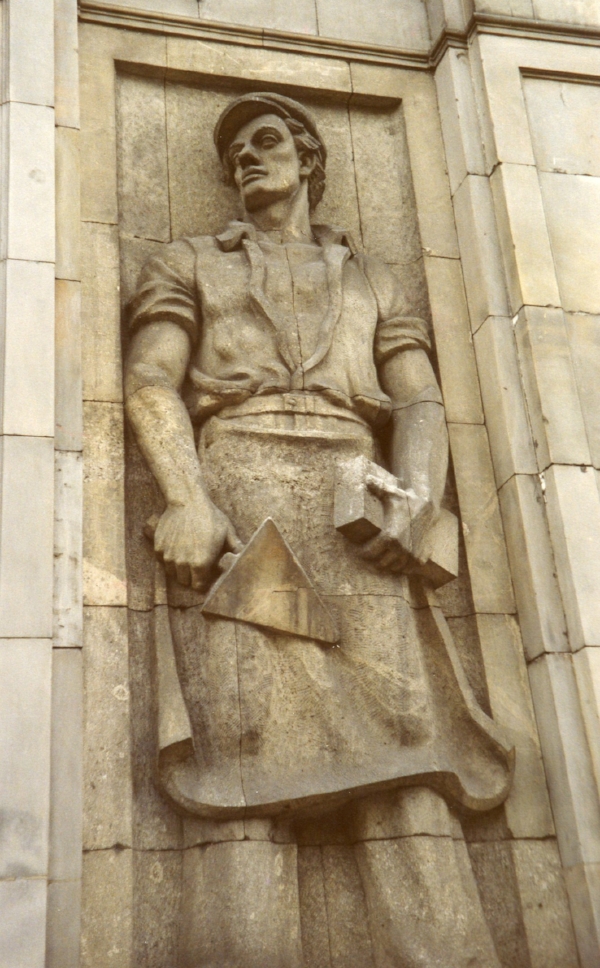
Marszalkowska 1, Warsaw, September 1988  © Andrew Stuttaford

Marszalkowska 1, Warsaw, September 1988  © Andrew Stuttaford

Twentieth-century totalitarian art did not just gild the cage; it helped to build it. Paintings, movies, sculpture, architecture and festivals of choreographed joy were vital elements in the Nazi and Communist attempts to remake man. It is key to our understanding of the nightmare states that resulted, argues Igor Golomstock, and deserves to be classified as a distinctive artistic genre alongside Modernism, of which it was both byway and heir. Like Modernism, totalitarian art was intended to help sweep away what had gone before, but unlike Modernism it was prepared to steal from the past to do so. The style of the 19th-century "bourgeois" academy was thus conscripted into the service of Reich and eventually revolution, as hallmark, teacher and, to us, cliché.

In his newly updated (it was first published in 1990) "Totalitarian Art in the Soviet Union, the Third Reich, Fascist Italy and the People's Republic of China," Mr. Golomstock convincingly demonstrates how the overlapping aesthetic values of these superficially disparate regimes underlined how much they had in common. This was never clearer than at the Paris exhibition of 1937.  In an unsettling preview of the Molotov-Ribbentrop pact, the Eiffel Tower found itself squeezed between massive Nazi and Soviet pavilions. Conceived as fusions of sculpture and architecture, both were expressions of brute power that played Neanderthal tribute to ancient Rome and were guarded by giant images, of the master race on the one hand, the master class on the other.

The strongest sections of the book concern the Soviet Union, as one might expect from an author whose career included membership in the Union of Soviet Artists and direct encounters with Stalinist brutality. Mr. Golomstock's father was sent to the camps in 1934, and then, some years later, his mother, taking the young Igor with her, signed up to work as a doctor at Kolyma, one of the worst of the Gulag's outposts.

Mr. Golomstock tracks the way that the smash-it-all-up trial-and-error of late imperial Russia's avant-garde (experiments that were paralleled, revealingly enough, by Italy's proto-fascist Futurists) initially meshed with the ecstatic starting-from-scratch of the Bolshevik revolutionary intelligentsia.

The extraordinary artistic innovation of the early Soviet years was rapidly replaced, however, by the stodgy conservatism of high Stalinist culture. The revolutionary past was sanitized, then mythologized. The hardscrabble present was transformed into a time of abundance by what Mr. Golomstock marvelously calls the "magic mirror" of Socialist Realism. The didactic, neo-Victorian paintings, the monumental if clumsily neoclassical architecture and, after 1941, the numerous evocations of martial valor and national pride, were all manifestations of an ersatz traditionalism that resonated with a people exhausted by decades of upheaval and were, of course, perfectly suited to the maintenance of a tightly controlled, rigidly hierarchical new order.

That said, for all Mr. Golomstock's experience and erudition, he falls some way short of conveying the ambition, allure and, well, totality of totalitarianism's cultural projects. While his examination of Nazi art takes useful detours away from the time-worn trudge through lumpen Arcadias and leaden Valhallas to include discussion of the centralized (Soviet-style) control of artistic production, he devotes relatively little space to the party's sometimes brilliant manipulation of design, its use of spectacle—Albert Speer's cathedrals of light—or, even, the films of Leni Riefenstahl. The whole picture never quite comes into view, and it was the whole picture that was the point.

It is no less frustrating that Mr. Golomstock allocates such a small portion of his book to China, the third of the 20th century's great totalitarian empires—particularly as he does find room for an addendum on Saddam Hussein's Iraq, a revoltingly bloody but basically traditional despotism that left little behind it of artistic interest to anyone other than connoisseurs of peculiarly servile kitsch. By contrast, as Mao's Cultural Revolution gathered pace from 1966 on, the mounting political hysteria was reflected, channeled and amplified in and by the arts in ways still terrifying today.

There were the dazibao, the giant-lettered, largely hand-made "big character" wall posters that signaled its beginning. There was the hectoring banality of revolutionary opera. And there were the images—sometimes reproduced in their millions—that both drew upon Socialist Realism and transcended it, a process that culminated in the depiction of Mao as essentially divine. As a demonstration of the fundamentally religious nature of communism, the deification of the Great Helmsman is hard to beat, and it represents the logical conclusion of totalitarian art. Unfortunately, you won't find any direct reference to it in Mr. Golomstock's fascinating, painstaking but ultimately incomplete book.

Q&A: Stieg Larsson's Ghost Speaks

Bookforum, June  21, 2011

Stockholm, November 2010 © Andrew Stuttaford

Stockholm, November 2010 © Andrew Stuttaford

STIEG LARSSON: What model Ouija board are we on?

BOOKFORUM: Hasbro.

SL: I like to know the hardware. I always kept my readers informed about the technology Lisbeth was using. Always.

BF: They certainly liked something that you were doing. More than thirty million copies sold. Shocked?

SL: Well, we Swedes try to be modest. Still, read the books carefully. You can see that I liked what I had written. I’d planned ten Salander books in all, you know.

BF: She’d have been your Miss Marple. Some say—how can I put this?—that your death, nearly seven years ago now, boosted sales.

SL: Like Elvis?

BF: Elvis? Well, you both liked junk food, but I was thinking about the freedom that unpleasant event gave international publishers to toy with your text—and to scrap that terrible first title. You must agree that The Girl with the Dragon Tattoo sounds better than Men Who Hate Women.

SL: But there are plenty of men who hate women, no? That’s not fiction, even in that Swedish paradise everyone so likes to talk about, and I wanted to remind my readers of that with a fact or two.

BF: Like the unsourced statistic that “eighteen percent of the women in Sweden have at one time been threatened by a man”? Whatever that vague term threatened may mean . . .

SL: What are you saying?

BF: You’re the investigative journalist. Something doesn’t add up. And the same could be said about some other tales you are said to have spun, about training the Eritrean lady guerrillas, say, or even the one about the gang rape of a “Lisbeth” that allegedly so influenced your development as a feminist. There’s even a book, The Larsson Scandal, that focuses on some of these, uh, inconsistencies.

SL: Jävlar! As you pointed out, I was an investigative journalist myself. I exposed threats, dangerous conspiracies, but this . . .

BF: Let’s return to the pleasanter topic of all those royalties—and, comrade, the contradiction they might represent. You are on the far left, a former Trotskyist, no less.

SL: Well, it was my estate that hit the jackpot, not me. Sure, I hoped to make a bit of money, but all Stieg wanted was a stuga—a cottage—in the country, and maybe to set aside a bit for retirement, the usual. I wasn’t one of those greedy financial types, overpaid for trading bits of paper with their yuppie pals. I created a product that people liked. No one was exploited. Taxes were paid. I have more than done my bit for the welfare state.

BF: And for a lot of other Nordic writers, too. The hunt for the next Stieg Larsson is proving lucrative.

SL: That’s fine. Per Wahlöö and Maj Sjöwall started it all decades ago, not me. They were leftists too, I might add, opposed to the Vietnam War. They made America tremble. Still, I wish that the first Stieg Larsson was still around. Fifty was too young to die.

BF: That’s why you never made a valid will?

SL: Yes, that was a mistake. Swedish intestacy laws hate unmarried partners. Eva deserves more than she’s getting. Then again, the law’s designated legatees, my father and brother, aren’t monsters.

BF: How do you rate the movie versions of your books?

SL: They cut too much of my story, but the girl who played Salander was terrific. As for the Hollywood remake, Mikael Blomkvist, who is, of course, me, will be played by Daniel Craig, James Bond himself. Makes sense, if not to our Mr. Fleming. That snob just laughed when he heard the news. Here he comes now. I’d better go. He can be rough.

BF: Stieg, wait! One more question: Is there really a fourth book, the one they say is on your laptop?

SL: Well, let’s just say if it appears, a ghostwriter will have been involved [laughs, fades].

Greater Europe, Lesser Europe

National Review, June 2, 2011 (June 20, 2011 Issue) 

By the time you read this, Greece may have defaulted on its debt. Or it may be preparing to default, but without the D-word. Most likely it will be negotiating another rescue package, but it may still be fighting to secure the latest payment under its existing bailout. Only one thing looks certain as I write. The eurozone crisis will not be over.

It’s been a long, hard journey since the first Greek bailout just over a year ago, a €110 billion loan package from the European Union (€80 billion) and International Monetary Fund (€30 billion) secured by pledges of drastic austerity. A €750 billion European Financial Stability Facility was announced a little later. The prospect of its billions’ being available to any eurozone country that ran into difficulties was intended to “shock and awe” (yes, that term again) the financial markets into calm.

It did not work out. Both Ireland and Portugal have since had to be bailed out. The destructive contradictions of the one-size-fits-all currency remain unresolved. The damage they caused is unrepaired. Then there’s the fact that the very nature of the eurozone leaves its weaker members vulnerable to fears of default. Most of their debt is in euros, and, for all practical purposes, the euro is a foreign currency. Once investors move out of, say, Irish bonds to safer euro debt elsewhere, all that Ireland can do to lure them back is increase interest rates and tighten its belt yet again. If that doesn’t work, the cash will run out.

Belgian economist Paul de Grauwe argues that a liquidity crunch of this type could force an otherwise solvent country into default. Maybe; but in Greece’s case that’s beside the point. The country has, financially speaking, ceased to be a going concern. Neither the 2010 bailout nor the (partial) introduction of austerity measures that are already at the limit of the politically possible have been enough to do the trick. Indeed, by depressing domestic demand, the latter have — at least in the short term — made the budgetary situation even worse. Tax revenues have been hit by the slump in an economy that shrank by over 4 percent last year, and will likely dwindle by another 3.5 percent this year. The conventional response — a massive devaluation designed to restore international competitiveness — is unavailable so long as Greece remains yoked to the euro.

And it’s not easy to break free. Capital controls would be introduced overnight. The Lazarus drachma would collapse in the morning. Inflation would surge the day after. The country would, de facto or de jure, default on its debt (as would a sizeable slice of its private sector). Greek industry would face a painful funding squeeze. Payrolls would plunge, a brutal blow with the official Greek unemployment rate already at 16 percent or so — and rising.

Beyond Greece’s borders, there would be panic selling of debt issued by some or all of the other PIIGS. With a number of EU banks heavily exposed to the PIIGS, an uncontrolled Greek default, and, more dangerous still, its consequences, could conjure up sweaty memories of the financial crisis. And those affected might include the European Central Bank itself. The ECB has been an active buyer of PIIGS debt. Writing down those holdings could be awkward, especially since the eurozone’s embattled taxpayers would be left holding the tab.

But if Greece’s departure from the euro is too risky to consider, that does not change the fact that the May 2010 financing has not worked. And default would be default whether inside the eurozone or out. It’s all very well criticizing the dodgy process by which Greece was admitted into the currency union, and there are few words ugly enough to describe the squalid state of Greek public finances. Nevertheless, for creditors to insist that the country can cut, privatize, and tax enough quickly enough to stave off disaster is to allow indignation to prevail over financial and political reality. Greece lacks the social cohesion (and shared memory of recent hardship) required to weather the kind of drastic “internal devaluation” that (fingers crossed) took the Baltic countries through their recent debt crises.

According to the EU Commission, Greece’s debt/GDP ratio will rise to 166 percent next year. The annual budget deficit will stand at just under 10 percent of GDP. Under the terms of the May 2010 bailout, that number is supposed to fall to 3 percent by 2014. Dream on. On May 30, Greece’s two-year bonds were yielding over 26 percent. The market’s message was clear. Without substantial additional external financing, default was on the way.

Adding to the concern have been worries that Greece might not satisfy the conditions necessary to allow the IMF (more rule-bound, it is speculated, in the wake of Dominique Strauss-Kahn’s departure) or EU lenders to release their next portions of the original bailout funds. You may know if they have agreed to do so by now, but the best guess must be that these monies will somehow reach Athens, even if it takes a new bailout agreement to get them there. If they don’t, that could, within weeks, trigger the “hard” default that no one wants.

Arranging a fresh bailout will be an unpleasant process, thanks not least to politics. After years of restraint at home, financing the feckless abroad has proved highly unpopular in Germany, the EU’s principal paymaster. The single currency has been a boon for the country’s exporters, but its voters don’t seem to care. They never wanted the euro, and the events of the last twelve months have only reinforced their suspicion that their beloved Deutsche mark was replaced with an extremely expensive dud. Forcing through the earlier support for the PIIGS was a nightmare for Chancellor Merkel. To ask this most cautious of politicians to demand yet more from restless German taxpayers is to ask a great deal. And lender discontent, a useful reminder of how little grassroots appeal EU “solidarity” really enjoys, is not confined to Germany. The Austrians are unhappy, the Dutch government is floundering, and anger in Finland over its participation in eurozone rescue parties has helped propel the populist-nationalist True Finns to the top of the polls. A new bailout will only add fuel to these fires. Merkel, it seems, may be preparing to walk through them. On May 31 markets surged on reports that Germany had dropped its insistence that any new bailout should be conditional on bondholders’ sharing in the taxpayers’ pain.

But despite, doubtless, additional austerity measures and fierce mechanisms to enforce them, new rescue packages will do little to solve the underlying structural problem in Greece and, for that matter, elsewhere. They may buy time but, in the end, there is simply too much debt for some PIIGS to repay. If an honest, old-fashioned default is too terrible to contemplate, that leaves three routes to a theoretically more permanent solution.

The first is, basically, what Merkel wants, “restructuring,” a default in sheep’s clothing, albeit one timed later than she would like. This would be designed in a way that allows banks to dodge the write-downs that could bring them low. The ECB is fiercely opposed to this approach, arguing that it will inevitably set off a fresh wave of financial contagion, even a new Lehman. Nouriel Roubini, Doctor Doom himself, disagrees. It is impossible to say who is right. Both sides are, in the end, making guesses about the mood of a perpetually manic marketplace. That said, the ECB’s stance implies the PIIGS will eventually be able to repay all their debt: an idea as implausible as the notion that they might fly.

More probably, the ECB is relying on Brussels to push forward with the closer fiscal and economic union without which no large monetary union can succeed. This has always been on the European Commission’s agenda, but until this thoroughly predictable and most convenient crisis, it had been politically impossible. That’s changing. Fiscal and economic integration has gone farther and faster over the last 18 months than would have been imaginable just a few years ago. The Eurocracy may, despite current traumas, even see this all as a vindication of the great gamble that was taken when the euro was launched half-done. The problem for Brussels is that the events of the last year have left voters in the eurozone core free from any illusion as to how costly such deeper integration — which would essentially establish a permanent funds-transfer regime from north to south — would be. Will they go along? Will they even be asked?

The third, and, I’d argue, best alternative for now — the split of the euro into two, a strong “core” euro and a weaker euro for the PIIGS — is not without its difficulties, but it ought to work. It would give the PIIGS both the devaluation they need and a chance of avoiding default, and, in addition, it should trim some of the “excess” German surplus. This may be the best alternative, but it’s also the least likely. To Brussels such a velvet divorce would represent an unacceptable step back, and that would never do.

Estonia’s anti-euro campaigners compare the single currency to the Titanic. It’s easy to see why.

The Province of Chance

Andrew  Roberts: The Storm of War: A New History of the Second World War

National Review, June 2, 2011 (June  20, 2011 issue) 

West Berlin, August 1977  © Andrew Stuttaford

West Berlin, August 1977  © Andrew Stuttaford

The fall of Singapore is not news, the Rattenkrieg in Stalingrad’s ruins is not news, the grotesque theater of arrival at the Auschwitz railway siding is not news, but Andrew Roberts’s narrative gifts are such that it is almost impossible to read his retelling of these nightmares without some feeling of encountering the new. Almost: World War II is too familiar a saga for that. Still, Mr. Roberts, a distinguished British military historian, has produced a volume that serves as a comprehensive and clear (good maps too) introduction to this most sprawling of conflicts while adding fresh insights for those already well-versed in its twists, turns, and minutiae. Who knew that Hitler, ever the mystic, held the belief — ominous in the light of Russian winters to come — that “human barometers . . . gifted with a sixth sense” could predict the weather more accurately than mere meteorologists?

This is also, in the best meaning of the word, a balanced book, up to date (its author has made good use of recent research) without being faddish. That’s rarer than it should be. Clio is a restless, untrustworthy muse. History is malleable. Initial impressions count. That’s why Winston Churchill was so quick to write his account of the war: He wanted to set the mold. And he wasn’t the only leader to play this game. Their memoirs are valuable, but partial: Scores are settled, excuses are made, credit is claimed.

Later, when the professional historians moved in, they often seemed to do so in waves, all too frequently driven by fashion, opportunism, contrariness, and ideology. Magisterial in tone and spirit, The Storm of War rises above all that. No history book can ever truly be definitive, but this comes close.

There’s little that rewrites the past more than the release of once-hidden files. Roberts emphasizes the contribution made by the codebreakers of Bletchley Park; yet 40 years ago, their deeds were still classified. The opening of many archives in the former Soviet Union since 1991 ought to have eliminated any remaining traces of doubt about the nature of the Western democracies’ vile, essential, and dangerous ally: “The SS had been using gas vans to kill . . . since 1939: It was an idea borrowed from Stalin’s purges of the 1930s, during which people had been gassed in specially converted trucks.” “Uncle Joe”? Not so much.

Sometimes, the evidence was already available for all to see, even if not too many wished to look. The Holocaust was hardly a secret, yet it was decades before it assumed the central role it now does in our understanding of the European war. Roberts chronicles the darkness that descended in a chapter written with fewer rhetorical flourishes than its title — “The Everlasting Shame of Mankind” — might suggest. He lets the horrors speak for themselves: “Oswald ‘Papa’ Kaduk — his nickname came from his ‘love for children’ — gave Jewish children balloons just before they were squirted (abspritzen) in the heart with phenol injections at the rate of ten per minute.”

The conflict in Europe was, of course, about more than the Holocaust. The Allies did not go to war to rescue the Jews. Many Germans fought for reasons that owed little or nothing to Hitler’s anti-Semitic obsession. Nevertheless, Roberts doesn’t wall off the slaughter of the 6 million into one discrete chapter. As he rightly grasps, it infected everything. Roberts is an enthusiast and expert (as this book repeatedly demonstrates) of battle, campaign, tactics, and strategy, of tanks and planes and all the rest. That said, despite his appreciation of the fighting qualities of the German military — and the skills of its officer corps — he rejects the argument that the “decent” Wehrmacht was quite so different from the wicked SS as many have liked to maintain.

That myth may have helped build the peaceful postwar Bundesrepublik, but myth it was, and a highly successful one at that: An exhibition depicting some of the regular army’s fouler activities outraged a surprising number of Germans as late as the 1990s. But Roberts finds the Wehrmacht guilty as charged. He names the deeds, and he names the names: “After [the massacre of tens of thousands of Jews at] Babi Yar, Field Marshal Walther von Reichenau issued an order celebrating the ‘hard but just punishment for the Jewish sub-humans’ and [Field Marshal Gerd von] Rundstedt signed a directive to senior officers along much the same lines.”

More damning yet, if the experience of the “middle-aged, respectable working- and middle-class citizens of Hamburg” who made up Reserve Police Battalion 101 (the subjects of Christopher Browning’s devastating 1992 book Ordinary Men, and a force responsible for the killing or deportation of 83,000 people in German-occupied eastern Europe) is anything to go by, there would have been little risk of serious punishment for those who opted out of mass murder. It would have been a bad career decision, that’s all, but one that too few were willing to take. We can only wonder why. Ingrained prejudice? The effects of Nazi propaganda? Wartime brutalization?  Military discipline? Peer pressure (not all bands of brothers are benign)? Others simply enjoyed killing. Some were indifferent. Human nature is what it is. Our species had much to be ashamed about before Auschwitz. It has had even more to be ashamed about since.

And the disgrace was not confined to the Reich. Roberts devotes a good portion of his book to the war in the Far East and Pacific (with the Nationalist Chinese justly receiving more praise than usual, and Mao’s Communists, quite correctly, less), but, again, never lets his admiration for the martial get in the way of his grip on the moral. He describes Japanese cruelty in the Philippines in revolting detail, but, in a commendable display of respect, holds back on the even worse (“there were many other scenes . . . not denied by the perpetrators that are simply too disgusting to recount here”). The victims have already been degraded enough. In this war, however, there was plenty of savagery to go around: Roberts does not skate over the darker side of the Allies’ long march to victory. That he never falls into the platitudes of moral equivalence speaks volumes.

All this is typical of a book that is, at its core, deeply humane — and is so at several different levels. Roberts clearly relishes history’s wide sweep, which he relates in grand style; yet, no determinist, he is particularly fascinated by the missteps of those who shaped the war’s course. If you want to read a fascinating discussion of the sometimes idiotic decisions that led to the Axis defeat, The Storm of War is for you. Roberts is an author who never loses sight of the human side of this epic: His sketches of the extraordinary collection of bickering warlords who constituted the Anglo-American command, and of quite a few other senior officers besides (the Chindits’ inspirational, onion-munching Maj.-Gen. Orde Wingate — failed suicide, nudist, devout Christian, and ardent Zionist — for one), are worth the price of admission in themselves. But he doesn’t forget those in humbler roles, the millions of innocent dead, the millions left bereft, and, perhaps above all, the millions of soldiers whose feet filled those muddy, dusty, broken, bloody boots on the ground.

“Armchair strategists,” wrote George MacDonald Fraser, creator of the wonderful Flashman books and author of a fine memoir of the war in Burma, “can look at the last stages of a campaign and say there’s nothing left but mopping up, but if you’re holding the mop it’s different.”

Naturally, Mr. Roberts includes that quote.

A World Behind Barbed Wire

Anne Applebaum (ed) : Gulag Voices

Tamara  Petkevich: Memoir of a  Gulag Actress

Cathy Frierson & Semyon Vilensky: Children of the Gulag

Stephen Cohen: The Victims  Return - Survivors  of the Gulag after Stalin

Fyodor Mochulsky: Gulag Boss

Alexander  Solzhenitsyn: The Gulag Archipelago

Kolyma Tales: Varlam Shalamov

Journey into the Whirlwind: Eugenia Ginzburg

My Testimony: Anatoly Marchenko

Faithful Ruslan: Georgi Vladimov

The Wall Street Journal, April 23, 2011

Lubianka, Moscow, February 1991 © Andrew Stuttaford

Lubianka, Moscow, February 1991 © Andrew Stuttaford

The most remarkable thing about "The Way Back," the 2010 film by Peter Weir, was neither its protagonists (escapees from the Soviet gulag system who trekked thousands of miles to their freedom) nor the curious tale of the almost certainly fictional 1956 "memoir" that inspired it (Slawomir Rawicz's "The Long Walk"). No, what distinguished "The Way Back" was its depiction of life in Stalin's camps. There have been a handful of films on this topic, but, as observed Anne Applebaum, author of a fine 2004 history of the gulag, this was the first time it had been given the full Hollywood treatment. Hitler's concentration camps are a Tinseltown staple, but Stalin's merit barely a mention.

Publishers have been more even-handed. There are many books on Soviet terror, and some have won huge readerships. Yet, as Hollywood's cynics understand, the swastika will almost always outsell the red star. That's due partly to the perverse aesthetics of the Third Reich but also to a disconcerting ambivalence—even now—about what was going on a little further to the east. The slaughter of millions by Moscow's communist regime remains shrouded in benevolent shadow. The Soviet experiment is given a benefit of a doubt that owes nothing to history and far too much to a lingering sympathy for a supposedly noble dream supposedly gone astray.

A flurry of recent books on Soviet oppression—surely encouraged by the interest generated by Ms. Applebaum's "Gulag"—is thus to be welcomed. One of the best is edited by Ms. Applebaum herself.

"Gulag Voices" (Yale, 195 pages, $25) is a deftly chosen anthology of writings by victims of Soviet rule. Some are published for the first time in English, most are by writers little known in the West and each is given a succinct, informative introduction. Above all, they help illustrate the duration, variety and range of Soviet despotism.

The Third Reich lasted for scarcely more than a decade. Most of those who died at its hands were slaughtered within the space of five years or so. The Soviet killing spree dragged on, however, from the revolutionary frenzy of 1917, through the terrible bloodbaths of the Stalin era, to the last violent spasms in 1991. The ultimate death toll may have been higher than that orchestrated by Hitler, but absolute annihilations like those envisaged by the Nazis were never on the agenda. Instead the nature of Soviet repression shifted back and forth over the years: sometimes more lethal, sometimes less, sometimes carefully targeted, sometimes arbitrary. The gulag itself was, as Ms. Applebaum notes, "an extraordinarily varied place." As the title of Solzhenitsyn's "The First Circle" reminds us, Stalin's hell, like Dante's, was layered. And how it endured: The most recent account in "Gulag Voices" is an excerpt from Anatoly Marchenko's "My Testimony," a memoir from 1969 that highlighted the way that Stalinist cruelty had successfully survived the dead, officially disgraced, dictator.

"Gulag Voices" begins in 1928. Dmitry Likhachev, an old-style St. Petersburg intellectual, was arrested when his literary discussion group was deemed to be a hotbed of counterrevolutionary plotting. He served four years in the Solovetsky Islands, the beautiful northern archipelago that from 1923 hosted the first organized camps, the tumor that metastasized into the hideous "archipelago" of Solzhenitsyn's great metaphor.

Mr. Likhachev's contribution is followed by a sampling of what could be found within that wider archipelago. Misery, gang rape and murder co-exist with Potemkin parodies of "normal life"—an excerpt from Gustav Herling's "A World Apart" (1951) describes the arrangements for conjugal visits. Occasionally, the prisoners might even carry on approximations of a career within the camp as an engineer, doctor or, as Tamara Petkevich recounts in "Memoir of a Gulag Actress" (Northern Illinois, 481 pages, $35), a performer for audiences of fellow convicts.

Such recollections come, as Ms. Applebaum acknowledges, with their own bias. With the exception of Mr. Marchenko, who died in the course of a later sentence, the authors all survived. Millions were not so fortunate. And some of those lives had hardly begun. In the devastating "Children of the Gulag" (Yale, 450 pages, $35), Cathy A. Frierson and Semyon S. Vilensky chronicle the awful fate of those literally countless children whose parents had fallen foul of the rage of the Soviet state. Here, a gulag convict nurse recalls handing over a batch of prisoners' children for transfer to a "special home": "The worst happened: We'd given, according to the receipt, eleven healthy beautiful children, and not one of them was ever returned. Not a single one!" This was a story repeated again and again and again. And as for those who did survive, many were forced to accept a suspect, fragile existence in which, for decades, the knock on the door was never so far away.

That tension would have been familiar to many prisoners eventually freed from the gulag. "Gulag Voices" includes one account by the pseudonymous K. Petrus, describing his 1939 release into what Ms. Applebaum describes as "the strange ambiguity" of a life that was closer to limbo. The big cities were denied to most former inmates. Their families were broken. Many chose to remain near the camps that had once held them.

The fate of those who emerged is also a central concern of Stephen F. Cohen's "The Victims Return: Survivors of the Gulag After Stalin" (Publishing Works, 224 pages, $22.95), a perceptive study of Khrushchev-era attempts to secure justice for Stalin's victims, the backsliding that followed and, finally, in the Glasnost years, the mass, too often posthumous "rehabilitations" of former prisoners—rehabilitations unaccompanied, however, by any realistic prospect that their tormentors would be brought to justice. Mr. Cohen was a frequent visitor to Moscow in the 1970s and 1980s and came to know some of those who had survived. His account is powerful and, often, very moving, marred only by traces of a belief in the impossible dream of a kinder, gentler Soviet Union, the will-o'-the-wisp that beguiled and destroyed Mikhail Gorbachev.

A very different (and highly unusual) perspective can be found in "Gulag Boss" (Oxford, 229 pages, $29.95) by Fyodor Mochulsky, the reminiscences of an engineer recruited by the NKVD (the Stalin-era secret police) to supervise forced labor in a Siberian camp. It was written during and after the U.S.S.R.'s implosion and ends with Mochulsky appearing to reject the methods, although not necessarily the ideology, of the system he served for so long. But he does so in the strained, awkward prose of a man unwilling to face up to what he had done. Mr. Mochulsky talks of disease, lack of food and other hardships, but the scale of the death toll that he must have witnessed is, at best, only there by implication. His overall tone is one of pained technocratic disappointment that the camp was so poorly run: He was a Speer, so to speak, not a Himmler. Yet Albert Speer served 20 years in jail. Mr. Mochulsky went on to enjoy a successful diplomatic and intelligence career and, in retirement, the luxury of modest regret.

And in those twilight years, he is unlikely to have been troubled by fears of prosecution. There has been no Bolshevik Nuremberg. Total defeat left Nazi horror open for all to see, but many Soviet archives remain closed, their tales of atrocity unpublished. The new books on the gulag cannot begin to redress the crimes they describe, but they can at least help history locate the facts with which it can pass the judgment that the victims and their jailers deserve.

Tales of the Gulag

The Gulag Archipelago By Alexander Solzhenitsyn

That "The Gulag Archipelago" had to be written says the worst about humanity. That it was written says the best. Solzhenitsyn (1918-2008) created an unanswerable indictment of the totalitarian regime under which he was still living and, no less critically, established that it had been poison from the start. As carefully researched as the difficult circumstances of its production would allow, "The Gulag Archipelago" is no dry roster of the dead but a work of passion and fury, underpinned by bleak humor and the hope (vain, it seems) that someday justice would be done.

Kolyma Tales By Varlam Shalamov

Far less well-known than they should be, these short stories by Varlam Shalamov (1907-82) are terse, lightly fictionalized, partly autobiographical glimpses into the gulag's abyss. "Kolyma Tales" derives its name from the region in Russia's far northeast that played host to a vast forced labor complex, in which hundreds of thousands (at least) perished. Written in a style of ironic, hard-edged detachment and so spare and so crystalline that they sometimes tip over into poetry, the tales rest at the summit of Russian literary achievement.

Journey into the Whirlwind By Eugenia Ginzburg

Rightly or wrongly, the Great Terror of 1937, an immense wave of violence that took down many who had either supported or benefited from the rise of the Soviet state, has come to be seen as the epitome of Stalinist despotism. Eugenia Ginzburg (1904-77) was among those expelled from a heaven under construction to a fully finished hell. "Journey Into the Whirlwind" remains a profoundly humane, wonderfully written first-hand account of arrest, imprisonment and exile into the gulag.

My Testimony By Anatoly Marchenko

Eugenia Ginzburg was a member of the Soviet elite; Anatoly Marchenko (1938-86) was the opposite, the son of illiterate railway workers. "My Testimony," his description of life in the 1960s gulag, is matter-of-fact, something that only makes its horrors seem worse. Marchenko's gulag experience transformed him from everyman into dissident. The last of his many re-arrests was in 1980. Still imprisoned, he died from the effects of a hunger strike in 1986. Perestroika had just begun: too late, far too late.

Faithful Ruslan By Georgi Vladimov

Moments of extraordinary beauty mark this haunting fable by Georgi Vladimov (1931-2003), told through the eyes of Ruslan, the most loyal of guard dogs. Abandoned by Master after their camp is closed down following Stalin's death, Ruslan patiently patrols the neighboring town waiting for the old order to return. It does, but only as a hallucination as Ruslan drifts into death after one final bloodletting. When Vladimov offered this novella for publication, though, it was rejected. Khrushchev had fallen and new masters were in charge. For real.

Naming the Crime

Timothy Snyder: Bloodlands - Europe Between Hitler and Stalin

National Review Online, March 18, 2011

Winter is bleak enough as it is. This year the gloom was deepened by the publication of How to Change the World: Tales of Marx and Marxism, by Eric Hobsbawm, one of Britain’s most feted historians, and, oh yes, a man who stuck with the Communist party until 1991 despite a global killing spree that took perhaps one hundred million lives. Naturally Hobsbawm’s new book has triggered the usual hosannas from the usual congregation for, to quote the Guardian, this “grand old man.”

There had, of course, been that minor unpleasantness back in the 1990s when Hobsbawm had appeared to imply that the deaths of 15 or 20 million people might have been justified had the Communist utopia actually been achieved. This ancient ogre (he is 93) is now more discreet. Reviewing How to Change the World in the Financial Times, Francis Wheen, no rightist and the author of an erudite and entertaining biography of Karl Marx, noted how Hobsbawm could not “bring himself to mention the Hitler-Stalin pact, referring only to ‘temporary episodes such as 1939–41.’ The Soviet invasion of Hungary and the crushing of the Prague Spring were [also] skipped over.”

But who are we to quibble, when, as his admirers like to remind us, Hobsbawm’s life has been “shaped by the struggle against fascism,” an excuse understandable in the 1930s (Hobsbawm, who is Jewish, quit Germany as a teenager in 1933), but grotesque more than six decades after the fall of the Third Reich.

Just how grotesque was highlighted by two books that came out last year. In the first, Bloodlands: Europe between Hitler and Stalin, Yale history professor Timothy Snyder describes the darkness that engulfed a stretch of Eastern Europe in the mid-20th century. He leaves only one convincing response to the question that dominates the second, Stalin’s Genocides, by Stanford’s Norman Naimark: For all the unique evils of the Holocaust, was Stalin, no less than Hitler, guilty of genocide?

The first half of Professor Snyder’s grim saga revolves around the Ukrainian famine of 1932–33, a manufactured catastrophe in which zeal, malice and indifference conspired to create a horror in which, Snyder calculates, well over three million perished (there are other, much higher, estimates). It was, Snyder writes, “not food shortages but food distribution that killed millions in Soviet Ukraine, and it was Stalin who decided who was entitled to what.”

The Ukrainian countryside had already been devastated by collectivization and the killing, imprisonment, or exile of millions of its most enterprising inhabitants. Now it was to be stripped of what little it had left. The peasants were given targets for the amount of grain and other foodstuffs they were expected to hand over to the state, targets that would leave them with barely anything to live on, and often not even that. Refusal was not an option. Starvation was not an excuse. Nothing was left behind. Nobody was allowed to leave. The peasants were trapped. And they were condemned. In the spring of 1933 they died at the rate of more than ten thousand a day. “The only meat was human.”

That fall the United States extended diplomatic recognition to the Soviet Union.

Communism has brought mass starvation in its wake on a number of occasions (2010 also saw the appearance of Mao’s Great Famine,by Frank Dikötter, a harrowing account of the death of millions during the Chairman’s Great Leap Forward), but what distinguishes the Ukrainian Holodomor (a coinage that means murder by hunger) is that, as Snyder demonstrates, this particular famine was not just incidental to the business of fashioning utopia. It was deliberate, a weapon designed to break a class enemy, Ukraine’s embattled peasantry, and the battered nation of which it was the backbone.

It is this national element that some historians would like to deny. It unsettles the conventional narrative under which the ethnically based mass murders of mid-20th-century Europe are associated almost exclusively with Nazis, and, in so doing, it raises some awkward questions about those in the democratic world who looked so longingly to Moscow in the 1930s. The details of the Holodomor might have been obscure or obscured, but there was a fairly widespread awareness in the West that something had occurred. How else to explain all that talk of omelet and eggs? Those who claimed to have turned to Communism only because of the growing Nazi threat must have believed that those millions of dead Ukrainians counted for very little.

And it wasn’t just Ukrainians. As the Thirties curdled on, the list of peoples brutalized by Stalin grew ever longer. The “national operations” that were a murderous subset of the Great Terror of 1937–38 accounted for some 250,000 deaths, including those of at least 85,000 Soviet Poles. The hideous ethnic persecution developing in the Third Reich throughout the 1930s may have been more overt than its Soviet counterpart, but it was in the USSR that the cattle trucks were already rolling. At that stage Hitler’s haul of victims lagged far behind.

That was to change. The second part of Snyder’s book details how the Nazis brought their own flavor of hell to the territories he dubs the Bloodlands. With his feel for neglected history, Snyder restores focus to the terrible fate of the Soviet POWs who had fallen into German hands: “The Germans shot, on a conservative estimate, half a million Soviet prisoners of war. By way of starvation or mistreatment during transit, they killed about 2.6 million more.”

He correctly sees this not just as a matter of callousness and cruelty but as an adjunct to Hitler’s wider plans for a region that was to be emptied of most of its original inhabitants and re-peopled by the master race.

And then, of course, there were the Jews. In page after grueling page, Snyder depicts the pogrom that erupted across the Bloodlands. After all these years, after all the histories, there are still details that appall: “By spring 1943, fires burned at Treblinka day and night. . . . Women, with more fatty tissue, burned better than men; so the laborers learned to put them on the bottom of the pile.”

In an interesting twist, Snyder reveals how the usual Western understanding of the Holocaust, centered on the almost clinical danse macabre of deportation and eventual extermination in a camp far from Paris, Amsterdam, or Rome, fails to reflect the more typical experience to the east. The frenzied killings that swept the Bloodlands in the wake of the German invasion — within six months one million Soviet Jews had been butchered — are the clearest possible evidence of a primeval savagery unleashed.

To suggest, as some have, that, by twinning his chronicle of Nazi atrocity with a history of the Soviet slaughters of the previous decade, Snyder has in some way diminished the Holocaust is absurd. The Holocaust was underpinned by a dream of annihilation that was all its own, but it was also a product of its era. Like Communism, Nazism was a creed with a strong religious resonance (it’s no coincidence that this was a time when more conventional religions were losing their traditional hold over the human imagination), yet it aimed at creating a utopia for its elect here on earth, a dangerous enough delusion under the best of circumstances, let alone those developing in the early 20th century. For these utopias were, quite explicitly, to be built by bloodshed and sustained by force, a prospect made all the more menacing by technological advance, the growth of the modern state, and, critically, the shattering of so much of European civilization by the First World War. That conflict opened the door to the Bolshevik Revolution, which in turn helped pave the way for the Third Reich, a state that was both reaction against and imitation of the Soviet Union.

The Führer who, contemplating the Holocaust, once asked “who now remembers” the Armenian genocide. would certainly have noticed how quickly the Holodomor was allowed to vanish down the memory hole.

In some ways it is still there. That the Stalinist regime was guilty of what any reasonable person would describe as genocide has been beyond dispute for decades. Yet somehow there has been a hesitation about branding the Soviet state with the worst of the marks of Cain, a hesitation that still resonates — in politics, in diplomacy, and in high culture and low. Would there have been quite such an uproar if fashion designer John Galliano had said that he “loved” Stalin rather than Hitler?

In Stalin’s Genocides, Professor Naimark recounts how the definition of genocide was diluted before being enshrined in the 1948 United Nations convention. At the insistence of the Soviets — and others — the destruction of specific social and political groups was excluded. It was a distinction rooted neither in logic nor in morality, but it worked its sinister magic. Sparing Stalin, and by extension the state that he spawned, from the taint of genocide allowed the USSR to maintain some sort of hold over the radiant future that — against all the evidence — it still claimed to be building, that radiant future that has proved such a handy alibi for all the Hobsbawms and, even, for their successors today. It helped ensure that Mao’s famine too was largely passed over in silence. It still enables Russia to avoid the hard truths of its own history, an evasion that poisons its politics both at home and abroad. Sadly, it’s no surprise that the new pro-Moscow government in Ukraine has been playing down the genocidal nature of the Holodomor.

Since the Balkan wars, the jurisprudence of genocide has, as Professor Naimark shows, evolved to the point at which there could be no serious legal doubt that the architects of Soviet mass murder would, if hauled before a court today, receive the judgment they deserve. Prosecutions for the Soviet genocides have, however, been pitifully few and confined to the liberated Baltic states. Thus, in May 2008, one Arnold Meri was tried for his role in the deportation of 251 Estonians almost sixty years before. He died before a verdict could be reached. Not long later Dmitri Medvedev awarded Meri a posthumous medal for his wartime service.

And if you want just one reason why these books by Professors Snyder and Naimark are so important, that’s not a bad place to start. Hobsbawm you can junk.

Big Bruder Watching

Gary Bruce: The Firm - The Inside  story of the Stasi

The Weekly Standard, January 24, 2011

The Wall, Berlin, August 1978 © Andrew  Stuttaford

The Wall, Berlin, August 1978 © Andrew  Stuttaford

Stalin’s observation that the death of one man is a tragedy but the death of a million is a statistic helps explain why some of the finest portraits of 20th-century totalitarianism have been miniatures. Ivan Denisovich’s “day without a dark cloud” and the hunt for the Jewish schoolboys in Louis Malle’s Au Revoir les Enfants illuminate horrors that stretch far beyond one outpost of the Gulag or a stagnant Vichy town. The decision by the Canadian historian Gary Bruce to focus his new history of the East German secret police, the Stasi (Staatssicherheit), on Perleberg and Gransee, two out-of-the-way districts in communism’s distaff Germany, might have promised something of the same. But that’s not what his book delivers.

Instead, Bruce takes advantage of the fact that an unusually high proportion of the Stasi archives were left untouched in the backwaters that are his setting to produce a meticulous, grassroots examination of (to quote Timothy Garton Ash) “the quieter corruption of [East Germany’s] mature totalitarianism.” Supplemented by a series of interviews both with former secret policemen and those they watched over, The Firm is well done, even if Bruce’s approach has meant that the grand guignol of the Stasi’s formative years is passed over too lightly for his book to be viewed as a truly comprehensive analysis of that organization’s malignant DNA. The worst aspects of the later, more discreetly brutal, decades also escape the scrutiny they deserve. There’s little on the fates of those “the firm” (the Stasi’s smug nickname for itself) considered its most serious opponents. Their cases would have been handled by (and usually in) East Berlin.

This matters. East Germany’s past remains poorly known outside its former borders and, judging by the perverse phenomenon of Ostalgie, even within them. In making Au Revoir les Enfants, Malle could rely on his audience’s familiarity with the film’s backstory of war, occupation, and Holocaust. Bruce is in no position to make similar assumptions. Nonspecialists would thus do better to turn elsewhere, perhaps to Anne McElvoy’s The Saddled Cow (1992), a perceptive overview of East German history written by a journalist who witnessed its final years, or for a somewhat later examination of still raw memories, Anna Funder’s haunting Stasiland (2003):

Frau Paul started opening doors. First a compartment so small a person could only stand. It was designed to be filled with icy water up to the neck. There were sixty-eight of these, she told me. Then there were concrete cells with nothing in them where prisoners would be kept in the dark amid their own excrement. There was a cell lined entirely with padded rubber. Frau Paul was held nearby.

You won’t find much of that in The Firm. Also missing are the Stasi’s international activities, from espionage to the support of terrorism, dirty work that took place far from the dull towns in which Bruce’s narrative unfolds. Equally, there are few traces of the dangerous dance between regime and intelligentsia that forms the subtext of Florian Henckel von Donnersmarck’s Oscar-winning The Lives of Others (2006). The prominent playwright who is that movie’s principal protagonist bears scant resemblance to Bruce’s bullied provincials.

Where The Firm comes into its own, however, is as a demonstration of the remarkable reach of East Germany’s surveillance state. The Stasi employed 91,000 full-time officers at the time the regime fell. In the prewar Reich, a country with a population well over three times as large, the Gestapo made do with 7,000. To be sure, the Nazis enjoyed greater popular support than their Communist successors, but statistics from other Warsaw Pact countries suggest that this cannot be the sole explanation for the difference. As Bruce notes, “The secret services of .  .  . Czechoslovakia (1:867) or Poland (1:1,574) did not even come close to the ratio in East Germany of one full-time secret police officer for every 180 East German citizens.”

We are left to guess why. Fear of the vanquished fascist enemy? Maybe. Stereotypically Teutonic thoroughness? Probably. The dangerous, reproachful proximity of the free, increasingly prosperous, Germany next door? Almost certainly.

The snooping didn’t stop with the 91,000. In 1989, the Stasi had 173,000 informants on its books. They were given the generic, now reviled, name of unofficial coworker (I—Inoffizieller Mitarbeiter) but were then subclassified according to a distinctively totalitarian taxonomy. This included Secret Lead Informants (GHI), and below them, trusty Full-time Unofficial Coworkers (HIM), and below them, lowly Societal Coworkers for Security (GMS), and then, forming part of the base of this unlovely pyramid, Sporadic Contact Persons (KP) and Collaborative Operational Partners (POZW). In 1988, there was one informant for roughly every 76 preretirement adults in sleepy Perleberg District, a total that Bruce contrasts with one snitch for every 16,800 people in the Ukrainian regional hub of Kharkov at the depths of Stalinist terror.

The Gestapo, of course, benefited from the willingness (for varied reasons) of so many Germans to volunteer information on their neighbors to authorities for whom they had some sympathy. As “the sword and shield” (naturally the iconography was borrowed from the Soviet secret police) of a regime profoundly disliked for most of its existence, the Stasi had to be more proactive. Bruce shows how it recruited (predictably, a mixture of carrot and stick) and why. One Kurt Wollschläger was chosen because of the need to ferret out grumblers at the local river port. That Wollschläger was separated from his wife was, the Stasi (prudish when it came to behavior within its own ranks) reckoned, a plus: He had more time to hang around in bars. That he was a former Nazi was no problem.

Informants would report regularly to their handlers, a snippet here, an observation there, sometimes harmless, sometimes not, and sometimes, perhaps most characteristically, as a piece in a complex composite portrait being assembled of an individual that the regime was beginning to distrust. If it looked as if those suspicions might have been justifie—he bar was low: no laws needed to have been broke—he screws would tighten, relentlessly, remorselessly, but not necessarily attributably. There was not always a warning chat. A job would be suddenly lost; new employment would be hard to find. A child would not win that university place. Ugly gossip might be circulated. The phone would ring at night, with only silence at the other en— perfect expression of this shadowy, subtle, and devastating form of repression.

There was a word for this: Zersetzen (“to undermine” or “to break down”). For outright dissidents, for those “preparing to flee the Republic” or those whose mutters of discontent had tipped over into something more insistent, there was prison (and, on occasion, the bullet). The more fortunate won exile, or had exile forced upon them. For the law-abiding who never crossed such lines, there was always the reality or the risk of Zersetzen, a vital element in a system of understated control that Bruce describes as hovering “ominously in the distance, always threatening, always unsettling, a constant potential threat.” And it worked. The German Democratic Republic was, almost until the end, one of Moscow’s better-behaved satellites.

Coerced good behavior should not be confused with enthusiasm. An appropriately skeptical Bruce reports on reprehensible efforts by some historians to strip that ill-mannered adjective “totalitarian” from the regime that collapsed with the Wall: “Welfare dictatorship .  .  . post-totalitarian bureaucratic dictatorship .  .  . thoroughly ruled society .  .  . forced through society” and, thanks to its colossal number of informants, “participatory dictatorship” are amongst the euphemisms that have slithered into view. We can only speculate at what motivates such nonsense: Is it the persistent academic desire to minimize the crimes of the left, or is it an unwillingness to come to terms with the full implications of past horrors?

Such poisons have a way of seeping out from university campuses, but in the case of the former East Germany, their potency is reinforced by the natural tendency of its onetime citizens to allow past moments of personal happiness to cast a favorable glow over the republic in which they once endured: “Oh, it wasn’t all bad, you know.” Bruce handles this difficult topic with considerable subtlety before concluding that one can no more put a boundary between everyday life in the fallen republic and the ever-present awareness of the Stasi’s presence than “one can encircle a scent in a room.”

The Stasi’s stink not only lingers where it once did (and sometimes very strongly) but has also been allowed to waft into the former West Germany. The Left party, a grouping formed by the merger of western leftists with the “reformed” heirs to East Germany’s old governing party, took some 12 percent of the vote in the united Germany’s 2009 elections. Reformed? Well, when Joachim Gauck, a former dissident and for 10 years the first federal commissioner for the Stasi archives, addressed the parliament in Saxony, a territory that was once part of East Germany, the event was boycotted by all Left party parliamentarians.

A Flock of Black Swans

adam Fergusson: When Money Dies

The Wall Street Journal, December 30, 2010

It says something about present anxieties that a 35-year-old account of Weimar hyperinflation has come into vogue. In early 2010, Adam Fergusson's long-out-of-print volume was trading online for four-figure sums. There were (false) reports of kind words about it from Warren Buffett. Now back in print, this once obscure book from 1975 has been selling briskly. Just another manifestation of the financial millenarianism now sweeping the land? Perhaps, but "When Money Dies" remains a fascinating and disturbing book.

The death of the German mark (it took 20 of them to buy a British pound in 1914 but 310 billion in late 1923) plays a key part in the dark iconography of the 20th century: Images of kindling currency and economic chaos are an essential element in our understanding of the rise of Hitler. Mr. Fergusson adds valuable nuance to a familiar story. His tale begins not, as would be popularly assumed, in the aftermath of Germany's political and military collapse in 1918 (by which point the mark had halved against the pound) but in the original decision to fund the war effort largely through debt—a decision with uncomfortable contemporary parallels (one of many in this book) tailor-made for today's end-timers.

Yet the parallels go only so far. The almost inevitably inflationary consequences of paying for a world war on credit were exacerbated by: Germany's relatively shallow capital markets, the creation of "loan banks" funded solely by a printing press that was also at the disposal of the central bank; and the muffling of warning signals in a way unimaginable in our information age. The rise in prices was obvious to all. That it was due to more than wartime shortages was not. The country's stock markets were closed for the duration of the fighting. Foreign-exchange rates were not published.

And then there were the black swans. Early 20th-century Germany was savaged by a flock, including defeat in what was then the world's most destructive war, revolution, civil unrest, territorial loss, the imposition of punitive reparations, a fresh occupation of its industrial heartland and, as if these woes were not enough, a Reichsbank presided over by Rudolf Havenstein. Even in the era of Zimbabwe's Gideon Gono, Havenstein must be considered a strong contender for the title of worst central banker of all time. There seemed to be no limit to the amount of currency he was willing to print. Yes, America has its problems today, but by comparison . . .

"When Money Dies" was written in the early 1970s for a British audience. Inflation was accelerating fast, and London's political class was at a loss about what to do. Mr. Fergusson's book (which began as a series of newspaper articles) reflected the growing national alarm over inflation and hinted that price stability would not be won back without more focus on the quantity of money in circulation. With monetarist ideas just beginning to enter mainstream British political discourse, the Havenstein of "When Money Dies"—a printing-press banker supposedly unaware of the connection between soaring inflation and roaring money supply—made a useful villain.

Yet in all probability his behavior owed as much to desperation as ignorance. Mass unemployment seemed more of a threat to Weimar's dangerously fragile social order than rising prices. Devaluation was the other side of Germany's debased coin. It kept the country's exports competitive and its factories (given an extra boost by generous subsidy regimes) humming.

But in the end the music stopped. Without a reliable pricing mechanism, much of the German economy eventually ceased to function, even at the most basic level. Rent was payable in butter, a ticket to the movies with a lump of coal. Farmers stopped sending food to the cities. Under such circumstances the harsh medicine of monetary reform (the return to a fixed parity against gold and the dollar, the imposition of strict budgetary discipline) found the political support it needed despite the pain it was bound to bring to German industry and its work force.

And so, in November 1923, a new quasi-currency, the Rentenmark, was launched. Its asset backing was little more than a conjuring trick, but with the population desperate to believe (and with the Reichsbank no longer financing the government) the magic worked. Despite the rickety nature of the recovery that eventually ensued, Germany might have arrived at a lasting turning point had not black swans—the Great Crash and a global depression—returned to bedevil its future once again.

Readers of Mr. Fergusson's melancholy chronicle can comfort themselves with the thought: That was then, and this is now. "When Money Dies" cannot be used to prove that the combination of rising deficits and the modern money manufacture euphemized as "Quantitative Easing" can only end up in near-apocalyptic disaster. (In a note to this new edition, Mr. Fergusson, who subsequently became a Conservative member of the European Parliament in the early Thatcher years, stresses that no "advanced economy is threatened with inflation approaching such severity as in post-Imperial Germany.") Nevertheless, to borrow his adjective, the book is a "sobering" warning of what could go wrong.

His examination of both the seductions of inflation and its devastatingly corrosive effect is merciless and horrifying. Most haunting are the depictions of those broken on inflation's wheel, the workers without a union to protect them, the retired trying to live on pensions that had lost all meaning, the once-proud bourgeois after the annihilation of their savings. A nation can recover from hyperinflation, but for these people time had run out. Everybody ought to read this book. But baby boomers must.

PIIGS to the Slaughter

National Review, December 2, 2010 (December 20, 2010 issue) 

Checking into a roach motel often seems like a straightforward decision.

Signing up for the euro, the shiny new currency supposedly saturated in German fiscal rectitude, not only pleased Ireland’s paymasters in Brussels (the country has benefited hugely from lavish dollops of EU “structural” assistance) but offered Dublin the prospect of riches far closer to hand than the end of the traditional rainbow. The combination of EU aid (amounting in some years to as much as 3 percent of GDP), domestic frugality, shrewd supply-side reforms, and (those were the days) a timely currency devaluation had already given birth to a Celtic Tiger nourished on export-led success. But that beast was now set to burn very bright indeed.

And so it did. Money poured in, bringing the traditional speculative excess in its wake. So far, so normal: Usually such festivities are brought to a more or less timely close by both external and internal pressure. Inflation heats up, the currency buckles, interest rates rise, fiscal policy is tightened, bank lending is reined in, and everyone is soon back on their best behavior — until the next time.

Joining the euro meant that much of this script was jettisoned. Market signals were muffled by membership in a unified monetary system in which one size truly did not fit all. In particular, Irish interest rates, determined primarily by the needs of the eurozone’s sluggish Franco-German core, were kept far too low (on average, they were negative in real terms between 1998 and 2007) for a roaring economy growing at an annual average rate of 6 percent between 1988 and 2007. Throw in a poorly regulated banking system, endemic cronyism, vast infusions of foreign cash (euro membership had dramatically reduced currency risk), a lending war led by the remarkably reckless Anglo Irish Bank, the genuine housing needs of a large new immigrant population (a striking phenomenon in this land once known for its emigrants), and briskly increasing wage rates, and the stage was set for a gigantic property boom. What could go wrong?

Just about everything; and it went so badly that (finally) doing the right thing may have made matters even worse. When the global financial crisis erupted and the Irish economy slumped (GDP fell by 7.1 percent in 2009 after a 2 percent decline the previous year), real-estate prices fell (they are now some 35 percent below their peak, and weaker still in Dublin), and the banks came down with them. The government’s response bore some resemblance to the approach taken so successfully by Sweden during a not-entirely-dissimilar banking crisis in the early 1990s. This included guaranteeing most of the liabilities of the country’s troubled banks (and troubled they were — by 2007, property-related lending accounted for some 60 percent of their loan books) and transferring toxic assets to NAMA, the National Asset Management Agency, a state-run “bad bank.”

But Ireland’s banking sector was far larger relative to its GDP than Sweden’s had been, and so was its real-estate bubble. The Irish government has also had to contend with a far less favorable economic climate, a difference made even more damaging by the fact that the Irish tax system is unusually sensitive to changes in economic activity. Tax revenues fell by almost 14 percent in 2008 and by 19 percent in 2009, bringing yet more misery to the republic’s previously respectable but swiftly deteriorating public finances.

Recovery from a mess like this is never plain sailing, but one way to lessen the pain is to arrange a currency devaluation (Sweden let the krona fall by 20 percent in late 1992) to give exporters a break. Unfortunately, membership in the eurozone had closed off that option. Ireland was thus stuck with an overpriced currency, an overpriced workforce, and a rapidly growing hard-money debt burden that could not be inflated away. All that was left was “internal devaluation.” That’s an ugly name for an ugly cure generally revolving around extraordinarily brutal public-sector austerity. The aim is to restore both the state’s finances and the nation’s international competitiveness, and it’s just what Ireland had been attempting since 2008 with a series of increasingly bleak budgets intended to reduce the deficit by over $19 billion.

Internal devaluation is a bitter pill to swallow even when it works, but when it doesn’t . . .

And in Ireland it may well not. As it has lurched its way through 2010, the government has fed ever more money into the country’s devastated banks (most notably the now-reviled Anglo Irish Bank), effectively canceling out the savings being generated by the austerity program and pushing the estimated 2010 public-sector deficit to some 32 percent of GDP (it would otherwise have been around 12 percent). This renewed the market’s worries about Ireland and, ominously, other fiscally fragile eurozone members. Exacerbating the rising tension, the European Central Bank appeared to be continuing with its effort to scale back the short-term support it had been extending to the eurozone’s financial institutions — support that was widely assumed to be vital to many banks in most or all of the notorious PIIGS (Portugal, Italy, Ireland, Greece, and Spain). Perceptions of sovereign and banking risk were converging, not unreasonably so given the way that governments were standing (either explicitly or implicitly) behind their countries’ banks. To take one example, when Fitch cut Ireland’s rating from AA- to A+ this fall, it specifically cited the mounting cost of the bank clean-up.

All this made October a terrible month for German chancellor Angela Merkel to demand that the European Stability Mechanism, which is scheduled to replace the current European Financial Stability Facility in 2013, include a provision requiring private holders of government debt to share in the pain of future sovereign bailouts. The provision is common sense. To call for it at a time of jagged nerves over European sovereign risk was not. Merkel’s comments related only to arrangements that might be put in place in the future, but given her frequent tirades against “speculators” and Germany’s key role in funding any bailouts to come, many in the financial markets worried that they might herald an attempt to change the ground rules well before 2013 — and not in a way that would be in the interests of bondholders. Yields on PIIGS bonds rose, while money continued to drift away from Ireland’s banks, and investors from its debt. Theoretically, the country still had enough money to meet its financing needs until mid-2011, but, if panic was to be headed off (at least temporarily), its government had to be persuaded to accept the bailout that it was desperately claiming not to need.

The risk posed by spreading financial contagion was simply too high, and not just for Ireland. The European Financial Stability Facility, which was created for the eurozone with such fanfare (there was talk of shock and awe) at the time of the Greek bailout, is not large enough to rescue Ireland and Portugal and Spain, the next two countries most likely to be hit should confidence fall any farther. Dublin caved. An outline rescue package was announced on November 21. The full details were released a week later. The total package will amount to $110 billion, including an immediate $13 billion injection of fresh capital into the banking system. In an unanticipated development, Ireland will chip in $23 billion from its pension reserve fund and various other pots of money. The balance is set to come from the International Monetary Fund, from the European Financial Stability Facility, and from three non-eurozone countries, the U.K., Sweden, and Denmark. The whole thing is conditional on the passing of yet another Irish austerity budget, one that contains an additional $20 billion in tax increases and spending cuts. These cuts, when added to the earlier bouts of slash-and-burn, amount to roughly 20 percent of GDP.

At the same time, more details were given of the planned new European Stability Mechanism, but — not insignificantly — with (some) dilution of Angela Merkel’s proposal for sharing the burden of future bailouts. It was also agreed that Greece should be given an extra four-and-a-half years to repay its emergency financing from earlier this year. Ireland, however, will no longer be obliged to contribute to Greece’s bailout. On a brighter note, and over the objections of some in the rescue party, Ireland was allowed to retain the 12.5 percent corporate tax rate that has served it so well.

The republic’s governing coalition, a dying partnership between the centrist Fianna Fail and the Greens, has to pass the new austerity budget within a few days with a parliamentary majority of only two and without much popular support. In a clear warning sign for the general election now set for January, Fianna Fail received a November 25 by-election shellacking from Sinn Fein, a party frequently described as the political wing of the IRA. The EU’s mandarins like to claim that their “ever closer” union is burying Europe’s old nationalisms. That’s not how it looked in Donegal South West that weekend.

Despite this, Ireland’s mainstream parties recognize that the deficit needs to be reduced soon — even if they disagree on the specifics of the rescue package. At the time of writing, things are very fluid, but the best guess is that the budget will probably squeak through, albeit with a great deal of shouting. If it doesn’t, there’s a clear risk that financial chaos will soon engulf some or all of the PIIGS, and, no less dangerously, the banks that have lent so much to them. Even if it does go through, don’t expect too much. The distinctly downbeat market reaction to both the initial announcement of an Irish bailout (yields on the PIIGS’ government debt rose; the euro fell) and its later confirmation reveals a widespread belief that this rescue is not the end of the story.

It’s not. More bailouts undoubtedly lie ahead, and, in the case of Greece and Ireland, so does a debt restructuring (that’s the polite word for default) at some moment when it is judged that the financial markets can cope with the news. So long as these countries are yoked to the euro, there is no feasible alternative. Their domestic demand will be crippled by the processes of internal devaluation. Their export sectors will be hobbled by a hard currency. Under the circumstances, they will struggle to grow their economies at a pace fast enough to reduce their debt burdens to manageable levels. There are good reasons the yield on their debt continues to rise.

Meanwhile, Brussels, apparently unshaken in its belief that one size can be made to fit all, will try to impose unified fiscal and budgetary rules across the eurozone. If this succeeds, it may reassure restless German voters that there are credible limits on the amount they will be asked to pay to support European monetary union. That the implementation of such zonal discipline will, if carried through, also deepen European integration is even more to the Eurocrats’ point. That it would doom a large swath of the continent to years of subpar growth is just too bad. The European project must move forward!

Splitting the single currency into a “northern” euro for Germany and those of its neighbors that want to come along and a “southern” euro for the rest is one more congenial, if risky, alternative route to take. It would retain important elements of the status quo while paving the way for the devaluations that the PIIGS so badly need. But to take this path would be an admission of defeat too humiliating for the EU’s leadership to accept, at least for now. And if that’s off the agenda, so, even more so, is a return by the nations of the eurozone to their old currencies.

The final alternative, for an Ireland or a Greece to exit the euro on its own, would involve national bankruptcy, the collapse of much of the domestic private sector, and Lehman Part Deux. 

It’s not always easy to check out of a roach motel.