How Brexit Descended into ‘Braos’

Loosening the ties that bound the U.K. into the EU was always going to be complicated. Dropping out of Brussels’ relentless trudge towards political integration is not in itself too great a challenge, but doing so in a way that minimizes the damage to Britain’s economic access to its European markets is an entirely different matter. To Brussels, economic and political integration are inextricably intertwined. Preserving as much of the benefit of the former while escaping the latter needs patience, diplomatic savvy, a realistic understanding of the EU’s workings, and the ability to weigh the strength (or otherwise) of the U.K.’s negotiating position. Since the Brexit vote on June 23, 2016, Britain’s Conservative government has displayed no sign of any of these qualities.

Read More

Bear with a sore head

Keir Giles: Moscow Rules - What Drives Russia to confront the west

Standpoint, March 28, 2019

Archangel, Russia, August 1996 © Andrew Stuttaford

Archangel, Russia, August 1996 © Andrew Stuttaford

The key message underlying Keir Giles’s trenchant, persuasive and alarming Moscow Rules is that the idea of Russia as a part of the European family is an illusion. In fewer than 200 pages he pulls that notion to pieces and then suggests what the West’s policy towards Moscow should look like if it is to be guided by reality rather than hopes or a pretty dream.

Giles, a senior consulting fellow at Chatham House, explains how Westerners are misled by geography (a portion of Russia is, after all, in Europe), language (Russians may use the same political terminology as their counterparts in the West, but they tend to mean very different things by it), and even appearance: “[T]he majority of [Russians] are outwardly indistinguishable from white members of the Euro-Atlantic community.” The misunderstanding may be deepened by, as Giles notes, the high visibility of a “Westernised” intelligentsia, whose views are not representative of the country as a whole. And there’s something else that I’d add to the pile of deceptive resemblances: The civilisations of both Russia and the West owe much to Christianity. Even the Soviet rejection of religion (based, in no small part, on the writings of a German, which is to say, a Western, philosopher) can be reread as another of the millenarian explosions that have long scarred European history. The distance between Anabaptist Münster and revolutionary Petrograd is not so very far.

The belief, against a great deal of evidence (a good selection of it neatly sketched out in this book), in the essential similarities between Russia and the West is helped, as Giles points out, from the way that “Western minds, especially liberal educated ones, rebel against national stereotypes. The taint of orientalism causes them to reject explanations for personal or national behaviours that are based on psychological constructs or worldviews that are specific to a given people or culture. The notion that a nation will behave in a given way because that is how it has always done is a hard sell in academic circles.”

But “the taint of orientalism” is not the only reason for Western reluctance to accept Russia for what it is. Elsewhere, Giles refers to the manner in which the West “and, in particular, Western Europe, [has] moved on to a postnationalist view of international relations”. That’s true enough, but the blandness of the wording (“moved on”) understates the extent to which this shift is based on a quasi-religious faith in “progress”, rather than any understanding of human nature or, beyond a cosy corner of Europe, how much of the world actually still works.

Russia’s perception of itself is, Giles maintains, “far from unique — plenty of nations have convinced themselves of their special destiny and birthright of leadership”. But, even if the West has now adopted a different interpretation of what that means, Russia has not (and, nor, I suspect, has, China, say, or India). Russia’s claim to great power status may be considerably less convincing than it was in Soviet or imperial times, but the West still needs to deal with its consequences, which can be summarised as a demand for “respect”. In this context that is a more loaded term, as Giles warns, than the English word implies. It conveys a sense that Russia should be feared too. Russia wants to be deferred to both globally (Barack Obama’s jibe that it was a “regional power” stung) and also with regard to its supposed right to control a sphere of influence in its neighbourhood.

And the way that Russia sees itself cannot, Giles argues, be wished away, or blamed on propaganda or, for that matter, on Vladimir Putin. Putin is “enacting, rather than inventing” long-term ambitions which resonate with “ordinary” Russians in a way that should not be underestimated (Giles is clearly not optimistic that Putin’s departure would mean a change for the better). “What has changed” and “dramatically” so is Russia’s “capability to achieve these ambitions”.

That’s not a comforting thought, given Russia’s resentment over the humiliations of the 1990s, its zero sum approach to international relations (something also well covered in this book), and, if necessary, its willingness to resort to violence. The best response, Giles asserts, is to accept that there are profound differences between Russia and the West that cannot be “reset” away, and then find a method to manage them. This will have to include defining “the boundaries of acceptable behaviour” and then policing them, a task that will require the West both to stick more closely together and to increase spending on the various varieties of hard power required to back up its stance.

With President Trump still prone to thinking aloud about Nato and too many European nations still unprepared to take their own defence seriously, that may be a tall order. Under the circumstances, sending a few copies of this book to Berlin and Washington DC would be a good plan.

The Euro-fundamentalist

National Review, February 21, 2019

Jean-Claude-Juncker-800x500.jpg

The caustic reaction of EU Commission president Jean-Claude Juncker to a series of Brexit votes in the British parliament provoked a tweet from one Conservative Brexiteer describing Juncker in anatomical language un­printable in this magazine and — oh dear — of continental origin. Her fury was proof of sorts that Juncker is in the right job.

Jean Monnet, the most important founding father of what evolved into the EU, believed that only a united Europe could assure the continent’s peace and prosperity. In the absence of popular enthusiasm for such a union, it would have to be built, Monnet once remarked, “by zig and by zag,” obliquely, quietly, and by misdirection. “Of course,” observed Juncker years later, “there will be transfers of sovereignty. But would I be intelligent to draw the attention of public opinion to this fact?”

Sovereignty cannot be transferred to an idea. Monnet’s genius lay in establishing the essence of a government — a civil service (the commission), a court, and the precursor of a parliament — long before there was any state for it to run. The commission’s objective was to use the powers it had been given and then accumulate more, often with the connivance of politicians mistily supportive of “Europe” but unaware of the deeper significance of what they were agreeing to. As Juncker explained in a 1999 interview: “We decide on something, leave it lying around, and wait and see what happens. If no one kicks up a fuss, because most people don’t understand what has been decided, we continue step by step until there is no turning back.”

The three words — “ever closer union” — included in the EU’s defining treaties meant what they said. There is no reverse gear.

Two genuinely great Commission presidents were Walter Hallstein (1958–67), who set Monnet’s machinery in motion, and Jacques Delors (1985–95). Under Delors, the pace of integration picked up noticeably, not least with the establishment of the “single market” and the creation of a clear path to a shared currency. Since then, the principal task of the EU Commission’s president has been to steer rather than set the course, with plenty of direction — when it came to larger initiatives — from national leaders. Thus the Lisbon Treaty, the notorious pact that bypassed voter rejection of a proposed EU constitution, owed more to Angela Merkel than to José Manuel Barroso, then the president, a pattern repeated when the euro-zone crisis erupted in 2010. Merkel counted in a way that Barroso did not.

Juncker, too, counted. At the time, he was not only Luxembourg’s prime minister, a position he had held since 1995, but also its treasury minister. It was in that second capacity that he chaired the Eurogroup, a forum for the euro zone’s finance ministers, until 2013. He thus had a key role in the successful defense of the currency union against the financial pressures that could have fractured or even shattered it, a defense that, in its early stages, included — as his French counterpart admitted — violating “all the rules”: “The Treaty of Lisbon was very straightforward. No bailout.” What mattered more was keeping the euro zone intact, an example of how, throughout his career, Juncker has combined a certain — uh — flexibility with an unyielding dedication to ever closer union.

To be sure, the latter has been good for his career. The EU has handed Juncker a playing field that is far bigger than his native Luxembourg (which has a population of around 600,000). But his country’s geography and history, and, to the extent that we know much about it, the famously secretive Juncker’s background, are all reasons to think that his Euro-fundamentalism is sincere.

Luxembourg has three official languages, French, German, and Luxem­bourgish (a primarily Germanic language). It is lodged between Belgium and, more uncomfortably, France and Germany, both of which have lodged in it in the past — Germany, most recently, in both world wars. Luxembourg was incorporated into the Reich in 1942. Under the circumstances, it is unsurprising that Luxembourg was a founding member of what became the EU. Adding a personal twist, Juncker’s father, no Nazi, was drafted into the Wehrmacht and later taken prisoner by the Soviets. His father-in-law, by contrast, collaborated actively with Luxembourg’s German occupiers. Juncker was born nine years after the war, but his conviction that a federal Europe is a bulwark against a return to the horrors of the past makes at least psychological sense.

Juncker’s appointment to the Commission’s presidency in 2014 was a reminder that, however much Barroso may have been reduced to a secondary role during the euro-zone crisis, integration ground on. Juncker’s predecessors were chosen by the leaders of the EU’s member states, but this procedure was revised by the Lisbon Treaty with the addition of a proviso that they should “take into account” the results of elections to the EU’s parliament. This reliably federalist body, representing a European “demos” that doesn’t exist, used those words to try to snatch control of the nomination from the member states, asserting that the new president should be picked by the party that could summon up the necessary backing in the European parliament. That put Juncker, the nominee of the European People’s party, the parliament’s center-right bloc, in the pole position. Hungary’s Viktor Orban and, fatefully, U.K. prime minister David Cameron (backed by some of the more excitable sections of the British press) came out against Juncker. References in the Sun to Juncker’s family links to the “Nazi regime” were unlikely to turn the Luxembourger into an Anglophile.

Cameron and Orban distrusted Juncker’s Euro-fundamentalism. There were other concerns, too, and they were shared beyond the Anglo-Hungarian awkward squad even if those who felt them were not prepared to step so far out of line as to vote against Juncker. He was tainted by the memory of Jacques Santer, the last Luxembourgish commission president (handy intermediaries between France and Germany, there have been three in all), whose term ended in ignominy when he and his entire commission resigned amid widespread criticism and credible accusations of corruption against one of his team.

Juncker had served in government under Santer and had succeeded him as prime minister: Was he cut from the same cloth? Other worries included Juncker’s involvement in a scandal over the activities of — don’t laugh — Luxembourg’s intelligence service, which eventually led to his resignation from the premiership. Then there was his reputed love of the bottle. Wading through the euro mess might have driven anyone to drink, but it was a destination where Juncker had long since arrived. Allegedly.

None of this can have bothered Angela Merkel overmuch. She threw her support be­hind Juncker, and that, as usual, was that. Juncker took office in November 2014.

In normal times he would have been a suitable enough choice, amenable to accommodating the EU’s dominant Franco-German axis but otherwise devoted to the discipline of “ever closer union,” if, sometimes, rather late in the day. Almost immediately after assuming the presidency, Juncker came under fire when leaked documents showed how Luxem­bourg’s enviably relaxed tax regime had become even more welcoming during his years in office. Evidently shocked, shocked, by what had been going on, Juncker accepted only “political” responsibility for these “problems,” which could, he argued, be eased by the imposition of a “common tax base” across the EU of a type, further leaks a few years later revealed, he had previously opposed. Juncker, a climate warrior with a fondness for private jets, contains multitudes.

But these have not been normal times. Merkel’s decision to fling open Ger­many’s doors in September 2015 (and her subsequent demand that some of the new arrivals be relocated elsewhere in the EU) gave an additional boost to a populist revolt that had already been gathering momentum mainly, but not exclusively, in some of the countries most brutally affected by the procrustean economics of monetary union. Making matters worse still, even if they (for the most part) affected the U.K. only indirectly, the twin currency and migration crises reinforced many Britons’ belief that the EU was not only poorly run but also a menace, toxic sentiments with a Brexit vote in the offing. Even so, had Brussels demonstrated a little more flexibility in its negotiations with David Cameron ahead of the referendum, the Leave campaign, which secured only a 52–48 majority, would have lost.

Not all the blame or credit — far from it, in fact — for the referendum result lies with Junker. Nevertheless, his unbending loyalty to both Angela Merkel and ever closer union played a part in helping the Brexiteers past the winning post. To a lesser degree, the similar approach he is taking to the terms of Britain’s withdrawal is contributing to what is likely to be a damaging relationship with the U.K. after the divorce. Away from Brexit, Juncker’s robotic insistence that the answer to the EU’s wider problems — from its troubled currency to migration — is “more Europe” is stoking populist anger across the bloc, with possibly interesting implications for the EU’s parliamentary elections in May.

Juncker came into office promising a “highly political” commission, but, although he can boast of some technocratic achievements — such as this year’s trade deal with Japan — his political record, scarred by that rising populist challenge and, above all, Brexit, contains little to brag about. Brexit will, of course, remove the British brake on ever closer union, but that silver lining will accrue to a future president. The cloud is all Juncker’s.

A tin ear (fêting Marx’s 200th birthday was not a way to win over restless Eastern Europeans) and embarrassing public displays (his sporadically strikingly un­steady gait has, however, been blamed by loyal officials on sciatica rather than alcohol) have all contributed to an impression of growing disengagement from a job Juncker recently described as “hell.” All this has made all the more credible allegations that he has fallen under the sway of a German puppet master, Martin “The Monster” Selmayr, the authoritarian Euro­fundamentalist who was until recently his chief of staff. These fears were exacerbated when, in a charade rushed through in a few minutes and relying on a legally questionable technicality, Selmayr was appointed the commission’s secretary general (its top bureaucrat) in February 2018. Any opposition at the top of the commission was — it is claimed — muffled by talk of increased retirement benefits. After looking into the matter, the EU’s ombudsman expressed serious reservations last year. These were confirmed in a final decision issued on February 11: “Mr Selmayr’s appointment did not follow EU law, in letter or spirit, and did not follow the Commission’s own rules.” Meanwhile, in December, a vast majority of the normally docile European parliament had passed a resolution calling for Selmayr’s resignation. None of this has made any difference. Juncker will step down when his term ends later this year, but the Monster will continue to preside from his new lair.

This shady, secretive, and successful maneuver, which the EU’s parliament described as “coup-like,” is yet more evidence that the EU is sliding ever further away from democratic control. Despite the current turbulence, it will probably continue to do so, and there will be no shortage of Junckers to help it on its way.

Optimists, not Madmen

Boris Groys - Russian Cosmism

The New Criterion, February 1, 2019

Monument to the Conquerors of Space, Moscow, March 1993 © Andrew Stuttaford

Monument to the Conquerors of Space, Moscow, March 1993 © Andrew Stuttaford

If nothing else, the Bolshevik Revolution was seen as an absolute break with the past. That is how it was planned, how it was hymned (“We’ll burn up Raphael for our Tomorrow’s sake,” wrote Vladimir Kirillov; he was shot twenty years later), and how many of its opponents understood it. With the exception of those realists who regarded it as a reversion to barbarism, Red October was perceived as something essentially modern, or, even, to some, as rather more than modern, a pathway, to borrow a pre-revolutionary phrase from Trotsky, towards a “radiant future.”

The imagining of that radiant future owed more to ancient fantasies than a Lenin or Trotsky would ever admit, even probably to themselves. But burrow through their verbiage, eliminate the preoccupations of time and place—czars and capital and imperialism— and it becomes obvious that the Bolsheviks, or at least their truest believers, were merely the latest generation of millennialist fanatics to bother our planet, even if they wanted to build rather more of Heaven here on earth (or “earths”—I’ll get to that) than their predecessors. “We are kindling a new eternity,” declaimed the poet Vladimir Mayakovsky shortly after the revolution—and a decade or so before his suicide.

Read the words that follow Trotsky’s reference to “a radiant future” and the breadth of his vision is impossible to miss: “Man, strong and beautiful, will become master of the drifting stream of his history and will direct it towards the boundless horizons of beauty, joy and happiness.” Trotsky returned to this mirage just over twenty years later in some passages in Literature and Revolution (1924). The communist Heaven on earth was to be Promethean, with man moving “rivers and mountains.” Man himself would be its greatest project. “The most complicated methods of artificial selection and psychophysical training” would be used to “create a higher social biologic type, or, if you please, a superman.”

Trotsky clearly anticipated that his superman would be able to live a (very) long time, but he doesn’t seem to have expected him to be immortal. Compared with what the Russian philosopher Nikolai Fedorov (1829–1903) had in mind, Trotsky’s was a narrow, crabbed, shirker’s Prometheanism. Fedorov dreamed bigger dreams. He insisted that humanity’s (compulsory) “common task” should be not the postponement of death but its defeat, a demanding enough objective even without Fedorov’s typically maximalist twist. Immortality was not enough. All the dead must also be brought back to life. In a rare nod to practicality, Fedorov admitted that completing the common task would take a very long while. In the meantime, however, it would provide mankind with a great unifying purpose (under the direction, conveniently, of a Russian autocrat). It would also push our species into space, as we searched for the particles necessary to restore long-perished ancestors, many of whom would have to be re-engineered (in ways infinitely more extensive than anything envisaged by Trotsky) so that they could survive on some distant planet: all those Lazaruses, you see, would be too numerous for earth (by this time transformed into a spaceship, “a great electric boat”) to host.

An eccentric’s eccentric (slept on a trunk, vegetarian, librarian, odd views about sex, mistaken for a beggar in the street, impressed Tolstoy), Fedorov wrote reams and attracted a few devotees but published very little during his lifetime. Nevertheless, he became known as the father of “cosmism,” an ill-defined mishmash of beliefs, convictions, and delusions, not all of which he would have shared. Cosmism, or ideas that could be squeezed into that obligingly elastic pigeonhole, drew growing attention before the revolution, and considerably more in the decade of utopian hysteria that followed it, including, in every probability, from Trotsky. In his introduction to Russian Cosmism, a collection of writings by some of the better-known (in Russia at least; over here, well . . . ) cosmists published last year, the New York University professor Boris Groys observes how many cosmists took Trotsky’s side during his duel with Stalin.

Stalin, who had his own more downbeat take on the future, did not approve of cosmism and would not have been convinced by post-revolutionary efforts to strip it of its mystical baggage. He thought even less of those who sympathized with Trotsky. Under the circumstances, it is unsurprising that a number of cosmists were forced into the queue for resurrection earlier than they might have hoped. Others served long terms in the Gulag. But some “scientific cosmists” (cosmism is a tree with many branches), valuable to the regime in other respects, were tolerated so long as they kept their esoteric philosophizing mainly to themselves. Konstantin Tsiolkovsky (1857–1935) may have been inspired by Fedorov’s visions of space travel, but he was also the father of Russian rocketry, and, despite official unease over some of his views, was supported by the Soviet state.

Other cosmists’ encounters with science were less successful. Alexander Bogdanov (1873–1928), an early associate of Lenin and a revolutionary, doctor, science-fiction writer, and much more besides, recommended blood transfusions from the young to the old as a way of reversing aging. As the appearance of a “blood boy” in an episode of the television show Silicon Valley suggests, this theory is going through a revival, but it killed Bogdanov. He died after an exchange of blood with a student who had been written off by her doctors owing to malaria and tuberculosis. She, amazingly, recovered.

Interest in cosmism within Russia began to pick up again in the waning days of the Soviet Union and has gathered speed since. Anton Vaino, Vladimir Putin’s chief of staff since 2016, no less, has claimed to be the co-inventor of a “Nooscope,” a device designed as a technocratic tool to study humanity’s collective consciousness. This is a questionable proposition at many levels, but it was undoubtedly inspired by the thinking of Vladimir Vernadsky (1863–1945), some sort of cosmist, but a good enough geologist to be awarded a Stalin Prize rather than a stint in the Gulag—or worse. Cosmism’s comeback in post-Soviet Russia is part of a much broader effort to reconnect with an intellectual heritage wrecked by the long communist ascendancy. It has also helped that Fedorov’s preference for autocracy and his belief in a uniquely Russian form of manifest destiny fits into attempts to cobble together an ideological structure for a Putin regime that no longer finds Western liberalism compatible with its ambitions.

Cosmism is a slippery, protean concept. Anyone hoping that Professor Groys’s book will offer anything approaching a precise definition of what cosmism was (and is) will inevitably be disappointed. To be sure, Groys’s introduction does include some useful clues, notably the contrast between the cosmists’ view that science could fulfill the millennialist hopes of the past and the Futurist conviction that the new technologies of the twentieth century represented a chance to start again from scratch. Groys also spells out how Fedorov’s ideas were (at least notionally) rooted in materialism: to Fedorov, the soul had no existence separate from the body, let alone any prospect of outlasting it. But because, as Groys summarizes it, everything was “material, physical, everything [was] technically manipulable,” a properly organized society—a requirement that aligned some initially unsympathetic cosmists with Soviet statism and, in some cases, totalitarianism—should, in the end, be able to bring back the dead. Indeed, it had a moral obligation to do so. Why should admission to Utopia be confined to the (currently) living?

Yes, this was nuts, but it was a nuttiness not so far removed from what some in the Bolshevik hierarchy were saying (Trotsky was not alone), and it was embraced with enthusiasm by zanier elements on the revolutionary fringe. The Biocosmists-Immortalists called for “immortality, resurrection, rejuvenation . . . and the freedom to move in cosmic space.” They were “daring,” one prominent Biocosmist conceded, but “optimists, not madmen.”

After his introduction, Groys throws the reader in at the deep end, leaving him to work his own way through a well-chosen selection of writings (many only recently republished in Russian, and never translated before into English) that are both of scholarly interest and an intriguing glimpse into a certain state of mind. They can be heavy going—“Here I present only sixteen theorems of life”—but are not without their highlights, among them weather control, intra-atomic energy, a worldwide labor army, homes in the ether, the colonization of space, a spot of eugenics, “happy atoms,” and a mad sci-fi story from Bogdanov: “Margarita Anche, a blossoming woman of seven hundred and fifty . . . ” But any newbies relying solely on Groys’s introduction for their understanding of cosmism will be left somewhat bewildered. This book is better read alongside works such as George M. Young’s The Russian Cosmists (2012) and The Occult in Russian and Soviet Culture (1997), edited by Fordham University’s Bernice Glatzer Rosenthal. The title of the latter is yet another much-needed reminder that Soviet history is not always what we have been led to believe.

The Red Ink of Red October

Hassan Malik  - Bankers and Bolsheviks: International Finance & The Russian Revolution

The Wall Street Journal,  January 22, 2019

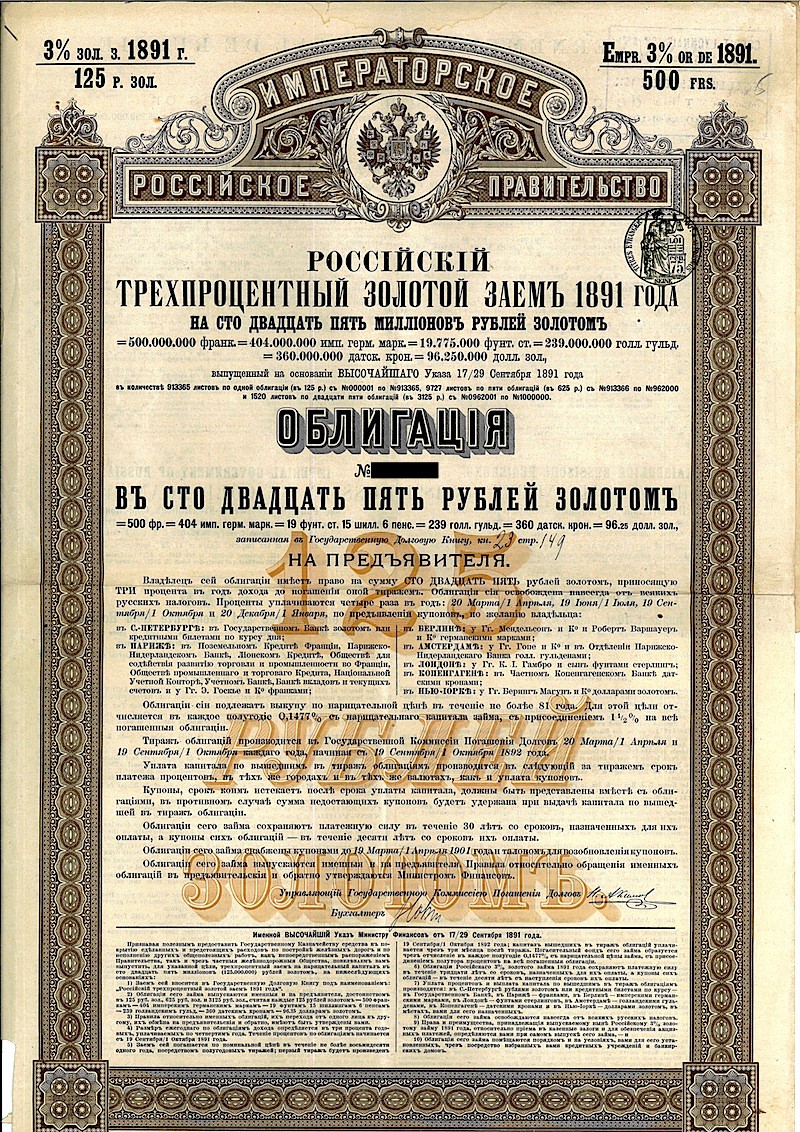
Russian bond.jpg

With “Bankers and Bolsheviks: International Finance and the Russian Revolution,” Hassan Malik has written a fascinating study of an overlooked topic—but not a book for emerging markets investors who like to sleep soundly at night. Mr. Malik chronicles the involvement of foreign capital in Russia before and up to the October Revolution. It ends expensively. Shortly after taking power in 1917, the Bolsheviks repudiated Russia’s debts. Adjusted for inflation, this remains the biggest sovereign default in history, made costlier by its completeness. No debts or obligations were “restructured”: With token exceptions, the money was gone for good.

Mr. Malik’s meticulous, forensic account reveals why late Romanov Russia—for a few years the world’s largest oil producer—had been so successful in attracting funding from abroad. Mr. Malik, an investment strategist and financial historian, is more skeptical than many about the contribution made by Sergei Witte, who was Russian finance minister between 1892 and 1903 (before rising higher still). But the surge in Russia’s economic development during those years is beyond dispute. Net national product grew at an estimated compound annual rate of nearly 5%, “very high” for the time, according to Mr. Malik. Other numbers tell a similar tale.

That Russia turned to foreign bond markets during a wave of financial globalization was not “particularly remarkable,” the author notes. That it would become “the largest net international borrower in the world” was, he believes, a different matter. Given the pace of Russian growth, however, and bankers’ perennially Pavlovian response to the whiff of profit, I am not so sure.

There was also the perception at the time that, for all its faults, Russia was “a responsible member of the European family of civilized nations.” As such, the czar’s government was rewarded with more trust than it probably deserved. In 1906 Russia secured a massive loan despite troubling finances, an economic slowdown, a shaky currency, recent military defeat by the Japanese, and something close to outright revolution. More foreign money followed, drawn in by a return to growth. Nevertheless, Mr. Malik argues that late imperial Russia was more fragile than understood then (and now). Debt was piling up and the political system was unstable. It took a huge build-up in defense spending—the silver lining of a cloud about to burst—to revive an economy that was again faltering.

If the attitude of foreign financiers toward Russia up to 1914 can be defended, their behavior afterward is rather harder to explain. By early 1917 Russia was losing World War I, its finances were crumbling, the economy was buckling and the political climate was deteriorating. Despite this, Mr. Malik notes, “the risk premiums on Russian debt relative to Western benchmarks approached multiyear lows.” Wartime politics played their part, and so did moral hazard, thanks to Russian government guarantees (and vague support from its allies). The liberal revolution that overthrew the czar in early 1917 was broadly welcomed as another step in a transformation in which, as Mr. Malik observes, international financiers considered they had long been participating. Maintaining or increasing their presence in a newly liberal Russia would be a “logical continuation” of that role, so that’s what they did.

What ensued, unfortunately, was not the next stage in a benign evolutionary process, but an abrupt break with the past. Foreign investors anticipated radical change, maintains Mr. Malik, but not the direction it took. This was a mistake more forgivable than he implies: There was nothing inevitable about the Bolshevik triumph that fall. The author is right to highlight the probability that, even if the liberals had held on to power, “a fairly significant default” was on the cards. But a default by a liberal regime would have borne no comparison to the Bolshevik default.

Even had the Bolsheviks been able to honor the debt, they would not have done so. This was a matter of principle (why, asked Lenin, repay lenders who financed “the Cossack whip and sword”?) as well as strategy. Debt repudiation was a weapon in the class war, intended to dismantle the economic strength of the bourgeoisie at home and to foment trouble abroad—specifically in France, where investment in Russian securities had spread a long way down the social scale.

Mr. Malik records the insouciance or even optimism of foreign financiers in the face of late 1917’s political turmoil. This may have peaked with “in hindsight . . . one of the most bizarre business decisions in American banking history”—no mean feat: The forerunner of Citibank opened its Moscow branch “nearly three weeks after the Bolshevik takeover.” This was an extreme example of the consequences of some financiers’ misreading of Lenin’s new order, a phenomenon Mr. Malik handles well. Precedent (Russia had never defaulted) suggested the new regime would see reason, as did a conventional understanding of morality and self-interest. Yet bankers and Bolsheviks defined reason, morality and self-interest in very different ways. Lenin’s oddball sect wanted to remake Russia (and the world). If that meant cutting itself off from international capital, too bad.

Mr. Malik criticizes foreign investors for not grasping “the political dimension” of financial support for the czar’s sometimes savagely repressive rule. But their unpopularity with the opposition was somewhat ironic: It overlooked the way in which “apolitical” foreign financing contributed to a modernization that, however unintentionally, subverted the ancien régime. And investors may have paid too much attention to politics later on. One element in the seemingly complacent reaction of international financiers to the February Revolution was a desire to help the liberal reformers. This may have been too much of a gamble but, given what was to come, it was worth taking. Russia’s tragedy was not that it ran out of money, but that it ran out of time.

Reflecting What They Were?

National Review Online, January 12, 2019

The Velvet Underground Experience, New York City, December 2018 © Andrew Stuttaford

The Velvet Underground Experience, New York City, December 2018 © Andrew Stuttaford

If you can remember the 1960s, goes that quote with many authors, you really weren’t there. I was about six when the Sixties properly got going and living somewhere where the last person to truly swing had botched a rebellion against a Tudor. So sadly, I remember those Sixties pretty well, a distant party glimpsed mainly on the telly, colorful, whimsical, and saturated with bright, shiny music — coffee-flavored kisses at Clarksville station, love is all you need, gentle people with flowers in their hair.

What I never heard was this:

Cut mouth bleeding razor’s

Forgetting the pain

Antiseptic remains cool goodbye

So you fly

To the cozy brown snow of the east

That was the Velvet Underground doing their best worst in The Black Angel’s Death Song, a torrent of words, melody, and screeching electric viola that, played once too often before puzzled audiences in Greenwich Village’s Café Bizarre, brought an abrupt end to their stint there in December of 1965. The Velvets had started taking shape the year before, but after the departure of their first drummer, an eccentric who later came to an unsatisfactory end in Nepal, assumed the form (Lou Reed, John Cale, Sterling Morrison, and Moe Tucker) in which, with one brief, spectacular addition, they ultimately entered rock legend. The band’s name was stolen from the title of an, uh, investigativepaperback (“a documentary on the sexual corruption of our age”) found on the sidewalk or — pick your myth — the gutter. Another early song, inspired by a book by Leopold von Sacher-Masoch (yes, that Masoch), was a further sign that the Velvets were not headed for Main Street, Pleasant Valley, or Penny Lane.

Given the time, the place — New York City — and the Velvets’ direction, it is not so surprising they spun into Andy Warhol’s orbit. He became their ringmaster, handing them a chanteuse — the German-born Nico, who had trouble holding a tune — and the role as the band in a series of multi-media events known as the Exploding Plastic Inevitable. It was a chance, said Warhol, “to combine music and art and films,” a Gesamtkunstwerk of a kind, if not one that Wagner would have appreciated.

The collaboration lasted longer than Warhol’s “15 minutes” (about 18 months), and — despite some entertaining reviews (Cher grumbled that their gigs would “replace nothing, except maybe suicide”); The Velvet Underground & Nico, their astonishing debut LP; some media attention; and even the approval of Marshall McLuhan — it didn’t leave the Velvets particularly famous, at least then. The album flopped.

But more than anything else, those 18 months explain why, after more than half a century, The Velvet Underground Experience, a sprawling, “immersive” exhibition, opened, after a run in Paris, in New York City this fall (it closed in December) not so far from the location of the long-vanished Café Bizarre. There are reportedly plans for it to reappear in Chicago, San Francisco, and Los Angeles.

Most exhibitions dedicated to a band struggle to offer a new perspective on what is, primarily, an aural experience. Ancient guitars and fading posters will please only the saddest of fanboys. But when the music was part of a broader cultural moment, there are possibilities for something better, an opportunity that the curators of this show (backed by Citi, among others, a sponsor that Warhol, no foe of the dollar, would have relished) grabbed and then fumbled.

The first hint of trouble was lurking on the placard — “Welcome to America” — by the entrance to the main hall, a dreary proclamation enlivened only by a three-way fight between banality, cliché, and groupthink:

In the aftermath of World War II, America’s consumerism spread more than ever, often carrying with itself conformist and family-centered values as broadcast in the image of the Good American in the newly-booming media.

This gave rise to a provocative counter-culture of artists and thinkers, who rejected the era’s fake smiles and condemned the rigidity of a supposedly liberal society in which non-conformity was thought to be deviant and dangerous. These individuals . . . defended radically different ways of life, took alternative paths and questioned prevailing rules and taboos. All of this was embodied in the life and work of the indefatigable figurehead of the Beat Generation poets, Allen Ginsberg.

Allen Ginsberg. Not again. On one side, the sound of the sage of the East Village reading America, and on the other, a selection of film footage designed to contrast vintage blandness with uncomfortable truth and vintage woke. That the consumer society was infinitely more revolutionary than some bearded “prophet” bemoaning materialism (a commonplace nuisance for thousands of years) went unnoticed, an error Warhol never made.

But that “provocative counter-culture” was indeed flourishing — and self-aware. One reason the Velvets took their name was the “underground” in the book’s title. They also defined themselves by reference to where they were — downtown Manhattan. Rifling through a pile of words that someone had left on a laptop, the writers of the “about” section on the exhibition’s website expanded on the latter:

This was where experimental musicians, underground filmmakers, taboo-busting poets and young people challenging the diktats of the heterosexual norm all converged. In this unique context, the verses of the Beat poets the audacious harmonics of La Monte Young and the experimentation of underground cinema would rub off on Lou Reed and John Cale before they brought the Velvet Underground to life. At the intersection of pop culture and the avant-garde, conceptual art and tribal beats, juvenile shenanigans and the most sophisticated of theories.

Juvenile shenanigans! The most sophisticated of theories!

The convergence was real enough. Classically trained John Cale, the band’s viola player (and much, much more), was involved with New York’s avant-garde music scene. It was an experimental filmmaker, Barbara Rubin, who introduced the Velvets to Warhol. The exhibition managed to convey an impression of this world with photographs of a grubby East Village, the band, their associates, and long-forgotten happenings — among them an 18-hour piano recital and a performance featuring wet paint, sausages, raw fish, and writhing. For all the typos, overwriting (“music that was both schizophrenic and fluid”), hyperbole, malapropisms, chaotic grammar, and, on at least one occasion, chaotic chronology, the various displays gave a useful sense of who was doing what. Some films from that milieu were on continuous loop. Watching Peyote Queen with only Anacin to hand is, I now know, a mistake. Behind a closed door promising X-rated material was Rubin’s Christmas on Earth, a movie (filmed in Cale’s apartment) that used to bear a less misleading title. Step away from Google, people.

The Velvet Underground Experience, both conceptually and literally, revolved around the band’s Warhol connection. Visitors could lie back on silvery cushions, a nod to the décor of Warhol’s studio, the Factory, in a wood-framed central space and stare at multi-screen projections — another mid-Sixties fad — of mini-documentaries made for the exhibition as well as of original footage of the Velvets and other Factory denizens. The band was shown performing or (filmed with the paradoxically passive voyeurism the Factory had made its own) just doing not so very much. Other spots elsewhere were dedicated to the band and its individual members. But gazing up at those images was the best way to understand the magic — often a dark magic — of Warhol’s universe and the role that the Velvets filled within it.

In another room, more footage, this time dedicated to Nico (Christa Päffgen), tall and blonde with a Warholian remoteness. Nico had been an actress, a model, and a Marianne Faithfull in more ways than one, and had previously recorded a bouncy pop song on which a friendly Rolling Stone had played. Warhol calculated that she would add glamor to a foursome that rarely looked better than down at heel. He was right. Her contributions — including three deceptively dulcet counterpoints to some of the more obviously harsher moments on an album where her apartness was underlined in its title — The Velvet Underground & Nico — were some of the most memorable in the band’s history. But clashing egos and Nico’s uncertain relationship with the clock ensured that her history with the Velvets didn’t last long.

The other members of the band received their due too, and so did the albums that followed the break with Warhol and their breaks with each other. There were fewer artifacts than might have been expected, although this sad boy enjoyed seeing two copies of the first album’s original cover — one signed by the band and another where some wicked soul had peeled the notorious banana. This shortfall was in line with this exhibition’s somewhat slapdash quality, which extended beyond carelessly written materials to encompass a gift shop that combined a scarcity of anything that anyone might want to buy (Edie Sedgwick iPhone covers, anyone?) with prices ensuring that they would not even be tempted. Maybe the organizers thought that the Velvets’ brand was enough of a lure, and maybe they were right.

That said, there was just enough, other than nostalgia, to merit a visit by more dedicated fans, notably those films from the Factory. And there was one marvel: a short, animated documentary in which Tony Jannelli (one of the two directors) recalled the bewildered and appalled reaction when the Velvets played at his New Jersey high school. Any visitors unfamiliar with the Velvets’ music (not many, I reckon: Most attendees I saw were north of forty) might have wondered what all the fuss was about. But not only newbies would have been taken aback by the claim, made in a section dedicated to the band’s ‘legacy’, that the “spirit and range of their New York City rock” eventually “won over the entire planet”. They talk of nothing else in Pyongyang.

How much the Velvets influenced the way things were going and how much they merely anticipated what was already on the way is impossible to know. Where they were, perhaps, at their most innovative was lyrically. This was not so much for their matter-of-act descriptions of drug use. There had been popular songon that topic (sometimes camouflaged) decades back. So, in I’m Waiting for The Man the Velvets sang of a junkie (“sick and dirty, more dead than alive”) traveling “up to Lexington, one, two, five” to meet a (heroin) dealer, but thirty years before there was this about a weed, er, retailer from Stuff Smith And His Onyx Club Boys:

Where’s the man with the jive?

There is a man from way up town

Who will take away your blues

And any time the man comes round we like to spread the news

What was new was the Velvet Underground’s treatment of characters from subcultures that had been largely invisible in pop music, such as the transvestites whose orgy goes so wrong in Sister Ray (sailors, a murder, heroin, the police at the door, could happen to anyone), subcultures they simultaneously mythologized and helped usher into some sort of mainstream.

Musically, the Velvet Underground may have been at the cutting edge, but other bands were also beginning to blend pop, rock, and avant-garde. The Exploding Plastic Inevitable was not the first light show. What distinguished the Velvets was not their sales (lamentable at the time) but that they were, if only briefly, very, very good. People in the next city this exhibition is destined to visit who don’t know much about the band but are curious about their work should give The Velvet Underground Experience a miss. They should immerse themselves instead in the first three albums (forget the fourth, Loaded, whatever critics may say): The Velvet Underground & Nico, its successor, White Light/White Heat, with its madcap amphetamine rush, and finally the quieter and strangely unsettling The Velvet Underground. Then they should scour YouTube for footage of the Factory at its peak. If they do all that, they will learn more and spend less.

Jean-Claude Juncker’s boast about the euro is an insulting fantasy

Juncker.jpg

History may or may not repeat itself, but hubris certainly does. In April 2008, as the euro approached its tenth birthday, Joaquín Almunia, the EU’s then Commissioner for Economic and Monetary Affairs, recalled how its construction had been accompanied by “dissenting voices”. “One economist” had jeered that it was “at best, an act of uncertain merit”. Another had denounced it as a “great mistake”. Fools! Almunia bragged that “the euro [had] proved an economic success”.  Within 18 months Greece was in crisis.

Earlier this week Jean-Claude Juncker marked the euro’s 20th anniversary of with words seemingly so far removed from reality that not even sciatica could explain them away: “The euro has become a symbol of unity, sovereignty and stability. It has delivered prosperity and protection to our citizens…”

Goebbels once wrote that “the English follow the principle that when one lies, one should lie big, and stick to it. They keep up their lies, even at the risk of looking ridiculous”. However, he would not have expected the English to mock those who they were trying to convince.

Juncker, no Englishman, but known to some as “the master of lies”, has rarely shown much concern about appearing ridiculous. Nevertheless, boasting that that the euro has delivered prosperity insults almost every member state other than Germany, particularly those hit hardest by the bursting of bubbles wholly or partly inflated by the single currency. Most may have crawled out of the A&E (or in Ireland’s case done rather more than that), but memories of what they went through are fresh. And in some instances, they aren’t even memories. Youth unemployment in Greece has only recently fallen below 40 per cent. GDP per capita in Italy (where the euro’s corrosive effect is real, but more difficult to assess) stands roughly where it did in 1999.

On the other hand, Juncker’s claim that a currency which has brought chaos and division in its wake is a symbol of “unity” and “stability” may seem equally absurd, but seen from Brussels, it makes good sense. To appreciate why, note the reference to “sovereignty” as another of the qualities symbolised by the euro. A country that relinquishes its own currency gives up some of its sovereignty, but Juncker was focused on where that sovereignty had been transferred. And that was to “Europe”. Having its own currency represented a major advance in the EU’s step-by-step assumption of sovereignty, and with it, the attributes of a state.

Now adopt that same Brussels perspective to understand what Juncker meant by unity. Despite sharp disagreements, those running the Eurozone stuck together through the crisis, trashing treaty obligations, promises to voters, a referendum result, the integrity of the European Central Bank, economic logic and basic democratic norms to keep the currency union intact. They succeeded in a display of unity that also delivered Juncker’s notion of stability — a Eurozone that weathered the storm — as well as a strong indication that it will continue to overcome the challenges that come its way.

Part of the reason for that, is that once in the euro, there is no easy exit. “Ever closer union” are perhaps the three most important words in the EU’s definition of itself: They imply that there is no reverse gear. Nowhere is this more the case than, as its creators intended, with the single currency, described in 2012 by one top German civil servant as “a machine from hell that we cannot turn off” — words to remember amid current talk of widespread support for the euro.

But back to hubris. Like so much central planning, the euro was born of arrogance, over-confidence, conceit and ideological obsession. Cramming a large number of diverse economies into a necessarily Procrustean currency union made little economic sense—the savings flowing from the removal of foreign exchange risk were somewhere between minimal and illusory. It was also an invitation to disaster, made riskier still by the absence of any degree of fiscal union, something which might have provided a safety net, but would not have been politically acceptable in many of the countries signing up for the new currency.

One example of hubris overlapped with another. Some of those in charge of putting the euro together were aware of its innate flaws but expected that they would eventually lead to—as the phrase in Brussels goes— a “beneficial crisis”. This would be the catalyst for forcing through the fiscal union that had always been the logical counterpoint of monetary union and would also constitute a giant leap forward towards ever closer union. The hubris lay in believing that such a crisis would be manageable in the manner that Brussels hoped.

It wasn’t. Even allowing for its starting point, Juncker’s perception of unity is based on turning a blind eye to some highly inconvenient truths. Made even more destructive by its intertwining with the financial crisis, the storm that tore into the Eurozone essentially divided the currency union’s member states into two antagonistic camps, creditor nations in the north and debtor nations in the south.

The north’s distrust of the south, and the south’s resentment of the north, along with economic distress and the realisation that Brussels and its allies bore much of the blame for this mess (but had no interest in changing direction) also boosted political parties once confined to the fringe or triggered the formation of new parties that would once have found a home there. Those forces were given additional impetus by an unrelated issue— mounting unease over immigration and its longer-term implications. What’s more, many continental eurosceptics have been transformed from naysayers opposed to further integration into a force that actively wants to reverse the direction of ‘ever closer union’. Populist governments (of very different hues) have come to power in Greece and Italy.

Germany and other ‘northern’ states are now even more firmly set against fiscal union, rightly regarded as a device to milk their taxpayers in perpetuity. In the Eurozone’s south, meanwhile, there is increased resistance to Germany’s insistence on enforcing its sometimes counter-productive brand of fiscal discipline on everyone else. It’s significant that, with Emmanuel Macron’s own plans for fiscal union floating face-down in the Spree and gilets jaunes roaming France’s streets, his government will now be breaching (just a one-off, of course) the EU’s budgetary rules.

All that said, betting against the survival of the euro is unwise. The political will to keep this vampire currency going should, as the last ten years have shown, not be underestimated and populist parties are just as conscious as their more orthodox rivals of the general public’s fear of ‘something worse’.

But European growth prospects are deteriorating despite years of the ECB doing “what it takes”. The economies (and balance sheets) of many of the Eurozone’s weaker member-states continue to suffer from the after-effects of the last crisis and remain confined to the straitjacket of a one-size-fits-all currency:  They will not be well placed to cope with a fresh slowdown. It’s hard to avoid the conclusion that another Eurozone drama may well be approaching, with political consequences that are likely to be much trickier than last time around.

One way to head off some of the worse of what might lie ahead would be by splitting the single currency into ‘northern’ and ‘southern’ euros which would better reflect the economic realities of the domestic economies they serve. This would be far from straightforward, but it beats sticking with a status quo that offers much of the Eurozone little more than stagnation at best, and catastrophe at worst.

But such a split runs against the idea of the irreversibility of ever closer union. It’s never going to happen.


Dat's Capital

Alan Greenspan and Adrian Wooldridge - Capitalism in America: A History

National Review, December 20, 2018 (December 31, 2018 issue)

New York City, March 1989 © Andrew Stuttaford

New York City, March 1989 © Andrew Stuttaford

With 29-year-old “democratic socialist” and imminent congresswoman Alexandria Ocasio-Cortez widely seen as the harbinger of a future that, with luck, I may be too aged to see through to Caracas, Capitalism in America may come to be regarded as an obituary as much as a history. Not that its two authors, Adrian Wooldridge, political editor of The Economist — a magazine now closer to Davos liberalism than to the classical kind — and Alan Greenspan, who needs no introduction, would see it that way. Capitalism in America is a celebration — some of it should be read to music, Sousa, say, when the narrative reaches the Gilded Age — of the economic system that took the U.S. to the top of the world and could, maintain Greenspan and Wooldridge, still keep it there. They may warn of “America’s fading dynamism,” but they conclude that the country “is trapped in an iron cage of its own making,” to which it “has all the keys that it needs.” The question is whether it has the “political will” to use them. Indeed.

Messrs. Wooldridge and Greenspan possess a sharp understanding of the political foundations of American growth — as they must. There were, after all, other large countries blessed with rich resources and abundant land, and, as the 19th century drew on, the ability to exploit them. Argentina’s great liberal president, Domingo Sarmiento (1811–88), dreamt of emulating the developing colossus to the north. By the 1890s, Argentina was among the wealthiest places on earth (on one measure, briefly the richest), and European immigrants were pouring in. And yet the U.S. now stands where it now does, and Argentina is, well, Argentina.

“Anyone who regards economic history,” caution Greenspan and Wooldridge, “as history with the politics left out is reading the wrong book.” America’s economics would have been impossible without its politics, and the latter were, the authors emphasize, profoundly shaped by the happy timing of the country’s founding, born in the age of enlightenment. Although they do not explicitly say so, the variant of the Enlightenment that weighed most on the Founding Fathers, for ancestral as well as intellectual reasons, was British, the fruit of an incremental process dating back to (at least) 1688, rather than its more radical French alternative. Moreover, it was buttressed by having inherited what Greenspan and Wooldridge refer to as “many of Britain’s best traditions,” from the common law to a certain respect for individual rights. In that sense, “the American Revolution was only a half revolution.” The nascent republic was marked by a suspicion of both monarchical rule and unrestrained popular government. Commerce was able to slip through the gaps, helped by, as the authors explain, the insights of Adam Smith, the prohibition of internal trade barriers, and — a critical incentive for the enterprising — the strong defense of property (including intellectual-property) rights enshrined in the new Constitution.

This settlement was made easier to sustain by the United States’ birth in “an age of growth — an age when the essential economic problem was to promote the forces of change rather than to divvy up a fixed set of resources,” a summary that is on the crude side — fighting over the proceeds of growth can be ugly enough — but works well enough for a country that, more than anywhere else at that epoch, was a land of opportunity.

And what allowed America’s inventors, innovators, and entrepreneurs to make so much of this opportunity was the extent to which creative destruction (to Greenspan and Wooldridge, “the ‘perennial gale’ that uproots businesses — and lives — but that, in the process, creates a more productive economy”) was allowed free rein. In this heroic retelling — Howard Zinn, avert your eyes — of America’s expansion (the Gilded Age is rechristened “the Age of Giants”), creative destruction — the hammer in the invisible hand — is the mightiest hero of all, “the principal driving force of economic progress.” The government’s job, the authors note approvingly (did I mention that Alan Greenspan was a part of Ayn Rand’s circle?), was to protect property rights and the sanctity of contracts and then, rather than “tame” creative destruction, enable it and get out of the way. Less was more: “The old nations creep on at a snail’s pace,” wrote Andrew Carnegie. “The Republic thunders past with the rush of an express.”

While praising America “as a huge positive” not only for itself, but for what it has given the wider world, the authors don’t gloss over the darker side of “numerous disgraces” that have marred its rise. Slavery was a system resting “on foundations of unfathomable cruelty” that brought riches to the South but condemned it to economic backwardness as well as moral squalor. They also acknowledge that the state played a more active role in America’s economic explosion than it might be polite to mention in Galt’s Gulch. Railways, in many respects the Internet of the era (though, in a testimony to a time of remarkable innovation, there’s also the telegraph to think of), benefited — as, subsequently, did the Internet itself — from Uncle Sam’s largesse. Vast land grants offered railway companies the chance to risk a fortune building rails “in the middle of nowhere” in the hope of making a fortune by turning a “piece of nowhere into a part of the global economy.”

The authors write snappily and memorably, but not at the expense of subtlety. Thomas Edison’s “greatest claim to fame is arguably not as an inventor but as a systematizer of invention.” He created the first industrial laboratory and staffed it with “German PhDs, skilled craftsmen, and ‘absolutely insane men,’” the last category a preview, perhaps, of the pizza-munching Asperger’s army taking a (silicon) valley to fresh peaks.

By outlining the backgrounds of these economic pioneers, an impressively recurrent tale of creativity, social mobility, and sometimes uncontainable energy (Isaac Singer, of sewing-machine fame, sowed very widely, fathering at least 24 children, and, at one point, ran three households simultaneously), Greenspan and Wooldridge highlight the extent to which the American story was one of individual achievement. Those individuals did, Mr. Obama, build this.

But as the country grew richer, its politics changed, reflecting the growing electoral clout of those at the rough end of creative destruction, mounting alarm at escalating oligarchic and corporate power and its abuse (Teddy Roosevelt’s “malefactors of great wealth”), and a broader shift in opinion away from laissez-faire. This transformation in sentiment was accelerated by the Depression and two world wars but was well under way from the beginning of the 20th century, not least due to the size, complexity, and problems — “pollution,” relate Greenspan and Wooldridge, “on a terrifying scale” — of a country growing at an astonishing rate, a new kind of society that, it seemed self-evident, required steering by more than an invisible hand. There was also an early flowering of what has become an endemic phenomenon: “By producing prosperity, capitalism creates its own gravediggers in the form of a comfortable class of intellectuals and politicians” able to use the negative side of creative destruction to sell their own agenda.

The final two-thirds of the book details the evolution of American capitalism since the assault on laissez-faire first gathered speed. Adaptive, protean, and endlessly inventive, capitalism has proved to be more resilient than its early-20th-century champions might have expected. Government activism may have ebbed and flowed (this is not, incidentally, a book for FDR fans), but even if the Constitution acted as a restraint on the state’s encroachments, it never returned to low tide. Nevertheless, America’s private sector remained re­markably productive, famously through the 1920s, but again in the long post-WWII boom. Revived by Ronald Reagan after the stagflation of the 1970s, it flourished during what Greenspan and Wooldridge dub “the age of optimism” until the arrival of lean years marked by the dotcom bust, the runaway spending of the George W. Bush years, and the financial crisis, a catastrophe about which these authors have disappointingly (considering the identity of one of them) little that is novel to say.

Looking, however, beyond the proximate causes of the Great Recession, the authors are right to see signs of a deeper malaise in the economy, a creeping sickness that shows up in many ways, including lower productivity, declining social mobility, and unhealthy concentration in many industries. They attribute much of this to a decline in American exceptionalism. Creative destruction’s wild ride is being replaced by excessive risk aversion and overregulation. And they fret about swelling entitlements, both for their ultimate unaffordability and for the way they encourage consumption over the saving that is essential to fund productivity growth.

In an attempt to bring back a little cheer as their book draws to a close, Greenspan and Wooldridge observe that “America leads in all the industries that are inventing the future,” including artificial intelligence and robotics. But that future comes with a catch that they may have missed. Neither those industries nor their immediate digital predecessors, prime examples of creative destruction, are replacing the jobs or the wage rates to which they are laying waste. That could well account for more of America’s malaise than Greenspan and Wooldridge would care to admit, and may — Donald Trump, Bernie Sanders, or even Ocasio-Cortez could all be straws in a very different gale — herald an era of destruction with nothing creative about it.

Her Inner Brezhnev

National Review, November 15, 2018

Merkelangry.jpg

There was a time when Angela Merkel, like many young East Germans, would don a special shirt (blue rather than brown; different dictatorship) and parade for the Party, sometimes (not everything had changed) by torchlight. On occasion, she and her Free German Youth comrades would have marched behind banners carrying the portrait of Leonid Brezhnev, the Soviet leader whose extended (1964–82) rule has more than longevity in common with her own.

No, no, Merkel is not a Communist. Nor does she order the invasion of other countries; she merely bullies them. She may have participated in the overthrow of Italy’s unruly and unacceptably euroskeptic Silvio Berlusconi, but no tanks were deployed, just “suggestions” made menacing by Italian fears of what the bond-market vigilantes might do.

Look deeper, however, and unsettling similarities come into view. That Brezhnev was no democrat is hardly a surprise. That Merkel, the bien-pensant “leader of the free world,” has repeatedly demonstrated her disdain for democratic propriety is, by contrast, disappointing. Perhaps it is a legacy of her East German upbringing, but, whatever the cause, it has poisoned both the politics of the country she leads and those of the EU, the misbegotten union that Germany dominates with a mixture of passive aggression, money, and size.

In the early 2000s, Brussels, compelled as always by the imperative of “ever closer union,” midwifed an ambitious draft constitution only to see it felled by French and Dutch referendums. When voters get a direct say on deeper European integration, they have a way of saying no.

That should have been the end of the matter, but Merkel used Germany’s tenure of the EU’s rotating presidency (it’s complicated) to cobble together the Lisbon Treaty, a sly pact that reproduced the spurned constitution in every material respect but was structured in such a way that pesky referendums could be dodged everywhere other than reliably awkward Ireland. No matter: The Irish rejected the treaty in one referendum but, engulfed by the financial crisis, were cajoled into changing their minds.

The treaty became law, but, not for the last time, Merkel had underestimated the consequences of paying so little attention to popular feeling. Lisbon, which helped pave the way for Brexit, reinforced many Europeans’ anxiety that the EU was slipping into post-democracy, a perception later bolstered by Merkel’s role in the euro’s long ordeal and, more recently, by her efforts to bludgeon other EU countries into accepting more of the migrants and refugees she so carelessly welcomed in 2015.

Some of Merkel’s actions in the latter two instances were a straightforward defense of German national interests. But her insistence on Lisbon was another reminder that, at some level, this supposedly pragmatic politician clearly believes that European integration is on the right side of history, a phrase, Robert Conquest wrote, with “a Marxist twang.” If so, she is not alone, but it is reasonable to ask whether in Merkel’s case this dubious proposition has been made easier to swallow by formative years spent in a land where Marxism was a part of the ideology of the state.

Merkel’s authoritarianism has taken an even more disturbing turn at home. Her instinctive dislike of dissent — the dark side of consensus politicians — curdled into something more sinister in the wake of that 2015 decision to throw open Germany’s doors. With mainstream media hymning the chancellor’s Wilkommenskultur, Germans uneasy about the influx into their country had nowhere to go but online, sometimes via the gutter, often not.

Infuriated, Merkel began by bullying social-media companies to clamp down on what she regarded as hate speech. When they did not, in her view, do enough, she looked to her parliamentary colleagues for assistance. The result, prompted also by scaremongering over “fake news,” the switched-on censor’s excuse du jour, was Germany’s social-media law — the notorious Netzwerkdurchsetzungsgesetz. It represents an attack on free speech so draconian (for example, if a social-media company fails to take down “manifestly unlawful . . . hate speech” or “fake news” within 24 hours of a complaint, it can be fined up to 50 million euros) that it has provided useful cover for Russian legislators looking to shut down undesirable talk online, a development that would have amused old Leonid.

When Mikhail Gorbachev launched his program to overhaul the Soviet Union, he attacked Brezhnev’s “era of stagnation,” a label encompassing political as well as economic inertia. While Brezhnev was appealing to a far smaller “electorate” — the party elite — than Merkel has done, the key to the length of their tenures was (obvious differences aside) sticking with consensus and maintaining stability. As a strategy, it worked, but the stagnation that ensued contributed to the Soviet collapse. As for Germany, it is too soon to say.

By ending the experimentation of the Khrushchev years, Brezhnev shrank the political and intellectual space within which the regime could safely operate. When his moment came, Gorbachev saw a relaxation of party control as inseparable from a desperately needed economic reset, but, after Brezhnev, it was too late to change direction. If the opening for reform within the system had ever existed, it had closed.

Germany is not, of course, lurching toward a Soviet-style implosion. That said, Merkel’s capture of the middle ground, inspired by both personal conviction and strategic savvy, is showing signs of backfiring in ways that, if events oblige, as they well may, will undermine the centrist order over which she has presided for so long. The middle ground ought to be a battlefield of ideas. That is not how it has been under Merkel. By moving her center-right CDU so far leftward, Merkel has occupied much of the territory that the SPD, the leading party of the center Left, once called its own. The SPD’s displacement was accelerated by its participation in coalition governments with Merkel between 2005 and 2009, as well as since 2013. As partners go, she has proved to be something of a black widow. Between 2013 and 2017, the SPD’s support fell by over a fifth, to 20.2 percent, half its level in 1999, and it is still falling. The SPD now trails the Greens, who are hipper, socially liberal, migrant-friendly, NATO-not-so-friendly, eurofundamentalist, but — and this is a major but — environmental issues apart, relatively centrist on economics.

Upheaval has come to the Right, too. Merkel’s agreement to the bailout of the euro zone’s casualties drove some classical liberals, skeptical about both the single currency and the steps being taken to preserve it, to set up “the professors’ party,” the Alternative for Germany (AfD) — its very name a protest against Merkel’s stifling consensus — in 2013. The AfD saw some early success but shifted into a higher gear, losing much of its former leadership in the process, when it also became a vehicle for social conservatives and immigration skeptics who felt that there was no longer a place for them in the CDU or the CSU (the CDU’s considerably more conservative Bavarian counterpart). This was particularly so after Merkel flung open those doors — and clamped down on those who dared to demur.

The AfD’s transformation has given it a rougher-edged nationalist following. After a string of provincial successes, the party made it into the federal parliament in 2017, cutting into the vote won by the CDU and the CSU. In this October’s elections in Bavaria, home of the CSU, it took 10.6 percent. When consensus hardens into an orthodoxy enforced by establishment parties, voters, when worried enough, ignored enough, and silenced enough, look elsewhere.

Brezhnev’s era of stagnation was also an era of squandered opportunity. The USSR’s vast oil reserves could have made a substantial contribution to funding the reorganization of its economy. But, isolated within an increasingly archaic consensus, the Soviet leadership renounced even modest reform, preferring to anesthetize the population with (very) modest prosperity. The windfall was frittered away on massive defense spending, hugely generous subsidies of allies and satrapies, and a futile attempt to prop up a command-and-control system that could not meet the demands of a modern economy. The reckoning was not long in coming.

Whatever the criticisms that can be made of Merkel, splurging on the defense budget is not one of them. Her slide to the left may not have involved an embrace of the neutralism that runs through so much of German politics (Merkel is no fan of Putin and pushed for sanctions in 2014), but she has been reluctant to challenge either neutralism’s consequences — the armed forces have been so badly neglected that their combat-readiness has been called into question — or its assumptions. To be sure, Merkel has undertaken to increase defense spending (currently 1.2 percent of GDP), but only to 1.5 percent of GDP (still far below NATO’s 2 percent target) and only by 2024. Throw in the prospect of increased dependence on Russian gas once the Nord Stream 2 pipeline is operational, and after 13 years of governments headed by the alleged leader of the free world, it is uncertain how effective and reliable an ally Germany really can be.

On a brighter note, the German economy is booming, rich, and the envy of most of the world. Nevertheless, it’s worth remembering that in the 1990s Germany was, by its standards, struggling. Quite what changed is fiercely debated. Explanations include labor-market reforms and tax cuts (the latter, tellingly, opposed by Angela Merkel, then the CDU’s new leader) introduced by the Social Democrats under Chancellor Gerhard Schröder in the early 2000s; the boost to Germany’s crucial export sector from a concealed devaluation (the switch from the deutsche mark to the euro); the easing of some of the strains associated with German unification; and, since the 1990s, the manner in which more-decentralized wage-bargaining has increased flexibility (and, with it, restraint) over pay. This turnaround gave Merkel the latitude to coast, but, given her own less-than-market-friendly views and her determination to command the center ground, she was never likely to build on the Schröder reforms. And she has not. Sometimes, such as by the introduction (in 2015) of a uniform minimum wage across the country, she has even subverted them. Business remains heavily regulated, a hurdle that goes some way toward explaining the relatively low levels of capital investment by German companies in their own country. That investment shortfall has, in turn, contributed to faltering productivity growth.

High taxation is another disincentive, and not only to investment. The writer of a recent article for the business daily Handelsblatt detailed how Germany had failed to keep pace with corporate tax cuts elsewhere. He blamed the complacency bred by the economy’s current strength, but that is only part of the story. Germany’s prevailing consensus has scant room for aggressive tax-cutting, something that Merkel has done nothing to change.

Meanwhile, a blend of panic after the Fukushima nuclear disaster in Japan (which triggered a German decision to speed up the planned phase-out of nuclear power) and an enormous and hugely expensive program of investment in renewable energy prompted by panic over climate change (another critical element in the politics of Germany’s middle ground) has meant a dramatic hike in energy costs for industry and, even more so, consumers, while — central planning being what it is — failing to yield the promised environmental return.

So long as Germany prospers, none of this may matter, but a cyclical downturn, perhaps exacerbated by trade tensions, could well be approaching. That may cause difficulty in the immediate future — and it will not help the absorption of all those migrants into the work force — but longer-term concerns are beginning to surface, too. The old Soviet economic model was unable to cope with the changed world of the second half of the 20th century, and there are signs that its (admittedly immeasurably more flexible) German counterpart might not be doing what it takes to keep up with the evolving digital economy. This is so with basic infrastructure — according to a 2016 OECD report, under 2 percent of German broadband connections were fiber-optic — but also, more subtly, with the adaptation of business practices or, for that matter, products that lie ahead: With autonomous vehicles coming down the pike, will Germany’s automakers soon be facing off against Google?

That will be a problem for someone other than Merkel to contemplate. After the disappointing general election was followed by setbacks for the CSU in Bavaria and the CDU in Hesse, Merkel stepped down as the CDU’s leader. She will continue, she says, as chancellor until the next election. Maybe, maybe not — but there’s a suspicion that she sees hanging on in office as the best way of securing the CDU leadership for Annegret Kramp-Karrenbauer, the party’s general secretary, a Merkel 2.0.

If “AKK” should win, the CDU will show that it has learned nothing from the failures of the Merkel years. Stagnation is like that.

Blue wave? More like a blue trickle

TheArticle, November 7, 2018

New York City, July 2018 © Andrew Stuttaford

New York City, July 2018 © Andrew Stuttaford

“Treason,” it has been famously said, “is a matter of dates”. The same, rather more obviously, is true of political surprises. At the beginning of the year, there was excited talk of “a blue wave” that would sweep the Democrats into power in the House of Representatives and, despite unfavourable political geography (Democrats were defending many more Senate seats than Republicans, including a good number in states won by Trump in 2016), quite possibly the Senate too. A new president’s party typically struggles in the first Midterm elections held after his victory. And when that president was polling so poorly as Donald Trump, well…

By October, those hopes had largely evaporated. The prevailing conventional wisdom was that the Republicans would hold the Senate and lose the House, but not dramatically so. As it was, the GOP has actually managed to add to its current 51-49 majority, an impressive achievement under the circumstances. To be sure, Republicans have lost the House by a little more than the most recent expectations, but by quite a bit less than the carnage of Democrats’ January dreams or, say, the humiliation inflicted on the Democrats in 2010, two years after Obama first took up residence in the White House.

Even a blue trickle will prove sufficient to bring down that non-existent wall. However, the President will, come 2020, be able to blame the failure to fortify the border on Democratic obstruction rather than Republican hesitation, one element in a wider perk of defeat that Trump, better at running against than for, will exploit to the full. A Democratic House will make for a tremendous target, especially if, as seems likely, the Democrats continue to swing to the left. Making Trump’s task easier still will be the fact that this iteration of the left is driven more by the politics of identity—terrain where Trump has considerable skills of his own— than by those of economic grievance.

Today, of course, marks both of the start of the 2020 election season and a surge in complaints that it is too early to start discussing 2020. All I will say for now is that the GOP will, absent “events”, be fighting the 2020 election as unambiguously the party of Trump. The President’s appeal to a changing base both saved yesterday (more or less) for the Republicans, but his spiel –and the baggage that comes with it—drove yet more moderate voters on the coasts and in the more affluent suburbs into the Democratic camp. This is a self-reinforcing process. As ‘purple’ parts of the country turn blue, they throw out the GOP lawmakers most likely to push back against the President, leaving the remainder even more closely bound to the man from Trump Tower. There is a great deal of division in this nation, and it is not going to narrow.

Nevertheless, part of Trump’s persona is as a deal-maker. As he contemplates a newly hostile House of Representatives, he may well try to see if he can win its agreement to the increased infrastructure spending he has always wanted, but without the tax increases that would infuriate the Congressional GOP. He might get that—even if, with government debt coming into ever more uncomfortable focus, another splurge would not delight the bond market—but it won’t buy him enough Democratic goodwill to head off the flurry of investigations that will be coming his way from congressional committees now under Democratic control. Trump’s reactions to siege by subpoena will not be edifying, and they won’t help either him or his party. And if those investigations come up with anything, well…

Meanwhile Special Counsel Mueller plods on, gathering evidence, securing pleas, and, doubtless, fully aware that the decision to impeach is ultimately political, not legal. With the Democrats in charge of the House (the institution that would initiate impeachment) the politics have just changed, and not to Trump’s advantage.

No one ever said his presidency would be dull.