The Tariffs of April
National Review Online, April 8, 2025
When I see epic, self-inflicted disasters crowned by poor planning, slovenly, often outdated thinking, remarkable carelessness, and predictions of victory that are little more than slogans, the qualities of leadership that led to World War I — and the way that it was fought — have a way of coming to mind. They did so, for example, during the pandemic, and they do so when contemplating the pointless “race” to net zero.
And so, when thinking about the crisis dramatically deepened by “liberation” day, I recalled “The General,” a poem from 1917 by Siegfried Sassoon, a British officer so fearless that he was known as Mad Jack:
“Good-morning, good-morning!” the General said
When we met him last week on our way to the line.
Now the soldiers he smiled at are most of ’em dead,
And we’re cursing his staff for incompetent swine.
“He’s a cheery old card,” grunted Harry to Jack
As they slogged up to Arras with rifle and pack.
But he did for them both by his plan of attack.
I wonder how many voters supported Trump, in part, because he was “a cheery old card,” a joker, fun, serious, but not literal, only to be taken aback by how far he has taken policies designed to rebalance a global system in which, as he sees it, America has been preyed upon by friend and foe alike.
In foreign policy Trump has, since his first term, achieved far more than his predecessors when it comes to getting other members of NATO to pay their fair share. However, his current behavior toward Russia and maybe China hints at underlying ambitions that go well beyond the question of who chips in what for NATO.
Somewhat similarly, a central selling point for the president’s trade policy has been that other countries should treat the U.S. as it treats them. On “liberation day” Trump raged that “for decades, our country has been looted, pillaged, raped, and plundered by nations near and far,” a statement not easy to reconcile with America’s extraordinary economic outperformance, but, which in one form or another has typically resonated with voters. The U.S. is asking for a fair deal with its trading partners, what could be wrong with that?
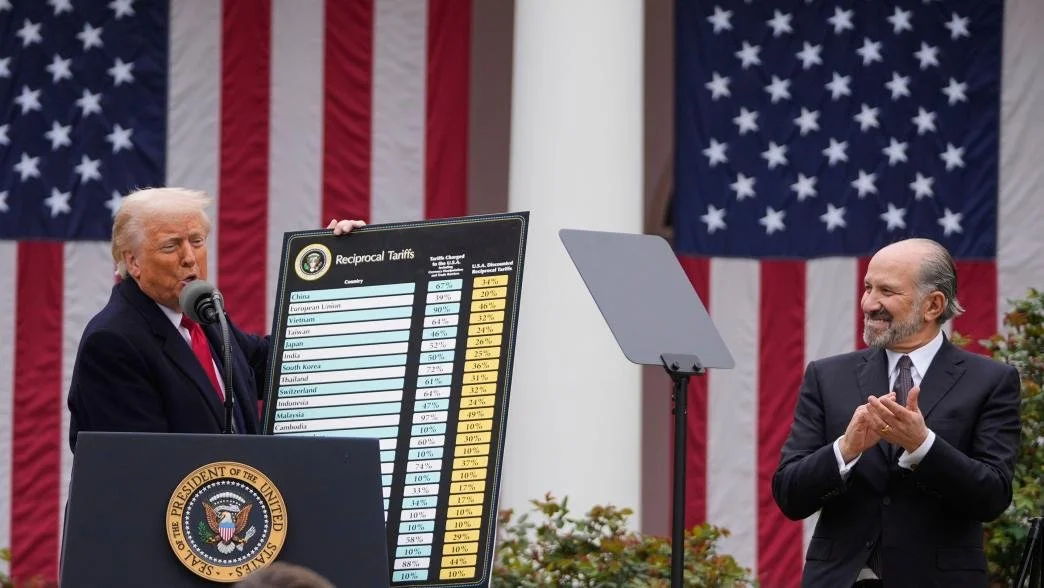
But a look at the way in which the Trump tariffs — taken as a whole, higher than those that prevailed after Smoot-Hawley — have been calculated quickly reveals that they have little to do with “fairness.” Their aim is clearly to put a brake on trade, a phenomenon that, despite all the evidence to the contrary, Trump seems unable to regard as anything other than a zero-sum game.
Dominic Pino explains:
[E]ven countries with which the U.S. has free-trade agreements are listed as having very high tariff rates. It says South Korea, for example, charges 50 percent tariffs on U.S. imports, when in reality, nearly all trade between South Korea and the U.S. is duty-free.
Enterprising folks on X figured out how the White House got these numbers. It turns out that they don’t have anything to do with tariff rates. The administration simply took the U.S. trade deficit in goods with each country, and then divided it by the amount of imported goods the U.S. buys from that country. The U.S. tariff rate is then “discounted” by dividing that result in half…
The U.S. has a trade surplus with over 100 countries. For those countries, the administration said the tariff rate is 10 percent. The 10 percent rate also applies if the trade deficit is so small that the formula would yield a rate lower than 10 percent. In other words, it’s a 10 percent minimum for every country, then additions beyond that if the trade deficit is large.
So, the real “crime” committed by many countries hit by Trump’s higher tariffs was not their trade barriers but exporting more goods to the U.S. than the U.S. imported to them. Goods? Yes. Why would services be omitted?
Dominic Pino:
The U.S. has a services trade surplus of nearly $300 billion, but none of that gets counted in the formula, making trade deficits look bigger than they actually are and justifying a higher tariff rate.
Oh.
Trade deficits mattered because of the presumption that they represented, a White House official explained, “the sum of all unfair trade practices, the sum of all cheating.” This is nothing to do with fairness. It is merely the result of the belief that trade can never be anything other than a zero-sum game, although apparently this only mattered if it was the U.S. was in deficit. There was no suggestion that nations that had a trade deficit with this country should be able to hike tariffs.
And so the U.S. will impose higher tariffs on Switzerland than on the European Union even though EU tariffs are higher than those of the Swiss. According to Bern, 99 percent of U.S. goods can be sold into Switzerland duty-free. Nevertheless, Swiss imports into the U.S. will be subject to tariffs of 31 or (there seemed to be some doubt) 32 percent. This is reciprocity?
Or take Brazil.
On March 31…the U.S. Trade Representative published its yearly National Trade Estimate Report on Foreign Trade Barriers. A reasonable person might have thought that this 397-page document would have informed the “reciprocal” tariff schedule, but of course it did not.
Amusingly, Brazil, which was dinged in the report for having “relatively high tariffs on imports across a wide range of sectors” and a “lack of predictability with regard to tariff rates” ended up getting the lowest possible tariff rate of 10% because the U.S. happens to have a trade surplus with Brazil.
David Bahnsen, posting on X:
These are not reciprocal tariffs – they were calculated based on “who sells us more than we sell them” – one of the most embarrassingly naive, statist, central planning determinations any leftist Democrat could ever conceive.
The administration showcased a formula containing some Greek letters in an attempt to make it seem as if its approach was fair and, by including a φ or two, scholarly, but, as Kevin Corinth and Stan Veuger of the American Enterprise Institute explained:
The Trump Administration assumes an elasticity of import demand with respect to import prices of four, and an elasticity of import prices with respect to tariffs of 0.25, the product of which is one and is the reason they cancel out in the Administration’s formula.
However, the elasticity of import prices with respect to tariffs should be about one (actually 0.945), not 0.25 as the Trump Administration states. Their mistake is that they base the elasticity on the response of retail prices to tariffs, as opposed to import prices as they should have done. The article they cite by Alberto Cavallo and his coauthors makes this distinction clear. The authors state that “tariffs [are] passed through almost fully to US import prices,” while finding “more mixed evidence regarding retail price increases.” It is inconsistent to multiply the elasticity of import demand with respect to import prices by the elasticity of retail prices with respect to tariffs.
Correcting the Trump Administration’s error would reduce the tariffs assumed to be applied by each country to the United States to about a fourth of their stated level, and as a result, cut the tariffs announced by President Trump on Wednesday by the same fraction, subject to the 10 percent tariff floor. As shown in Table 1, the tariff rate would not exceed 14 percent for any country. For all but a few countries, the tariff would be exactly 10 percent, the floor imposed by the Trump Administration.
Now, our view is that the formula the administration relied on has no foundation in either economic theory or trade law. But if we are going to pretend that it is a sound basis for US trade policy, we should at least be allowed to expect that the relevant White House officials do their calculations carefully.
That the administration has been intent on foisting these tariffs upon the American people on bogus grounds and in a manner that bypasses Congress is bad enough, but that it cannot even be bothered to get the math right, well . . .
As I noted in an earlier post:
[T]he only Greek letters of any relevance are not those in the formula that supposedly helped generate the tariff numbers, but these: ὑβρις (hubris). Let’s just hope that what is said to follow hubris, Νέμεσις (nemesis), can be avoided.
That may be difficult unless there is a change of direction soon. In Greek mythology, Nemesis is the agent of retribution for the sin of hubris, and there are signs that it is on the way. Trillions have already been lost in the stock market, junk bonds are looking shaky and China has announced a retaliatory tariff of 34 percent on all U.S. imports, with the promise of another increase should the U.S. retaliate against China’s retaliation (that’s the way trade wars work). But the extent of the damage inflicted on the U.S. by the Trump tariffs will not stop there.
In a note titled “There Will Be Blood,” JPMorgan’s head of economic research, Bruce Kasman, raised the probability of a global recession to 60% from 40%. The bank expects U.S. gross domestic product to contract 0.3% in the fourth quarter of 2025 from a year earlier; it previously expected 1.3% growth. Unemployment will reach 5.3% next year, JPMorgan says.
The tariffs, which on current estimates will be charged at an average of 22.5 percent (according to the Yale Budget Lab), a rate higher than that charged in 1910 (when other taxes were infinitely lower), amount to a tax increase of over $700 billion on American people and businesses. Others have calculated that the effective rate would be even higher.
Ambrose Evans-Pritchard, writing in the Daily Telegraph:
This is a contractionary macroeconomic shock of 2.3pc of GDP, even before taking into account reprisals, and ignoring the carnage in the industrial supply chain.
As Evans-Pritchard points out this tax is unlikely to raise the $6 trillion over ten years that Trump has been talking about (a figure, incidentally, that implies that any tariff negotiations will not get far):
The Budget Lab says he will collect just half that level once the “dynamic” effects of lower growth and economic damage are factored in. The US economy will be 0.6pc smaller in the long run and households will be $3,800 poorer.
And we should not forget inflation. Biden era inflation had not been fully extinguished. Now it will be given fresh life. Technically, price increases arising out of higher tariffs are not regarded as inflationary, a distinction that may be lost on those paying the higher prices. But there is an obvious danger that they will boost inflationary expectations with probable consequences that are easy to imagine. Moreover, if the Fed, trying to manage the fallout from wounded financial markets, slashes rates when it would otherwise not do so, the effect is likely to be inflationary. The yield on the five-year Treasuries has fallen from 4.6 percent in mid-January to 3.85 percent today. Capital Economics has forecast that inflation will have reached four percent by year end.
Higher prices may prove stickier than conventional wisdom would suggest or the administration would like. Rearranging supply chains is neither quick nor inexpensive. The elimination of “too cheap” foreign competition will remove some pressure on corporations to keep prices low. A warning tweet from the FTC’s chairman about how as “we adjust to the new economic order, the @FTC will be watching closely to make sure American companies are vigorously competing on prices” can be interpreted benignly as an example of an agency advertising its vigilance. It can also be seen as a sign that the administration, following the Biden playbook, will turn to scapegoating and bullying both to rein in rising prices and to dodge the blame for them. Good luck with that.
The idea that the hit to growth will be put right by the magic of reindustrialization anytime soon is laughable.
Michael Strain, writing in the Financial Times:
Around half of US imports are intermediate goods used domestically to produce final ones. High tariffs raise the costs of production for US companies, hurting competitiveness. Take steel. For every one job in US steel production, there are 80 that use steel in production. Trump’s tariffs might indeed help that one steel producer, but they will hurt the 80 others by reducing the competitiveness of their employers.
The economists Aaron Flaaen and Justin Pierce estimate that during Trump’s first-term trade war, the manufacturing employment losses from higher input prices were five times as large as the gains from import protection. In addition, the losses from retaliation were nearly three times as large as gains from import protection.
The implications of that are that the tariff hikes (or some of them anyway) will work against reindustrialization. In the Free Press, Niall Ferguson observes that:
[A]s Asia Times noted two years ago, capital goods—the very things you need to build factories—account for about a third of the U.S. trade deficit. To reindustrialize America, you would initially need a larger trade deficit, not a smaller one.
All this makes a nonsense of the president’s claim that getting American industry to a place he would like will be a two-year process:
Ferguson:
There is not enough time to build a new factory before people start assessing contenders for the presidency in 2028. Not all of them will endorse Trump’s tariffs. Permitting is too slow, especially in blue states. The U.S. energy supply is insufficient: Anyone with spare power is currently selling to data centers. Unit labor costs are too high. Land costs are too high.
Reindustrialization is not going to create a boom any time soon, but growth will be dragged down by shattered confidence (whether industrial or individual), lack of capital (whether foreign or domestic), uncertainty (any reductions in the new tariff regime are likely to be piecemeal and incomplete), lower levels of international demand, the difficulty of restructuring supply lines, and the regulatory burden that will come with a tariff regime that reinforces idiocy with complexity. Retaliation by America’s trading partners will not help either.
Slowing growth and higher prices will infuriate the voters with results — after the midterms and beyond — that are likely to be another blow to free markets and another reason for companies to hold back on investment.
The political consequences will not just be domestic. The Trump tariffs are an immense self-inflicted blow to the American-built order that, from Bretton Woods onwards, has delivered unprecedented prosperity globally and at home, and which, along with raw military and economic strength helped perpetuate America’s ascendancy through international institutional and financial structures and countless forms of soft power. It is an ascendancy that Americans would miss under any circumstances, but for their government to throw it away for no serious reason adds insult to injury.
But, throwing it away seems to be what the administration is set on doing. The tariff hikes can be added to a series of bizarre antics, from the bullying of Ukraine to the threatening of Canada and Denmark, which deliver the message that the U.S. is unreliable, possibly dangerous, and perhaps even worse, weak. There is something unmistakably whiny running through the arguments being made for higher tariffs.
Osama bin Laden:
When people see a strong horse and a weak horse, by nature, they will like the strong horse.
Beijing, meanwhile, is presenting itself as the strong horse. The EU is already unhealthily dependent on China, but a perverse consequence of the current brawl between Brussels and Washington might be to draw Brussels closer to Beijing, which would not be in either the EU’s interests or America’s, but trade wars, like real wars, can lead to some shockingly stupid results.
Part of Washington’s longer-term strategy for containing Beijing has involved drawing closer to China’s neighbors. The day after the tariff hikes were announced, Secretary of State Marco Rubio tweeted:
At today’s meeting with the Indo-Pacific partners, we agreed the region needs to be free from China’s coercive and unfair trade policies. Our security depends on it.
Heavy increases in the tariffs payable by Vietnam (to 46 percent), Indonesia (32 percent), and other lower income countries nearby are not an obvious way of achieving that goal. To be sure, they can be used as a conduit for Chinese goods, and are themselves sources of cheap products, but a subtler approach is needed unless, of course, the administration’s economic fantasies weigh more heavily than geopolitical reality.
And then there is the question of other long-term U.S. allies in the region such as South Korea (punished with a 26 percent tariff for running a trade surplus in goods with the U.S. despite import duties on American goods averaging 0.79 percent) and Japan.
But to return, at last, to the Great War, here’s what General Haig, Britain’s commander-in-chief, wrote in his diary the day after the launch of the Battle of the Somme:
‘A day of downs and ups. I visit two casualty-clearing stations. They were very pleased at my visit, the wounded were in wonderful spirits. Reported today that total casualties are estimated at over 40,000. This cannot be considered severe in view of numbers engaged and the length of front of attack. By nightfall the situation is much more favourable than when we started today.’
On Friday, JD Vance commented that there was nothing but “enthusiasm” for the President’s trade policy. For his part, the president has predicted that “the markets are going to boom … the country is going to boom,” although he has admitted there will be a “little disturbance” before that happy moment.
We’ll just have to see how little “little” is.
Extracted from the Capital Letter for the week beginning March 31, 2025.